
 Search Articles


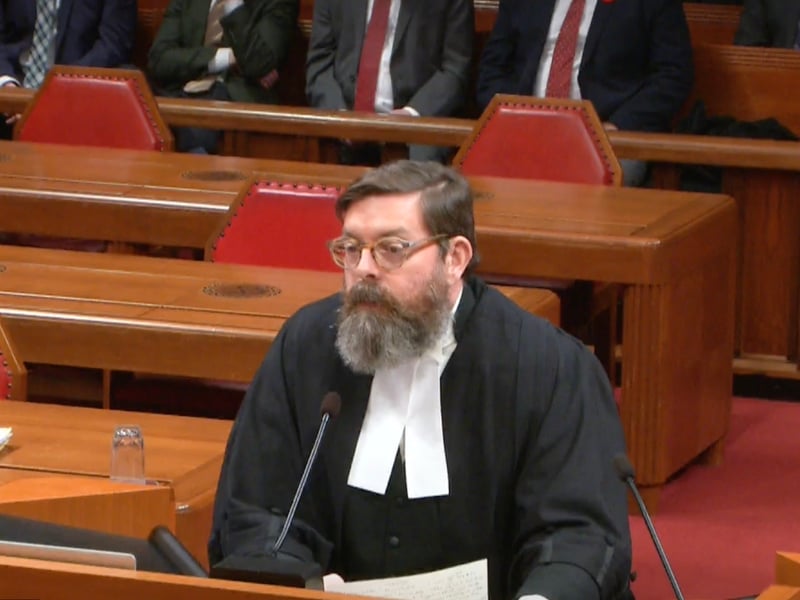
MONTREAL (CN) — A Canadian senator, part of a special committee reviewing intelligence operations, discovers that the government is conducting a mission that violates the civil rights of Canadians. The senator decides to raise the issue with their peers in Parliament, but under Canadian law, they could be prosecuted for sharing confidential information and face up to 14 years in prison.
That’s the scenario envisioned by Ryan Alford, an associate professor at the Lakehead University’s faculty of law in Ontario who challenged the law in 2022 in Ontario Superior Court.
After the Ontario Court of Appeal overturned a ruling siding with Alford, the Supreme Court of Canada must now determine whether the National Security and Intelligence Committee of Parliamentarians Act is constitutional.
The 2017 law created a special committee of parliamentarians to review national security and intelligence activities, similar to the Senate Intelligence Committee in the United States. The committee is an agency of the executive branch and reports to the Prime Minister’s Office.
Created with the goal of increasing transparency and accountability within the government, the committee has the authority to review national security and intelligence operations, as well as to examine the laws, policies, budgets and administrative systems that govern them.
Section 12 of the act stipulates that members or former members of the committee cannot invoke parliamentary privilege to immunity as a defense if they are prosecuted for disclosing confidential information.
During the two-day hearing before the Supreme Court, Alford argued that parliamentary immunity must remain intact, as it is essential for protecting the right to freedom of speech and debate within Parliament.
He cited a historical precedent from 1629, when Sir John Eliot and other members of Parliament were imprisoned by King Charles I for criticizing the Crown. According to Alford, parliamentarians must be able to speak and act freely without fear of prosecution.
On Thursday, several judges appeared skeptical of Alford’s arguments, noting that his interpretation of the law might go too far. Justice Malcolm Rowe observed that Canada is far from the 1629 persecution of legislators under King Charles I, and called Alford’s reading of Justice David H. Doherty of the Ontario Court of Appeal’s decision “a very strange one.” He went even further, comparing Alford’s argument to “a law school examination” with “really far-fetched questions.”
Doherty had concluded Section 18 of the Constitution Act allows Parliament to pass legislation that explicitly narrows or modifies its own privileges. Since this authority falls within Parliament’s constitutional jurisdiction, he found that Section 12 of the act within Parliament’s powers.
Justice Mary T. Moreau highlighted the sensitive nature of the information the committee handles, including material protected by litigation privilege, solicitor-client privilege or professional secrecy.
“This is highly confidential information, known in the common law world as the most protected type of information,” Moreau said, adding that there will be “some very far reaching consequences if privilege is breached.”
Catherine Lawrence, who represented the Attorney General of Canada during the hearing, qualified the appeal as “a solution searching for a problem.”
For more than a century, she said, parliamentarians have had the authority to define their own privileges through ordinary legislation, and therefore a waiver of this immunity is not unconstitutional, as it is the parliamentarians themselves who chose to enact Section 12 of the act.
She added that this limitation of parliamentary privilege applies only to a small number of parliamentarians, as the committee has roughly ten members, and that they are “willingly accepting that their privileges and immunity are going to be constrained by virtue of their participation in the committee.”
However, the justices noted that the challenge is Section 18 of the Constitution Act — the section that defines Parliament’s privileges and powers— being written in very broad terms and doesn’t clearly spell out its lower limits.
“How can we interpret Section 18 without understanding what its boundaries are?” asked Justice Andromache Karakatsanis.
In addition, some justices expressed concern about the power that Section 12 of the NSICOP Act grants to the executive branch over the legislature.
“It seems to me that the executive has a broad power here to stop the disclosure of information,” said Justice Suzanne Côté.
Given the complexity of the issue, the Supreme Court also heard from a series of interveners, including provincial attorneys general, legislators and members of civil rights organizations.
Michael Fenrick of the British Columbia Civil Liberties Association also raised concerns that Section 12 gives the government “broad discretion to decide what information is in and what information is out.”
He argued that the provision is too vague about what qualifies as confidential and warned that it could even cover information the government simply finds “embarrassing.”
Another major issue during the hearing was whether the court is even permitted to exercise judicial review over this legislation, or if doing so would overstep legislative authority and undermine the fundamental separation of powers.
After all, it is traditionally up to parliamentarians to define the scope of their own privileges and, in this case, to limit their immunity.
“What you are asking this court — and every court in this country — is to conduct a judicial review every time there is an amendment affecting the privilege, power or immunity of a legislator," Rowe said to Alford during the hearing.
“Parliament is the master of its own process. But you are arguing that we become the master of Parliament, that we become the master of the legislators, sitting in judgment over how they can formulate their privileges on an ongoing basis," he said.
Subscribe to our free newsletters
Our weekly newsletter Closing Arguments offers the latest about ongoing trials, major litigation and rulings in courthouses around the U.S. and the world, while the monthly Under the Lights dishes the legal dirt from Hollywood, sports, Big Tech and the arts.