
 Search Articles


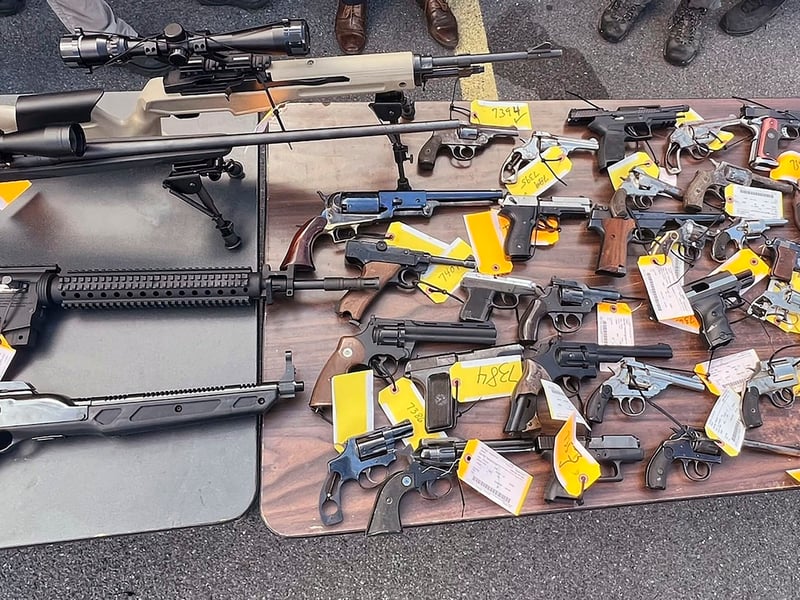
MANHATTAN (CN) — Gunmakers under fire for selling ghost gun kits asked the Second Circuit Wednesday to dismiss an effort by New York leaders to hold kits and standalone parts to firearms regulations.
Since gun parts are not subject to the same statutory background checks, nor require serial numbers, the weapons created from the parts are untraceable.
“It takes so little time and effort to finish them,” Barbara Underwood, an attorney with the New York Attorney General’s Office, said of the self-assembled guns. “And that’s how they’re marketed, as a way to get a gun without a background check and serial numbers.”
To crack down on ghost gun sales, New York Attorney General Letitia James and New York City filed a 2022 lawsuit targeting manufacturers. The companies say gun parts like unfinished frames and receivers are not “firearms” and should not be regulated as though they are.
The manufacturers claim that a rule made by the Bureau of Alcohol, Tobacco, Firearms and Explosives gives third parties the right to sell gun parts without being held to firearm license and serial number requirements.
“The object that is designed to expel a projectile is the ultimately complete firearm — not its trigger, its hammer, the grip, the front sight, or the frame,” the manufacturers say in their brief. “It is the combination of these objects into one that results in an item ‘designed’ to expel a projectile.”
During Wednesday’s hearing U.S. Circuit Judge Eunice C. Lee, a Joe Biden appointee, questioned if taking something apart and selling it separately changes the purpose of the part.
“If you have a bicycle, it’s missing a wheel, one of the wheels — that’s part of the definition of what a bicycle is,” Lee said. “Would someone refer to that, ‘Well, that’s an unfinished bicycle,’ or would they just say, ‘It’s a bicycle?’”
Brian Barnes, an attorney with Cooper & Kirk representing the manufacturers, rejected the analogy and said it’s much more complicated.
“You need to think about it in terms of, I’m taking the parts of the bicycle out of the box and the frame of the bicycle needs further machining for it to function as a bicycle,” Barnes said.
The manufacturers brought the case to the Second Circuit after a federal judge in the Southern District of New York denied their bid to dismiss the complaint, finding some products sold by the manufacturers amounted to firearms under federal law.
The state also claims the manufacturers’ sale of ghost guns constituted negligence since the sale of inconspicuous gun parts can lead to unchecked gun violence.
But according to the manufacturers, they are protected under the 2005 Protection of Lawful Commerce in Arms Act, which holds that firearm companies are not “liable for harm caused by those who criminally or unlawfully misuse firearm products.”
With the looming U.S. Supreme Court arguments regarding ghost gun regulation, set for October, the Second Circuit panel also questioned how much impact its decision in this case would have.
Barnes said the court should still hear the argument because the appeals court could help inform the Supreme Court’s decision.
“When do you think our opinion would come out?” U.S. Circuit Judge Joseph F. Bianco, a Donald Trump appointee, asked with a chuckle. “That argument’s in like three weeks.”
U.S. Circuit Judge Steven Menashi, a Donald Trump appointee, also sat in Wednesday’s panel. The judges did not indicate when they would rule.
 Follow @NikaSchoonover
Subscribe to our free newsletters
Our weekly newsletter Closing Arguments offers the latest about ongoing trials, major litigation and rulings in courthouses around the U.S. and the world, while the monthly Under the Lights dishes the legal dirt from Hollywood, sports, Big Tech and the arts.