Search Articles



BOGOTÁ, Colombia (CN) — Colombia, a country that elected its first leftist president in history four years ago, is likely to turn rightward again Sunday, when voters head to the polls for a critical presidential runoff. But this time, the candidate is far from the traditional conservative former presidents the country has grown accustomed to.
Abelardo de la Espriella, a far-right criminal lawyer who calls himself “El Tigre” and has run most of his campaign through strident TikTok videos, is leading the polls against Iván Cepeda, a leftist senator and often silent and discreet man. Although the runoff is expected to be tight, with de la Espriella having defeated Cepeda in the May 31 general election by less than a 3% margin, polls are placing the political outsider ahead of the seasoned politician.
Regardless of Colombia’s political history, de la Espriella’s rise comes amid a far-right tide in the Americas — from Javier Milei in Argentina, to Nayib Bukele in El Salvador, to the recent victories of José Antonio Kast in Chile and Daniel Noboa in Ecuador. De la Espriella, like his allies, is campaigning on drastic changes to structural issues in his country, ranging from violence and conflict to the economy and geopolitical debates around immigration and international conflicts.
“That a man like him can win this election,” said Juliette González, a 20-year-old working at a food shop in a popular market in Bogotá, “is super-dangerous.”
For many Colombians, the election has become a referendum on security, one of the country’s most persistent concerns and a central theme of De la Espriella’s campaign.
De la Espriella is pledging hard-line security policies in a country riddled with violence and conflict for decades. Those years have included successive peace accords that have been more or less successful and gained political momentum over the last decade after a landmark agreement signed with the FARC, one of the country’s then-most prominent guerrilla groups. The candidate deems conversations with these groups to be guarantors of “absolute impunity” and has said that “peace cannot be negotiated, but imposed.”
He has vowed to crush armed groups, which are present in at least 500 jurisdictions in the country, according to a 2025 report, within the first three months of his government. He has said he will build 10 megaprisons mirroring Bukele’s Salvadoran policy. He has also spoken against “gender ideology,” referring to gender-based policies in health and educational institutions in Colombia.
However, social discontent after four years of leftist rule under Gustavo Petro’s mandate has made him attractive to voters who feel their country needs to undergo a new experiment to tackle its issues.
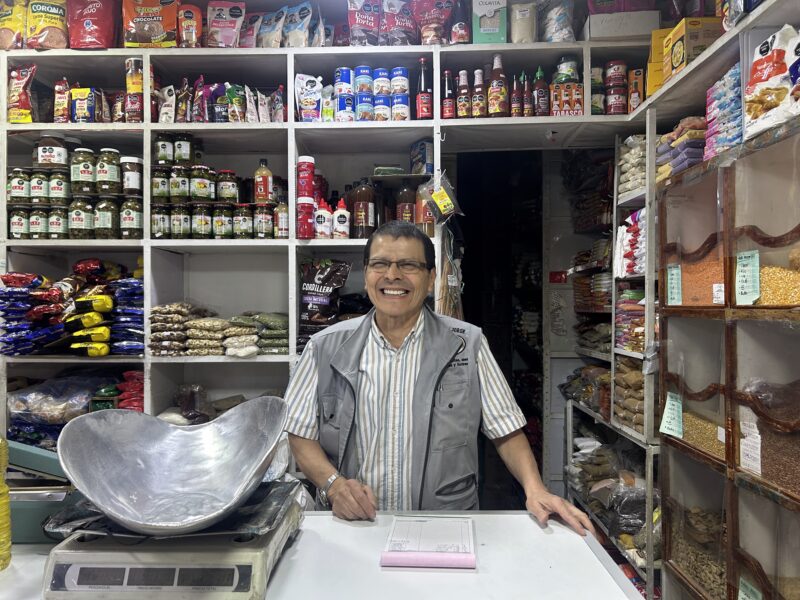
Humberto Ramírez, 73, stood behind the counter of the popular market stall, a place he has filled for over 50 years, selling food products. “We’ve been at war for my entire life,” he said. “The left didn’t bring us peace.”
Colombia, Ramírez said, needs order and tough policies. “We need someone to enact our laws, to treat criminals as criminals.”
If he were to win, de la Espriella would have support from influential figures across the Americas. During a phone call shared on social media this week, Milei supported de la Espriella by telling him to “beat that leftist motherfucker,” referring to Cepeda. On a post on Truth Social, U.S. President Donald Trump wrote, “As President, Abelardo will be tremendously successful in leading Colombia to Grow the Economy, Create Jobs, Promote Trade, Stop Illegal Immigration, Crack Down on Crime and Drugs, and Restore LAW AND ORDER!”
“Traditional right-wing candidates are no longer capturing the attention of voters,” said Carlos Moreno, a political science professor at the Bogotá-based Javeriana University. “Characters like de la Espriella have managed to do so.”
Moreno said de la Espriella is not so much of an outsider, as he has had support from traditional Colombian right-wing politics, but he has been more efficient in delivering a bold, coherent message against the incumbent leftist government. “He said he’ll defend Colombians, beat criminals, which works because insecurity in Colombia has worsened. The Petro government believed that negotiating with the armed groups would help curb violence, but it didn’t.”
The ongoing era of peace agreements and negotiations that started a decade ago and that Petro pledged to boost was preceded by a crackdown on armed groups in the early 2000s under former President Álvaro Uribe’s mandate, which delivered action at a very high cost — thousands of murders of civilians, disappearances, forced displacements and often an increase in violence in the most vulnerable territories.
Human rights groups and commissions were established years later to acknowledge the trauma and social fractures that those policies caused. De la Espriella does not just embrace the Uribe era but promises to go even further.
“I often worry about what will happen with his promises,” said González, the shop employee. “I think about having children in the future, what will happen to them?”
Lucía Cholakian Herrera is a Courthouse News correspondent based in Argentina. She reported from Bogotá, Colombia.
 Follow @luciacholakian
Subscribe to our free newsletters
Our weekly newsletter Closing Arguments offers the latest about ongoing trials, major litigation and rulings in courthouses around the U.S. and the world, while the monthly Under the Lights dishes the legal dirt from Hollywood, sports, Big Tech and the arts.