
 Search Articles


(CN) — The last time California had a streak of wet winters this long, people bought CDs in stores specializing in the music format.
And before that, they bought vinyl.
The Golden State has had three strong, wet winters in a row. On Tuesday, state officials said California’s statewide snowpack was at 96% of its historical average for April 1. That’s a key date, as it’s considered when the snowpack — essentially a frozen reservoir — is at its peak.
On April 1, 2023, statewide snowpack was at 237% of average, and at 111% of average on April 1 last year.
“When it’s wet, it tends to be wetter,” state climatologist Michael Anderson said of the state’s evolving weather patterns during a Tuesday press conference. “When it’s dry, it tends to be quite dry. We’re seeing these weather patterns having a little more kick to them.”
The last time California had three consecutive years with snowpack reaching at least 100% of the April 1 average was 1998 to 2000. Before that, it was 1978 to 1980.
Now, state officials expect fewer storms during the transition months of April and May and more bright and clear sunny days. Each day above freezing in the higher elevations increases the chances for the snowpack to melt and its water to enter the watershed.
The state’s snowpack started the year in fair shape. However, a mostly dry January significantly reduced its level, causing concern among the California Department of Water Resources. Storms scattered across February and March led to more accumulation — precipitation officials had hoped would arrive.
“It puts us in a good position,” Anderson said.
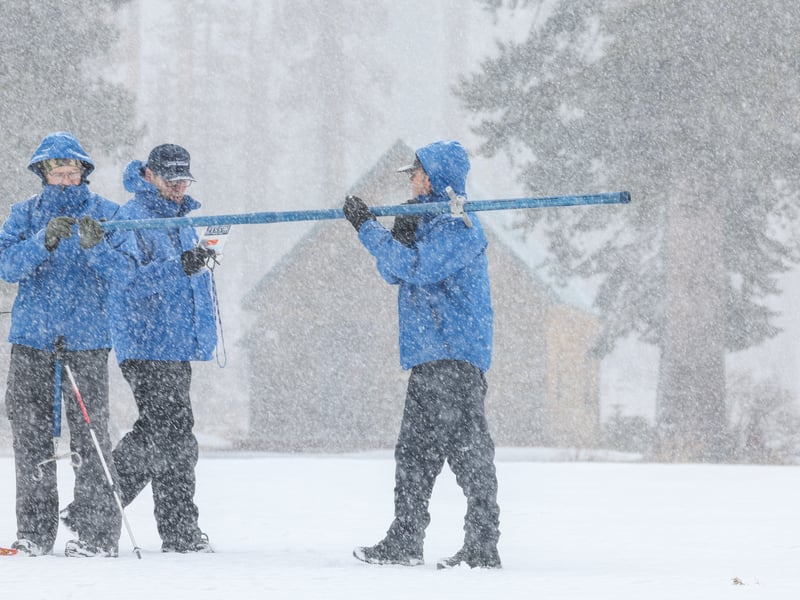
The department performs a series of snow surveys around the same time each year, typically from January to April. Those surveys yield snow depth and snow-water equivalent totals, the latter a measure of how much water would come from melting the snow.
Officials like to conduct snow surveys around the first of the month. However, they give themselves a 10-day window to account for inclement weather.
That’s what happened this past weekend. Forecasters knew a strong storm would hit, leading surveyors to take their measurements on Friday.
The surveys showed Northern California had the healthiest snowpack, at 118% of historical average. The central part of the state had 91% of average, with Southern California having the least at 84% of average. Taking the average of those totals brings the statewide average to 96%, which officials consider a strong showing for three consecutive years.
“There was some indication we’d have a dry year,” said Andy Reising, manager of the Department of Water Resources’ snow surveys and water supply forecasting unit. “Really dry January. Fortunately, February provided some storms for us.”
California’s reservoirs also remain in good shape. The strong 2023 winter season helped reservoirs maintain their levels throughout that year and into 2024, Anderson said. Most state reservoirs on Tuesday remained over their 100% historical averages.
While Sunday through Tuesday brought some precipitation to the state, it appears the rain won’t return for some time. Anderson said there’s little chance of rain falling over the next eight to 14 days.
Temperatures are expected to rise over the next few days. Sacramento will see highs in the mid-60s on Wednesday, with them rising to the mid-70s by the weekend.
This winter’s rain and snowfall was reason for state officials to celebrate, though they remain mindful of how drying vegetation over the warmer months will create fire fuels. Intense drought conditions, coupled with California’s heat waves, set the stage for significant fire risk.
Subscribe to our free newsletters
Our weekly newsletter Closing Arguments offers the latest about ongoing trials, major litigation and rulings in courthouses around the U.S. and the world, while the monthly Under the Lights dishes the legal dirt from Hollywood, sports, Big Tech and the arts.