
 Search Articles


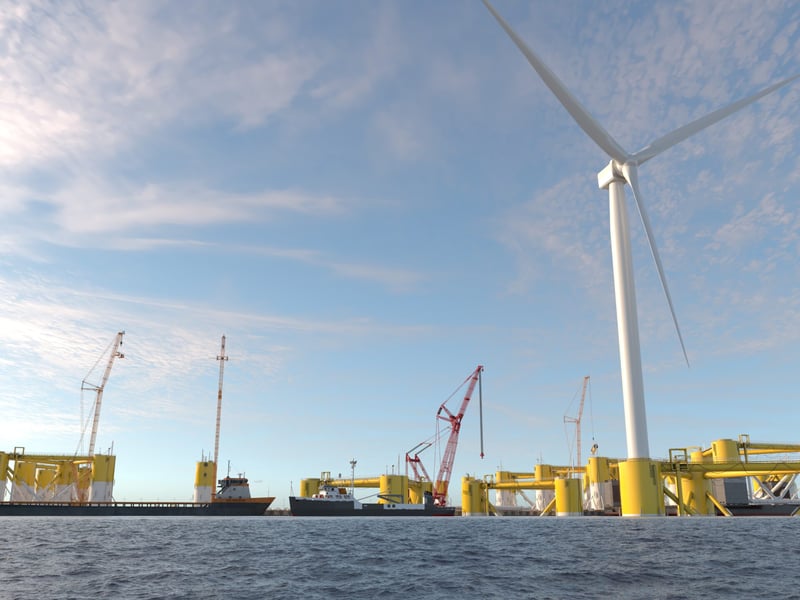
LONG BEACH, Calif. (CN) — The California State Lands Commission and the Ports of Long Beach and Humboldt on Wednesday announced they have formed a partnership to build infrastructure for floating, offshore wind turbines as part of the state’s transition to renewable energy.
“This agreement is a monumental step forward in California’s clean energy journey," Lieutenant Governor and State Lands Commissioner Eleni Kounalakis said in a joint statement. “It underscores our commitment to responsibly, sustainably, and equitably developing offshore wind while uplifting Native American tribes, local communities, and underserved populations.”
The Port of Humboldt Bay in Northern California and the Port of Long Beach in Southern California each have been working on plans to become a staging area for the nascent floating offshore wind technology.
Whereas most offshore wind farms around the world use turbines that sit on the sea floor, the steep ocean floor on the U.S. West Coast requires turbines on floating platforms that can be towed 20 to 30 miles offshore and anchored to the seabed.
Such floating wind farms have only been commercially deployed in Europe in recent years.
The ports will be the staging and integration sites where the floating platforms and massive turbines — as high as the Eiffel Tower — will be assembled before they are towed to the particularly windy swaths of Pacific Ocean in Northern and Central California that the federal government auctioned off to offshore wind developers in late 2022.
California aims to install between 2 and 5 gigawatts of offshore wind by 2030 and 25 gigawatts by 2045, enough to power 3.75 million homes in the short term and 25 million homes by 2050. It will require $11 billion to $12 billion in investments to build out the ports to support offshore wind energy development, according to the State Lands Commission.
In a report supporting the partnership, the commission said the agreement formalizes a collective vision and shared commitment to support offshore wind energy development off the California coast.
The collective will support “the responsible, equitable, and sustainable development of port infrastructure to support offshore wind energy to advance climate goals, improve public health, increase energy independence, advance energy equity, and support a clean energy economy,” the commission said.
In Long Beach, the port has proposed to develop a 400-acre staging and integration terminal, known as Pier Wind, to assemble and deploy floating offshore wind turbines. Earlier this year, California Governor Gavin Newsom signed legislation that authorizes the city of Long Beach to procure contracts and use alternative delivery methods to build the Pier Wind.
Long Beach’s port has begun its environmental review process for the project and has been conducting public outreach and engagement, according to the state lands commission.
In Eureka, California, the Port of Humboldt Bay has proposed a 180-acre heavy lift marine terminal project to support offshore wind energy development.
In January of this year, the U.S. Department of Transportation granted $426 million to the Humboldt Bay Harbor, Recreation and Conservation District to construct the terminal project. The Harbor District also has begun the environmental review process for the project and has been conducting public outreach and engagement.
“This commitment is a significant first step that lays the pathway for responsible and equitable engagement, open and honest dialogue, and the incorporation of meaningful feedback,” Humboldt Harbor District Executive Director Chris Mikkelsen said in Wednesday’s announcement. “May this promise invite all interested and affected parties to engage, contribute, and join in unity to bring opportunity, strong environmental health, and leading economic development to our communities today and into the future.”
To achieve 25 gigawatts of offshore wind will require more than 1,600 floating offshore wind turbines to be built off California’s coast, according to the state’s energy commission. The sites that have been leased to energy developers so far are off the coast of Eureka in Northern California and off Morro Bay in Central California.
The floating turbines can be installed far enough from the coast that they won’t be an eyesore on the horizon, and they can take advantage of the higher wind speeds away from the land.
 Follow @edpettersson
Subscribe to our free newsletters
Our weekly newsletter Closing Arguments offers the latest about ongoing trials, major litigation and rulings in courthouses around the U.S. and the world, while the monthly Under the Lights dishes the legal dirt from Hollywood, sports, Big Tech and the arts.