
 Search Articles


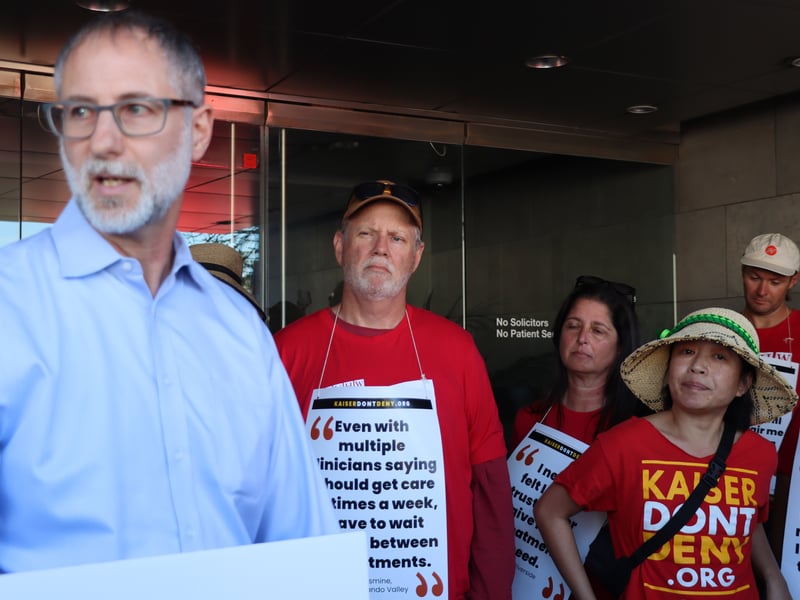
SAN DIEGO — On the 156th day of their strike, mental health care workers at Kaiser Permanente facilities in Southern California took their list of demands for better pay and benefits to ease workloads and better patient care straight to the company’s front door in San Diego.
“Folks are not asking for anything that Kaiser doesn’t provide for all their other employees. It’s been six months. What we’re hearing from Kaiser is that everything is okay, everything is okay, but we know things are not okay. Patients are not okay, and that’s on Kaiser. Again, six months. People are not numbers,” said Sophia Mendoza, president of National Union of Healthcare Workers, speaking to Victor Voisard, senior director of human resources at Kaiser Permanente.
After dozens of union members marched in the street and staged a die-in in front of the company’s administrative building, a small group of workers attempted to contact company officials by ringing the building’s call button.
Instead Voisard appeared from behind the workers and said he’d relay a message from the San Diego and Imperial Counties Labor Council on behalf of the union to higher ups.
“Does everybody deserve a pension?” Mendoza asked Voisard.
“That’s not for me to answer,” Voisard retorted. “Thank you for the time and for speaking out. I hear you. I will relay those messages. I sincerely hope that we can move forward in the most positive way for everyone.”
Before Voisard could leave, Linda Randall, a registered nurse and union steward told him she knew he and other company executives are good people who came out to hospitals and facilities to see how employees were doing during the pandemic, but now that they’re demanding changes, the same administrators are refusing to engage with them.
“This is so demeaning as we ask for the resources that we need to take care of members, including also ourselves, we can’t get any acknowledgement. We can’t get good faith bargaining. We can’t even get anyone to come down here,” Randall said. “We’re in health care. Can Kaiser please put the care back in health care?”
The striking workers also handed Voisard a large posterboard printed with a letter directed to Kaiser officials.
“It appears beyond question that this work stoppage is exacerbating the serious deficiencies in behavioral health care services that existed before the strike. I have seen reports of high acuity patients decompensating and needing to seek emergency room psychiatric treatment, calls and messages to crisis lines going entirely unanswered, and thousands of patient appointments being canceled without prior communication and without the legally required offer of timely and appropriate replacement services, with the work stoppage being cited as the reason for cancellation,” wrote Brigette Browning, executive secretary-treasurer of the labor council in the letter.
The union’s demands, Browning added, are comparable to things already offered to other Kaiser employees with similar training and experience.
“We began bargaining in July 2024. After 28 bargaining sessions with NUHW, we agreed to enter into mediation, where we had hoped to reach an agreement. We were disappointed when, on the second day of the three-day session, NUHW walked away from mediation, falsely claiming to their members afterward that Kaiser Permanente was ’not ready to negotiate’ on their ‘strike priority’ issues. These allegations are disingenuous, as it was NUHW who chose to suspend mediation while it was still in progress," Kaiser said in a press release after the protest. “NUHW has made little or no movement on key bargaining issues throughout the contract bargaining process. Instead, the union remains focused on trying to disrupt the care of our patients through their unnecessary and counterproductive open-ended strike. Today’s demonstration is another example of that.”
Since October 2024, 2,400 mental health therapists, psychologists, social workers and psychiatric nurses at Kaiser facilities in Southern California from Bakersfield to Los Angeles, to San Diego have been on strike to demand the company reinstate pensions and pay increases to make up for a number of years when workers didn’t get cost of living adjustments, to match their pay with other health care workers in similar positions and attract and retain workers.
They’ve also asked that the company to include seven hours per week to deal with the bureaucratic work needed to care for their patients, like developing treatment plans and coordinating with social services, not only benefits workers, but their patients as well, the union argues.
Although she has a pension, Randall said in a separate interview with Courthouse News she worries for younger mental health care workers who’ve gone into debt to work in the field and now won’t have a pension like older workers.
“I wish they put economics aside and care about those patients and the people who deliver the care to them. I need to get back to work,” Randall said. “I’m not super religious but I’m just praying someone has a little attack of consciousness and realizes ‘hey, there’s enough for everyone. People want to come to Kaiser and you have that good name and are thriving I think because of the work we do,” she added about higher ups at the company.
“I believe in the fight. We need better patient care,” Yen Du, a psychosocial therapist at a Kaiser facility told Courthouse News. “I’m demanding equity.”
The union members noted the successful 10-week strike of NUHW workers in Northern California in 2022 on similar grievances as a lodestar for the current strike in Southern California.
In 2023, Kaiser Permanente agreed to a $200 million settlement with California to resolve investigations into its behavioral health system that found patient mental and behavioral health care was on average nine days longer than state law allows.
Kaiser, the union claims, has $60 billion in financial reserves.
“It’s a struggle but you know what? When I’m out with my union sisters and brothers, that’s what keeps me going. We’re not going to let Kaiser bully us anymore,” Du said. “It’s time.”
Subscribe to our free newsletters
Our weekly newsletter Closing Arguments offers the latest about ongoing trials, major litigation and rulings in courthouses around the U.S. and the world, while the monthly Under the Lights dishes the legal dirt from Hollywood, sports, Big Tech and the arts.