
 Search Articles


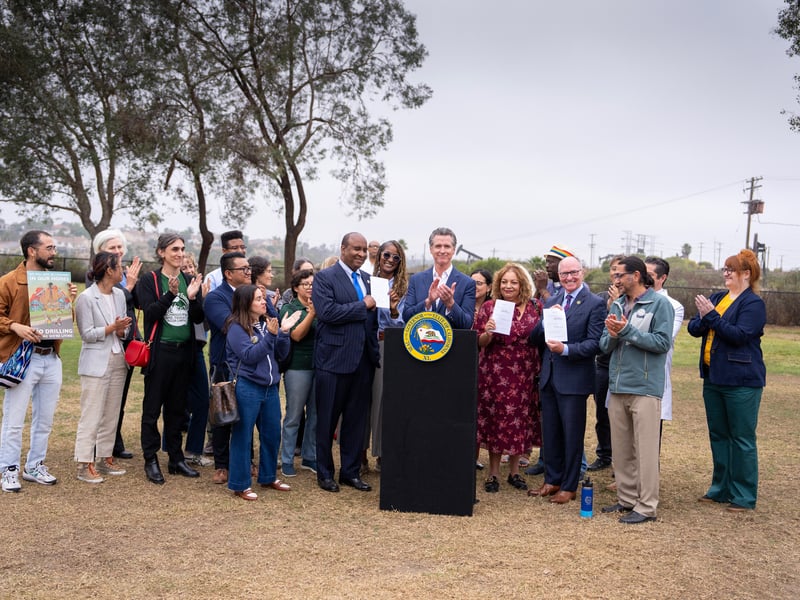
INGLEWOOD, Calif. (CN) — Oil rigs seesawed behind California’s governor as he stood Wednesday in a nearby soccer field.
Surrounded by elected officials and health advocates, Governor Gavin Newsom signed three bills that will affect the oil industry. The bills will lead to the capping of idle wells, limit the use of low-producing oil and gas wells in a specific area and give local governments more power to restrict oil and gas operations.
“No drilling!” one man yelled as Newsom signed the bills, leading those gathered to respond: “Where we’re living!”
Local officials said the bills will help bring environmental justice to the long-suffering area.
Assembly Bill 1866 — written by Assemblymember Gregg Hart, a Santa Barbara Democrat — will impose higher fees on idle oil wells. Additionally, it will add more stringent rules to keep oil companies responsible for maintaining and plugging them, stopping potential contamination.
“It is the oil industry itself that has to fix these wrongs,” Hart said Wednesday.
Los Angeles County Supervisor Holly Mitchell said proximity matters. People live, go to school and work, and recreate near wells that have caused multi-generational harm.
As a child, Inglewood Mayor James T. Butts Jr. was told that the wells were dinosaurs.
“All we ever knew were these oil wells,” he said, adding moments later: “We just thought this was part of our topography.”
Newsom intends for the bills to change that.
“These new laws allow local leaders to limit dangerous oil and gas activities near homes, schools, and other areas as they see fit for their communities, and give the state more tools to make sure that idle and low-producing wells get plugged sooner,” the governor said in a statement. “This builds off of our all-of-the-above efforts to protect communities from pollution and hold Big Oil accountable.”
Assembly Bill 2716 — written by Assemblymember Isaac Bryan, a Los Angeles Democrat — will prohibit low-oil production wells in any field within the Inglewood Oil Field. It also puts a $10,000 per month fine on wells in that field until they’re plugged and abandoned. Money gained from those fees will go toward green projects like parks.
“The Inglewood Oil Field is the largest urban oil field in our state,” Bryan said in a statement. “Production in recent years has been marginal, but for decades the negative health impacts surrounding it have cost the nearby community with their life expectancy. Today, with Governor Newsom’s signature, we will finally shut it down and establish the state’s first repair fund for the frontline communities who have been organizing for years to be seen, heard, and protected.”
Being heard is important to** Martha Dina Argüello, executive director of Physicians for Social Responsibility Los Angeles. She said efforts to protect people from oil drilling have been ongoing.
“We have faced this industry with its deep pockets and we have prevailed,” Argüello added.
The final bill signed Wednesday by Newsom was Assembly Bill 3233, written by Morro Bay Democratic Assemblymember Dawn Addis. That legislation will give cities and counties more power over oil and gas production in their jurisdictions, and they could limit or stop a new development.
The fate of Addis’ bill was in limbo at the end of the legislative session. It failed by one vote in the state Senate after lengthy debate. However, state senators agreed to reconsider it. It then passed the Senate on the final day of session, and secured the final vote for passage later that day in the Assembly.
“The signing of AB 3233 is vital win for communities across the Central Coast, and all of California,” Addis said in a statement. “Putting this bill into law affirms our right to clean air and water, free of oil and gas pollution.
Newsom said that signing a bill doesn’t necessarily solve a problem, and that he looks forward to working toward achieving the effects the bills promise.
The governor also referenced the Legislature’s special session, which he called to focus on oil and gas prices. The Assembly Petroleum and Gasoline Supply Committee is scheduled to meet Thursday for a hearing on Assembly Bill 1.
That bill is the main thrust behind the special session. It would require refineries to meet set criteria before performing maintenance, which officials have said affects California’s gas supply and, consequently, its prices. The bill also would require refineries to keep a minimum level of refined transportation fuels.
The Assembly is scheduled to convene on Oct. 1.
Subscribe to our free newsletters
Our weekly newsletter Closing Arguments offers the latest about ongoing trials, major litigation and rulings in courthouses around the U.S. and the world, while the monthly Under the Lights dishes the legal dirt from Hollywood, sports, Big Tech and the arts.