Search Articles


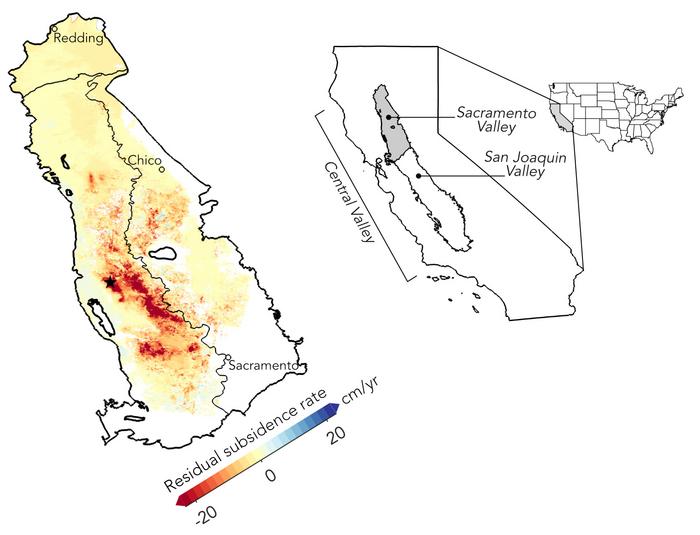
(CN) — A new study of groundwater in California’s Sacramento Valley shows that the ground sank faster than expected during the 2020-2022 drought due to heavy groundwater pumping, resulting in less water storage capacity in the aquifer.
The authors of the study published Monday in the Proceedings of the National Academy of Sciences say the damage to the aquifer may be long-term and irreversible.
Land subsidence occurs when excessive groundwater is withdrawn from rocks and sediment, causing the ground to sink, according to the U.S. Geological Survey. As groundwater is depleted, aquifers become more susceptible to compaction because the water no longer provides enough underground pressure to support the overlying land.
“As global demand for groundwater intensifies in response to climate change, its ability to act as a buffer against surface water variability becomes increasingly critical,” the authors write. “A growing concern, however, is that intensive exploitation of groundwater resources can damage aquifer systems and hence threaten future groundwater availability."
The researchers used high-resolution satellite measurements to track ground deformation and groundwater levels in the Sacramento Valley from 2016 to 2022.
Their analysis found the land initially exhibited elastic deformation, allowing it to rebound. But during the 2020-2022 drought, subsidence accelerated beyond the normal rate of elastic deformation by several decimeters, or about a couple of feet, per year.
The Northern California Water Association considers the 2020-2022 drought the worst in the region’s recorded history. The drought strained farmland, the environment and drinking water supplies, leading to increased groundwater pumping that the authors say likely drove the accelerated subsidence.
Stacy Larochelle, a professor of geophysics at the University of California Los Angeles, said that this subsidence could have other long term implications for the region.
“When we lose permanent storage capacity and also the ability for the aquifer system to recharge, that means we’re going to have less groundwater in the future,” Larochelle, an author of the study, told Courthouse News. “That’s a major problem under climate change because we’re going to be relying on groundwater more.”
Additionally, land subsidence could increase flood risk and damage irrigation canals, roads and other infrastructure.
The Sacramento Valley is one of California’s largest agricultural regions, producing about 21% of the state’s irrigated field crops. Stretching 150 miles across the northern Central Valley, it spans multiple counties from Redding to Sacramento.
Scientists have documented land subsidence in the San Joaquin Valley, farther south in the Central Valley, since the 1970s. The state’s Sustainable Groundwater Management Act designates its groundwater basin as critically overdrafted.
Larochelle said the new study shows the Sacramento Valley should receive the same designation.
Larochelle and her coauthors also say the abrupt increase in land subsidence during the drought could not have been predicted from groundwater records alone.
“Subsidence rates reaching several decimeters per year and not following groundwater levels indicate lasting damage to the aquifer system and underscore the need for more conservative groundwater management,” the authors say. “By imaging this sharp transition at the regional scale, our analysis demonstrates the potential of space-based monitoring for early detection of groundwater overdraft and the resulting loss of aquifer storage capacity worldwide.”
Although the damage to the Sacramento Valley aquifer is permanent, the researchers say it could revert back to an elastic state.
“While this compaction will never recover, the recent surge in precipitation in California brings hope that the aquifer system has or will soon transition back to a primarily poroelastic regime in response to decreased groundwater demand and increased recharge,” the authors write. “Nonetheless, we anticipate the thicker and lower-permeability sedimentary units to undergo delayed compaction for years to come, implying that overexploitation of groundwater during the 2020-2022 drought may have long-lasting consequences for land subsidence in the Sacramento Valley.”
Subscribe to our free newsletters
Our weekly newsletter Closing Arguments offers the latest about ongoing trials, major litigation and rulings in courthouses around the U.S. and the world, while the monthly Under the Lights dishes the legal dirt from Hollywood, sports, Big Tech and the arts.