
 Search Articles


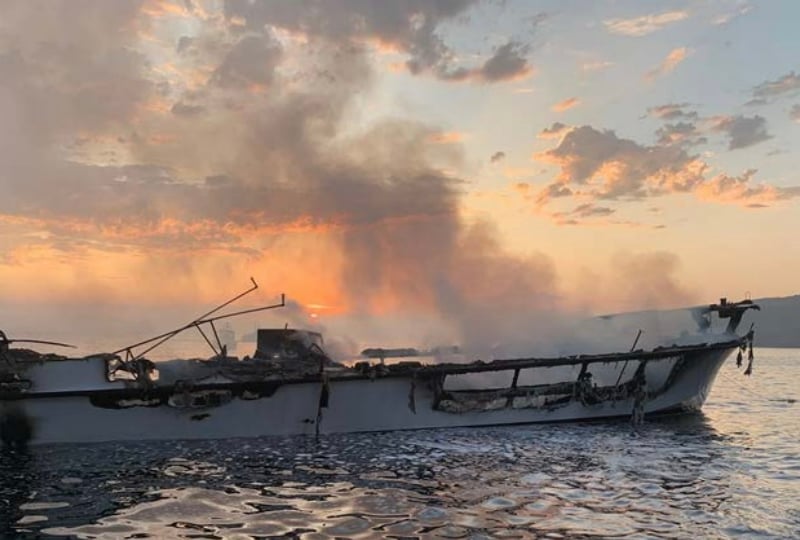
PASADENA, Calif. (CN) — The captain of the dive boat that burned down off the California coast in 2019, killing 34 people trapped below deck, on Tuesday tried to persuade a panel of the Ninth Circuit Court of Appeals to overturn his seaman’s manslaughter conviction.
Jerry Boylan, 71, was sentenced to four years in prison last year. A jury had taken no more than a day to convict him of gross negligence in the death of 33 passengers and one crew member on board the Conception during an overnight scuba diving trip near Santa Barbara.
The trial judge, U.S. District Judge George Wu, allowed Boylan to await the outcome of his appeal at home after agreeing with him that there was a “substantial question of law” whether the statute under which the captain was found guilty — misconduct or neglect by a ship officer resulting in death — required the judge to instruct the jury, as he hadn’t done, that Boylan’s conduct needed to be the actual cause of the fatalities on board.
Hunter Haney, a federal public defender representing Boylan, argued before the three-judge appellate panel in Pasadena, California, that Wu’s erroneous jury instructions, as well as the emphasis the judge allowed the prosecution to put on government regulations as opposed to industry practice on scuba diving vessels during the trial, warranted reversal of the jury’s verdict.
“The regulations played an outsize role in this trial and in the instructions,” Haney told the panel, “harmfully reducing Mr. Boylan’s industry standard evidence to a mere afterthought.”
U.S. Circuit Judge Consuelo Callahan, a George W. Bush appointee, wondered, though, that the issues of jury instruction and expert testimony about regulations might ultimately be nothing more than harmless error given the entirety of the evidence that was presented at the trial.
In this regard, Callahan noted, there was some damning and undisputed evidence that Boylan had failed to train his inexperienced crew in how to respond to fires on board, with some of them walking straight past the station with the firehoses after they had been awakened.
“It would seem that it would be hard for a jury to do anything other than to convict even if there had been some errors,” Callahan said. “It seems pretty undisputed that there was just a total lack of training and that the captain vacated pretty darn quickly.”
U.S. Circuit Judge Lucy Koh, a Joe Biden appointee, also pointed out that out of the six fire extinguishers on board the Conception, only one was used — by one of the passengers trapped below deck. Neither of the two fire hoses on the main deck was used, Koh said, and Boylan didn’t use the public-address system to alert the passengers sleeping below deck that there about the fire or that he was abandoning the ship.
“These are facts,” Koh told Boylan’s attorney. “So, why wouldn’t there be harmless error if Captain Boylan is first to abandon ship, doesn’t even notify any of the passengers that there’s a fire, and the PA system is right next to the phone where he called the Coast Guard?”
U.S. Circuit Judge John Owens, a Barack Obama appointee, was the third judge on the panel.
Assistant U.S. Attorney Alexander Robbins argued that the “hair-splitting” about different standards of causation, or different standards of misconduct and negligence, had anything to do with the totality of the evidence that went before the jury during the 2023 trial and wasn’t brought up by either side during their closing arguments.
“It didn’t affect the arguments, it didn’t affect how the parties framed their arguments, it didn’t affect anything,” Robbins told the panel. “It was literally irrelevant to the jury’s determination.”
The Conception, a 75-foot plywood and fiberglass vessel, was at anchor near one of the Channel Islands in the early morning of Sept. 2, 2019. The boat was on the last stop of a three-day dive trip over the Labor Day weekend, and all passengers were asleep in the bunk room below deck when a fire broke out on the main deck at around 3 a.m.
Boylan and four crew members were asleep on the upper deck, above the main deck, when the fire started, while a sixth crew member slept in the bunk room with the passengers. The second galley hand, or the “prep cook” on board, was awakened by a sound below, and when he looked out, he noticed the fire on the main deck and woke the other crew members sleeping above.
However, the stair from the upper deck to the main deck was already blocked by flames, the galley hand Mikey Kholes testified, and the crew had to climb or jump down to the main deck, with one of them breaking his leg in the process. There, they found that the entrance to the salon was engulfed in flames and impossible to enter.
Boylan remained in the wheelhouse to make a distress call, but when the smoke got into the wheelhouse, he jumped overboard while other crew members were still trying to break into the salon and reach the passengers below. One of the crew members, worried that Boylan was in danger, jumped after him only to find that the captain was unharmed.
The captain told the crew to abandon the burning boat even though, as the trial evidence showed, the passengers were still alive below deck. They were found in the following days by rescue divers, with some of them hugging each other in their final moments. A Santa Barbara County coroner determined they had all died from smoke inhalation.
 Follow @edpettersson
Subscribe to our free newsletters
Our weekly newsletter Closing Arguments offers the latest about ongoing trials, major litigation and rulings in courthouses around the U.S. and the world, while the monthly Under the Lights dishes the legal dirt from Hollywood, sports, Big Tech and the arts.