
 Search Articles


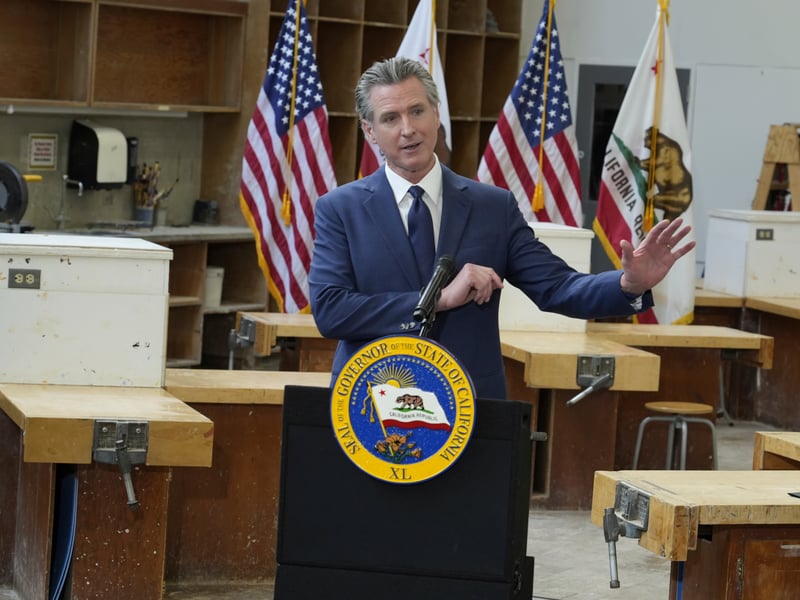
SACRAMENTO, Calif. (CN) — California’s finances appear in much better shape than this time last year, with Governor Gavin Newsom saying the state has avoided pulling from reserves to balance the books.
Tax revenues are trending up for the Golden State, with some $16.5 billion more in collections than last year. The state’s fiscal year 2025-26 budget, fully revealed Friday, is balanced with no discernable deficit. Joe Stepenshaw, the state’s finance director, said Friday that he’s projecting a modest surplus of $363 million.
“We’re a lot better off than the last couple of years,” Stepenshaw added.
Newsom presented a sneak peek into the state’s budget this week, with a more complete presentation by state Department of Finance staff occurring Friday. Newsom wasn’t present that day.
The budget calls for $322.2 billion in spending, with $228.9 billion of that coming from the state’s general fund. The remainder comes from sources like federal funds and bonds.
California has $16.9 billion in reserves. Some $10.9 billion of that is in the state’s rainy day fund, with another $1.5 billion in the public school rainy day fund and the remaining $4.5 billion in a special fund for economic uncertainties.
The state Legislative Analyst’s Office last year projected the state would face a $2 billion deficit, compared to the $363 million surplus California officials are estimating. Both agencies say the amount is minimal and that the budget is effectively balanced.
The analyst’s office last year advised against lawmakers adding more programs to the budget, giving that little wiggle room exists. Stepenshaw said the budget calls for $1.2 billion in new spending, mostly for existing programs and those with expiring funds.
“There is very limited new commitments in this budget,” Stepenshaw said.
Asked about a deal to provide funding to a struggling journalism industry, the finance director said his office is accounting for $30 million in the upcoming budget, with $10 million a year in a few following years. However, Stepenshaw said details of the arrangement haven’t yet been finalized.
“There’s no details yet,” he added. “Those are to be determined.”
Assemblymember Buffy Wicks, an Oakland Democrat, had a bill last year that would have required large online platforms to pay digital news providers. The bill was scuttled in favor of a deal between California, publishers and large tech companies.
Some newsrooms are still expected to receive funds, but money also will go toward a national artificial intelligence innovation accelerator. Supporters have said that accelerator will lead to more tools for journalists to gain and interpret public data.
The Media Guild of the West blasted the proposal when it was announced last year, and in a series of recommendations on Monday called it “the world’s worst Google deal.”
Friday’s presentation touched on several aspects of the upcoming budget, including the November passage of two statewide bond measures. One of those will include $1.5 billion for wildfire resilience.
Wildfires have ravaged the Los Angeles area this week, leading to massive evacuations and the destruction of homes. By Friday, the Palisades Fire had charred over 20,000 acres. It was 8% contained. The Eaton Fire, at over 13,500 acres, was 3% contained.
The state’s judiciary branch is slated to receive $5.2 billion in operating and facility funding.
Chief Justice Patricia Guerrero in a statement said she appreciated Newsom’s support of her branch.
“As the budget is finalized in the coming months, we are committed to working with the governor’s administration and the Legislature to secure adequate resources for the judicial branch to fulfill its public service obligations and meet the needs of Californians,” she added.
Financial risks still exist, Stepenshaw said. While revenues have risen, the state relies heavily on high-income earners and a bullish stock market. Additionally, the incoming Donald Trump administration brings more uncertainty about federal policy. Increasing deportations, which Trump has signaled, could affect the labor pool.
Another potential issue stems from the wildfires in Southern California. In 2023, the deadline to file taxes was delayed because of winter natural disasters. That led to a delay in financial information and the late discovery of a massive budget deficit the state faced going into 2024. That problem could repeat itself if another filing delay occurs.
California Republicans were quick to find holes in the budget.
On Monday, Newsom touted that no money was pulled from reserves to make ends meet. Republicans argued that’s exactly what happened during last year’s budget process.
The state last year faced a large deficit, with estimates at one point ranging from $38 billion to $73 billion. Newsom said at the time he filled anticipated budget shortfalls for the next two fiscal years — the current one as well as the upcoming 2025-26 year.
Assembly Minority Leader James Gallagher, a Yuba City Republican, and Assemblymember Heath Flora, a Lodi Republican and vice chair of the Assembly Budget Committee, said in a statement that $7.1 billion was pulled from the state’s rainy day fund to make the upcoming budget work.
According to a June budget summary, some $5.1 billion was pulled from the rainy day fund to bridge a 2024-25 budget gap, with another $7.1 billion for the 2025-26 budget.
“Spreading the use of the [rainy day fund] over two years allows more of the structural budget issues to be addressed in 2024-25 and provides greater budget resiliency,” authors of the budget summary wrote.
Subscribe to our free newsletters
Our weekly newsletter Closing Arguments offers the latest about ongoing trials, major litigation and rulings in courthouses around the U.S. and the world, while the monthly Under the Lights dishes the legal dirt from Hollywood, sports, Big Tech and the arts.