
 Search Articles


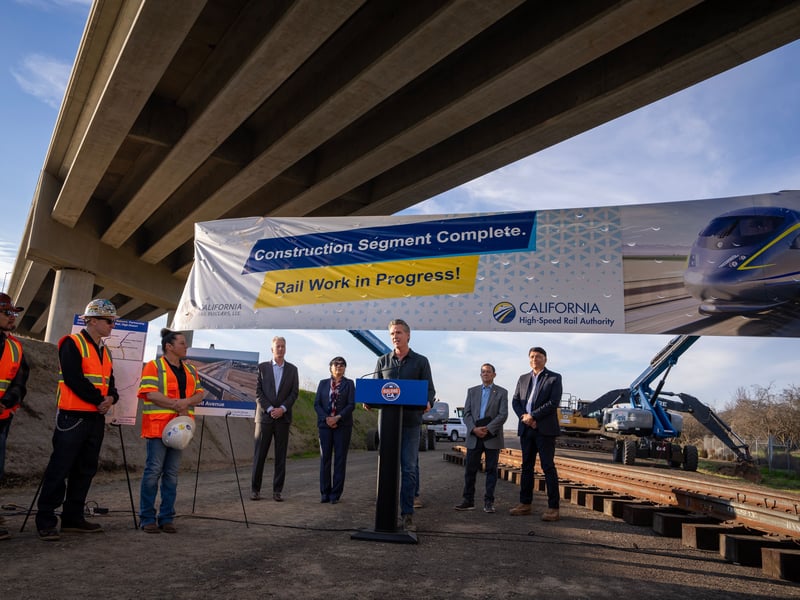
KERN COUNTY, Calif. (CN) — Spike mauls struck metal on Monday as California officials ceremoniously hammered in a planned high-speed rail connection that, potentially, will become part of a system that links the Golden and Silver states.
Officials celebrated a 22-mile stretch of rail about a mile south of the Kern-Tulare county line. The southernmost part of the project under construction, it will include overpasses, underpasses and viaducts for trains. The major civil works for that section are done and workers can now begin laying track.
Monday’s ceremony broke ground on the railhead, a freight yard where materials are received and work on laying track is staged. It’s the initial step before laying track.
Passenger service is expected between 2030 and 2033.
The ceremony was followed on Tuesday by the release of California’s state rail plan. That document details long-term plans for a zero-emission, interconnected rail network by 2050.
“California is building a clean transportation system for the future,” Governor Gavin Newsom said in a statement. “Our vision is simple: by 2050, every Californian should be able to choose rail as a way to get to their destination, near or far.”
The plan — of which Monday’s ceremony was just a small part — lays out goals for the next five, 10 and 25 years.
Expanding regional service is the goal for the next five years. The plan calls for all-day service in Southern California, a new regional service connecting the San Joaquin Valley to Sacramento, and linking the north Bay Area to Healdsburg through regional rail.
Over the next 10 years, the Golden State should start to see high-speed rail come online.
Officials in the plan say high-speed rail will be operational between Merced and Bakersfield, connecting to intercity and regional rail services. Southern California residents will see more regional and intercity services, with added service in core spots.
California expects its high-speed rail system to reach full build out by 2050.
Connections will exist between San Francisco and Anaheim, with other high-speed lines connecting Sacramento and San Diego. A connection from California’s high-speed rail project to Brightline West’s rail system linking Las Vegas and the Los Angeles area, heralded at Monday’s ceremony, also is expected by 2050.
These plans had their symbolic start point in Monday’s hammering on a Kern County rail line.
Arthur Sohikian, executive director of the High Desert Corridor Joint Powers Authority, said Monday that the project promises thousands of jobs, expanded access to affordable housing and better transportation options.
“This is more than transportation,” Sohikian said. “This is transformation.”
His authority includes among its members Los Angeles County, as well as the cities of Palmdale, Victorville and others, though the project has drawn widespread interest and praise.
“Our people are ready for this, they are excited by this,” said Leticia Perez, a Kern County supervisor and board chair.
Officials also highlighted the planned connection between California’s high-speed rail project and another, similar project linking Las Vegas with the Los Angeles area.
The connection is a track that would connect Palmdale, on the California High-Speed Rail project between San Francisco and Los Angeles, with Victor Valley, on Brightline West’s rail system between Las Vegas and Los Angeles. Palmdale and Victor Valley are about 54 miles apart.
Fresh off a state budget preview delivered earlier Monday, Newsom said he knows some Californians feel left behind, especially those in areas like the Central Valley. He said the rail connection project is aimed at economic development, noting that high-speed rail will bring some 15,000 jobs.
Newsom acknowledged the cynics of high-speed rail, suggesting politics as one reason for push back on the project. He said officials can’t return to 2008, the year voters approved the project. Instead, they must deal with today’s reality.
“We’re here making this work,” the governor added.
According to Newsom, the state has had a laborious process of navigating both the National Environmental Policy Act and California Environmental Quality Act. Permitting was required to remove infrastructure like gas lines. Also, the state had to purchase over 2,000 parcels.
Those tasks now are complete, Newsom added, urging people against cynicism — much of which has come from California Republicans.
Former state Senator Brian Dahle, a Bieber Republican, opposed some $1.1 billion for the high-speed rail project in the current fiscal year budget. He said Democrats funded the rail project while cutting millions of dollars in housing for veterans.
Assemblymember Tom Lackey, a Palmdale Republican, introduced a bill during a special session last year on oil and gas that would have pulled $3 billion from the High-Speed Rail Authority. The money would have been used for $100 rebates for registered owners of gasoline-powered passenger vehicles.
The bill failed to advance.
The California High-Speed Rail project seeks to connect San Francisco to Los Angeles by track, transporting people 500 miles in under three hours at over 200 mph. After that’s completed, planners hope to expand the project to Sacramento and San Diego.
High-speed rail officials have estimated the cost of project between $89 billion and $128 billion.
Brightline West has said its line between Las Vegas and Rancho Cucamonga will cost $12 billion. It’s a 218-mile connection that’s expected to take just over two hours.
“No state in America is closer to launching high-speed rail than California — and today, we just took a massive step forward,” Newsom said in a Monday statement. “We’re moving into the track-laying phase, completing structures for key segments, and laying the groundwork for a high-speed rail network.”
Subscribe to our free newsletters
Our weekly newsletter Closing Arguments offers the latest about ongoing trials, major litigation and rulings in courthouses around the U.S. and the world, while the monthly Under the Lights dishes the legal dirt from Hollywood, sports, Big Tech and the arts.