
 Search Articles


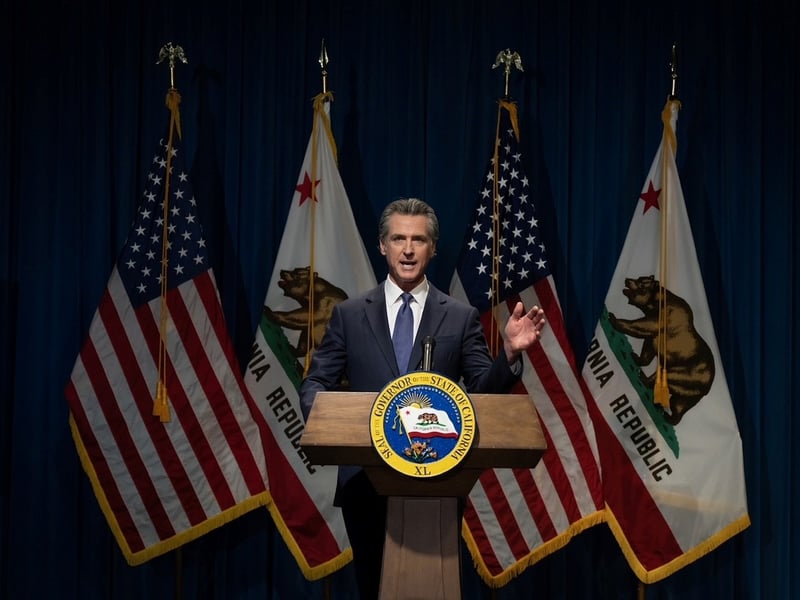
SACRAMENTO, Calif. (CN) — California’s legislative analyst said Monday that lawmakers should adopt its own revenue predictions as opposed to the governor’s rosier forecast and tackle the state’s ongoing budget problem.
In a report responding to Governor Gavin Newsom’s budget, the state’s Legislative Analyst’s Office said that the governor acknowledges the risk to California’s revenue, but the budget takes no real action to address that challenge.
Revealing his initial budget last week, Newsom called for $248.3 billion in spending from the general fund for fiscal year 2026-27. The total budget, including all the state’s various funds, totals $348.9 billion.
The governor projected a shortfall of around $3 billion for the upcoming fiscal year — but the Legislative Analyst’s Office had a more dire deficit prediction of some $18 billion.
State officials have said the governor’s budget is balanced and the $3 billion shortfall is bridged.
On Monday, the analyst’s office said the difference in the deficit numbers is because Newsom has estimated much higher tax revenues.
The analyst’s office said signs point to an overheated stock market that could turn downward in the near future. The state’s coffers heavily rely on high-income earners.
“Should a stock market downturn occur, income tax revenues would fall considerably,” the analyst’s office said in the report, adding later: “Further amplifying this precariousness, even under the administration’s more optimistic revenues, the budget is only roughly balanced in the near term.”
Adding to the precarious fiscal footing the state faces are multi-year deficits predicted both by Newsom and the analyst’s office.
Gabriel Petek, the state’s legislative analyst, has said California could face shortfalls of between $30 billion and $35 billion after 2026-27. The finance department saw around a $22 billion deficit in 2027-28, with shortfalls in the following two years as well.
The analyst’s office said that’s worrying because the state has faced four consecutive years of projected deficits, making its fiscal situation chronic. Also, its November budget forecast was the most negative since the Covid-19 pandemic.
“Finally, deficits have persisted even as the state’s economy and revenues have grown, underscoring that the problem is structural rather than cyclical,” the office added.
Added together, the analyst said serious concerns exist about California’s financial sustainability.
The analyst’s office advised lawmakers start their work immediately, as the deficits demand legislative action. They shouldn’t wait until the May revise, the name for the amended budget released in spring each year after tax revenues are collected.
The office pointed to two main obstacles legislators must overcome: the risk Newsom’s revenue estimates won’t materialize, and the future deficits California will face after 2026-27.
The analyst’s office advised lawmakers to adopt its own revenue predictions, as they contain the possibility of a market downturn. That would provide a practical starting point for taking action.
Lawmakers would then search for solutions to create a balanced budget.
The analyst’s office also recommended lawmakers craft a plan to address at least half of the expected deficits in future years — a move that would require at least $10 billion.
“These solutions could include spending reductions, revenue increases, or a combination of both,” the office said.
Those solutions could begin rolling out in 2027-78, giving programs time for thoughtful implementation.
The office pointed to similar fiscal circumstances in the recent past, when deficits persisted after a time of declining revenues even though tax collections started rising again — the dotcom bubble and the Great Recession.
“Today, without action to realign ongoing expenditures with ongoing revenues, the risk of repeating history looms large,” the office said.
State Senator Roger Niello, a Fair Oaks Republican and vice chair of his chamber’s Budget and Fiscal Review Committee, said the analyst’s report highlighted the need to address the Democratic supermajority’s spending problem and bring discipline to the state budget.
“Governor Newsom’s dangerously optimistic wait-and-see approach does nothing to address an $18 billion deficit and only deepens the risk," Niello said in a statement to Courthouse News. “How can our revenue be increasing at the same time as the deficit? The answer is in the misaligned spending by the majority party.”
Lawmakers will now begin digging into their own budget process.
The Legislature must pass a budget by mid-June, and the governor needs to sign a budget by June 30. The new fiscal year starts July 1.
Hitting those benchmarks doesn’t mean the work is over. Lawmakers and the governor must pass and sign a version of the budget by those deadlines, but will continue working on tweaks over the following weeks.
Subscribe to our free newsletters
Our weekly newsletter Closing Arguments offers the latest about ongoing trials, major litigation and rulings in courthouses around the U.S. and the world, while the monthly Under the Lights dishes the legal dirt from Hollywood, sports, Big Tech and the arts.