
 Search Articles


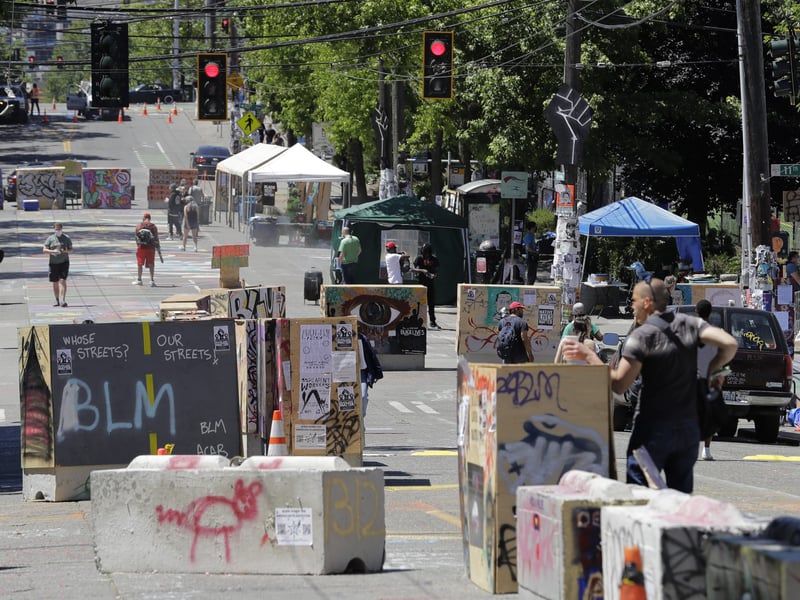
SEATTLE (CN) — Two Seattle businesses asked the Ninth Circuit on Tuesday to revive their lawsuit accusing the city of worsening conditions inside the police-free, autonomous protest zone created during a summer of civil unrest five years ago.
“The city took several actions that fueled a dangerous, unlawful environment that had a serious and devastating impact on the plaintiffs,” said Angelo Calfo, attorney representing the two Seattle businesses suing the city, Hugo Properties and Oma Bap.
In 2020, amid widespread protests in the wake of the murder of George Floyd at the hands of Minnesota police, Seattle protesters barricaded off a 12-block portion of the Capitol Hill neighborhood, and police withdrew from the precinct. The area became known as CHOP, which stands for the Capitol Hill Occupying Protest.
Within the occupation was a fast-casual Korean food restaurant called Oma Bap on the bottom floor of an apartment building owned by Hugo Properties. Both businesses sued the city, asserting claims of negligence, violation of substantive due process and nuisance.
The businesses accused Seattle of fostering a dangerous environment and disregarding public safety, negatively impacting their businesses.
The lower court dismissed the claims, finding the businesses didn’t prove the city had breached any duties owed to the businesses. It also found that the statute of limitations had elapsed on the nuisance claim.
Before a three-member panel of the Ninth Circuit, the businesses argued the city encouraged and supported the occupation, knowing it was harming the businesses within the zone.
The justices questioned whether Seattle did so intentionally.
“What did the city do affirmatively, as opposed to omissions?” asked U.S. Circuit Judge Richard Paez, a Bill Clinton appointee.
The businesses argued the city provided concrete barriers with plywood sheets that the protesters covered in graffiti.
“It added damage to your client that they had graffiti on barriers?” U.S. Circuit Judge Margaret McKeown, a fellow Clinton appointee, asked somewhat incredulously.
“Well, your honor, it created a lawless environment that encouraged vandalism,” Calfo said. He said the protesters shattered windows, moved outdoor tables and blocked access to the parking lot of the businesses.
Plus, the city placed dumpsters and portable bathrooms right outside of the building that housed both businesses and “encouraged a massive tent encampment” at Cal Anderson Park across the street, Calfo said.
But the justices weren’t convinced those actions showed deliberate indifference on the city’s side.
“Obviously, there were public safety concerns and there were public health concerns as a result of this gathering or, you know, conflagration up at the Cal Anderson Park,” McKeown remarked. “But when the city decides ‘They have to go somewhere,’ you’re not saying that the city should have just disregarded the health concerns, right?”
The businesses argued the city knew of the danger, kept its own employees out of the occupation area for their own safety and ignored the businesses’ pleas for help. But was it a private or public nuisance? The businesses argue it was both.
“It was private in the sense it was directed toward that building. It was public in the sense that the city blocked off that 12-block area,” Calfo said.
Seattle argued the businesses fell short of proving there was a state-created danger and that the businesses didn’t identify any particularized harm upon which they could bring economic harm claims.
“They are harms that affected, allegedly, businesses, visitors, workers, employees without particularity, without any particularity whatsoever,” said Shane Cramer, attorney representing Seattle. “They affect anybody who came in contact with CHOP, was exposed to danger. That’s the bottom line of the complaint here.”
Plus, the businesses claimed they sustained harm from the initial occupation in June 2020 until December of that year, a six-month period that undercuts the argument that there was an immediate risk or state-created danger, Cramer argued.
Seattle also provided portable toilets, dumpsters and concrete barriers to try to mitigate public health concerns and cool down tensions with protesters rather than encourage a prolonged occupation, the city argued.
Then there’s the question of whether the businesses can even raise their nuisance claim under Washington’s two-year statute of limitations for a nuisance claim. The businesses filed the lawsuit in 2023.
The Ninth Circuit panel, which also included U.S. Circuit Judge Roopali Desai, a Joe Biden appointee, did not indicate when it would rule.
Subscribe to our free newsletters
Our weekly newsletter Closing Arguments offers the latest about ongoing trials, major litigation and rulings in courthouses around the U.S. and the world, while the monthly Under the Lights dishes the legal dirt from Hollywood, sports, Big Tech and the arts.