
 Search Articles


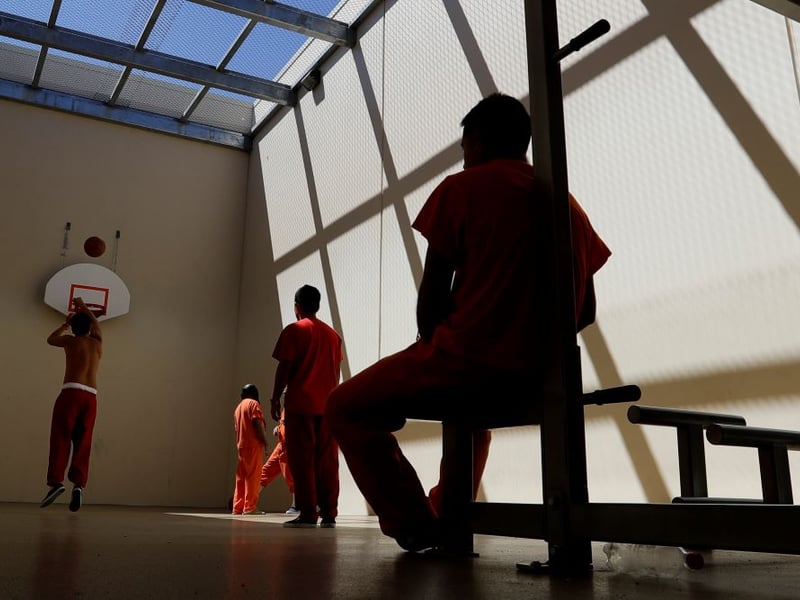
(CN) — A federal judge on Friday blocked the state of Washington from enforcing most sections of a law aimed at regulating private for-profit immigration detention facilities.
Immigration and Customs Enforcement, or ICE, detains more than 35,000 undocumented people trying to cross into the United States illegally every day, a number that has climbed steadily since the Covid pandemic subsided. According to the American Civil Liberties Union, 90% of these detainees are held in private for-profit facilities that contract with ICE.
In May 2023, Washington Governor Jay Inslee signed HB 1470, which imposed a slew of rules and regulations on private detention facilities. There is currently only one such facility in the state: Northwest Detention Center in Tacoma, which has more than 1,500 beds, making it one of the largest in the country.
Inmates there have long complained about overcrowding, lack of medical care and unsanitary conditions. In a video produced by The Atlantic in 2020, during the height of Covid, one inmate complained, “They’re not even offering us soap.” This year, there have already been two hunger strikes.
Washington state banned private detention facilities in 2021. The owner and operator of Northwest Detention Center, the GEO Group, sued the state, arguing the law violated the supremacy clause of the U.S. Constitution by “interfering with or controlling the operations of the federal government.” In September 2022, the Ninth Circuit Court of Appeals, in a different case, struck down a similar ban on private immigration detention centers in California. Following that ruling, the state of Washington agreed to scrap its ban.
The Legislature then passed HB 1470, an attempt to regulate the Northwest Detention Center. Among its panoply of regulations, Section 2 of the law required the center to “clean and sanitize living areas regularly,” “maintain safe indoor air quality,” provide “basic personal hygiene items” and laundry facilities, and install heating and air conditioning equipment. Section 4 banned solitary confinement and mandated that the prison respond “to sexual violence and harassment grievances immediately with ‘culturally competent professionals,’” conduct weekly mental health evaluations and allow daily in-person visitation.
Other sections required the state to perform routine unannounced inspections, and allowed detainees to sue over violations to the new law.
Again, GEO sued, claiming the new law violated the supremacy clause since its conduct was already regulated by its contract with ICE — which, according to the complaint, was “approximately 500 pages in length” and included “detailed standards” governing the center’s operations.
“Numerous operating requirements contained within HB 1470 are inconsistent with or directly conflict with explicit contractual requirements for the operation of” the facility, GEO Group said in its complaint.
U.S. District Judge Benjamin Settle mostly agreed with GEO, writing in his 64-page ruling that much of the law imposed a burden on the Northwest Detention Center that did not apply to any other facility in the state, which is also a violation of the supremacy clause.
“The state claims that HB 1470 does not impermissibly discriminate against GEO in violation of the supremacy clause because it simply replicates standards that already apply to residential treatment facilities. The court disagrees,” Settle wrote, reasoning that residential treatment facilities were sufficiently similar to private detention facilities like Northwest Detention.
Settle did make an exception for Section 4 of the law, which does not apply to any contract signed before January 1, 2023. Since GEO signed its contract with Washington in 2021, it is currently exempt from that section. GEO argued that it may apply to the company if it extends its contract after it runs out in 2025, but Settle decided that part of the matter was not yet ripe for a constitutional challenge.
Section 4 of the law remains in place while the rest of blocked by a preliminary injunction.
A GEO Group spokesman said in a written statement, “We are pleased by the Court’s ruling and are committed to continue providing the federal government with contracted secure residential care services in accordance with all applicable federal standards.”
The Washington Attorney General’s office did not respond to an email requesting a comment on the ruling.
 Follow @hillelaron
Subscribe to our free newsletters
Our weekly newsletter Closing Arguments offers the latest about ongoing trials, major litigation and rulings in courthouses around the U.S. and the world, while the monthly Under the Lights dishes the legal dirt from Hollywood, sports, Big Tech and the arts.