
 Search Articles


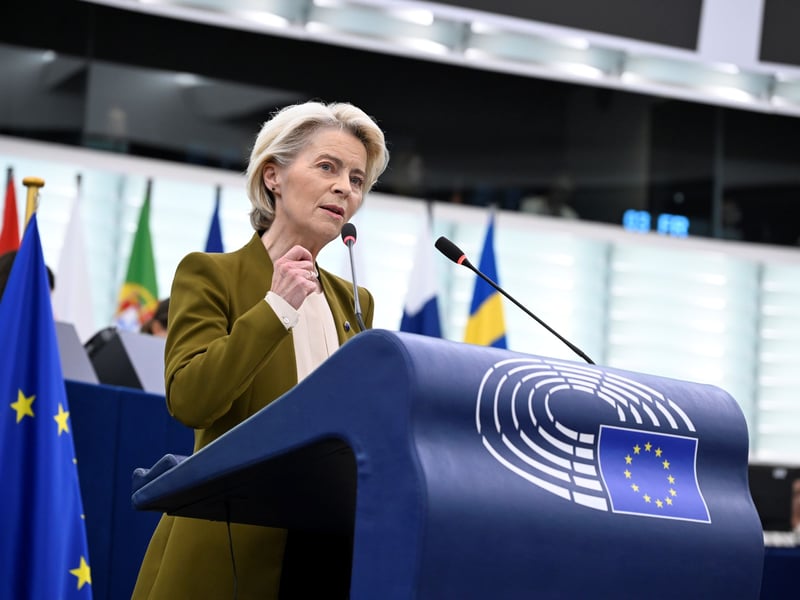
BRUSSELS (CN) — European Commission President Ursula von der Leyen announced sanctions against Israel and new aid for Ukraine on Wednesday during her annual State of the European Union address, with the timing shaped by Russian drone incursions into Poland just hours earlier and Israeli airstrikes in Qatar targeting Hamas leaders.
Von der Leyen announced the European Commission — the EU’s executive branch — would suspend bilateral support to Israel, propose sanctions on extremist Israeli ministers and violent settlers, and seek a partial suspension of the EU-Israel trade agreement — the first concrete steps after months of criticism that the EU has failed to respond adequately to the Gaza crisis.
The measures, while more assertive than previous EU statements, lack specific timelines or enforcement mechanisms — as von der Leyen did not specify which bilateral programs would be suspended, which ministers would face sanctions or when the trade agreement suspension would take effect.
The move breaks the EU’s previous deadlock on Israel policy. Just one day earlier, EU foreign policy chief Kaja Kallas told lawmakers that while the executive had an “inventory” of possible actions against Israel — including halting trade ties and suspending research partnerships — “member states disagree on how to get the Israeli government to change course.”
On her decision to proceed with EU executive action, von der Leyen said: “I know that any action will be too much for some. Too little for others. But we must all take our own responsibilities.”
“Man-made famine can never be a weapon of war,” she added, calling recent Israeli actions in Gaza “unacceptable.”
The timing drove home her point. Just one day earlier, Brussels condemned Israeli airstrikes in Doha targeting Hamas leaders, saying they “breach international law and Qatar’s territorial integrity.”
On Ukraine, von der Leyen announced several major initiatives in direct response to escalating Russian aggression: a 6-billion-euro ($7 billion) “drone alliance” to help Ukraine counter Russia’s increasing aerial attacks, a “reparations loan” funded by profits from frozen Russian assets and a summit on returning abducted Ukrainian children.
She also proposed creating an “eastern flank watch” with real-time space surveillance and a “drone wall” along Europe’s borders with Russia — proposals that come after von der Leyen toured eastern European capitals in early September to assess security needs firsthand.
“Europe will defend every inch of its territory,” she declared.
But the ambitious defense initiatives face the same coordination challenges that have long hampered EU security cooperation, with national governments jealously guarding military sovereignty.
The announcements came just hours after Russia launched what Polish Prime Minister Donald Tusk called the most serious airspace violation since World War II, sending over a dozen drones deep into Polish territory and forcing Warsaw’s airport to close. Poland scrambled fighter jets and shot down several drones, with one crashing into a house near the Ukrainian border.
NATO Secretary-General Mark Rutte condemned the violation on Wednesday, warning Moscow that the alliance was “ready” for further incursions. “My message is clear: … Know that we stand ready, that we are vigilant and that we will defend every inch of NATO territory,” Rutte told reporters in Brussels.
‘Independence moment’ call
Von der Leyen opened with a stark declaration that “Europe is in a fight” for its freedom and independence, framing her address around what she called “Europe’s independence moment.” The combative tone reflected the urgency she sees in confronting multiple crises simultaneously.
“Make no mistake, this is a fight for our future,” she told lawmakers, asking bluntly: “Does Europe have the stomach for this fight? Do we have the unity and the sense of urgency?”
Her central pitch was for unity, warning that the choice was between fighting together or being “paralyzed by our divisions.”
But von der Leyen’s bold policy announcements come as she confronts what observers say is the shakiest period of her five-year tenure leading the commission, the EU’s executive arm that proposes laws and enforces rules across Europe.
Her authority has been questioned by both national governments and members of the European Parliament over recent controversial moves, including the infamous trade deal with the United States. Two separate no-confidence votes are reportedly in the works, underscoring the political pressure she faces.
Most significantly, Executive Vice President Teresa Ribera, von der Leyen’s second-in-command, has emerged as her most prominent internal critic. Ribera has gone much further by becoming the highest-level EU official to describe Israel’s military assault in Gaza as “genocide” during a speech at Sciences Po on Thursday.
“The genocide in Gaza exposes Europe’s failure to act and speak with one voice,” Ribera told students, drawing swift condemnation from Israel’s foreign ministry.
The commission quickly distanced itself from Ribera’s remarks, with spokesperson Paula Pinho clarifying that genocide determinations are “for the courts.”
During her speech, von der Leyen also vigorously defended her controversial U.S. trade deal.
“As president of the commission, I will never gamble with people’s jobs or livelihoods,” she said. “We have put our companies at a relative advantage.” She insisted that “whether on environmental or digital regulation. We set our own standards. We set our own regulations. Europe will always decide for itself.”
But that claim of regulatory independence faces increasing challenges. European Parliament lawmakers are mounting what trade committee chair Bernd Lange calls a rebellion against the deal, while Trump continues issuing threats against countries with digital regulations.
European exporters have been battered by months of trade chaos since the U.S. imposed tariffs of up to 25% on cars in April, contributing to the sharp economic divergence between the two continents. According to Eurostat, Europe’s economy posted dismal 0.1% growth in the second quarter — eight times slower than U.S. growth of 0.8% — with Germany’s automotive sector hit particularly hard by a 0.3% contraction.
The parliamentary backlash was immediate and brutal. Socialists & Democrats leader Iratxe García Pérez accused von der Leyen of striking an “unfair deal with Trump,” calling the EU’s acceptance of a 15% tariff on exports while scrapping its own tariffs on U.S. goods “unacceptable.” She said the EU’s strategic autonomy had been buried “under a golf course,” referring to the deal struck at Trump’s Turnberry resort.
The criticism spanned the political spectrum. The Left’s Martin Schirdewan argued that “fighting overcapacity with more trade is like throwing lighters on the fire of the European economic crisis.” Even politicians who normally disagree — from the Greens to the far-right — found common ground in attacking von der Leyen’s promise to buy $750 billion worth of American energy.
Only her political ally, European People’s Party leader Manfred Weber, defended the agreement, asking: “What is the alternative to Scotland?”
Most damaging for von der Leyen’s credibility, her own Trade Commissioner Maroš Šefčovič reportedly blocked a planned antitrust penalty against Google Sept. 1 in response to Trump’s pressure — only to reverse course days later when the commission imposed a $3.2 billion fine on the tech giant.
The flip-flopping shows deeper problems, as Ribera — who oversees competition policy — pushed back against the initial accommodation to Trump on Google, declaring that “true freedom means a level playing field” and that “when markets fail, public institutions must act.” She has openly called for Europe to be “courageous” and “avoid the temptation of being subordinated to others’ interests,” pushing for a reassessment of the trade deal if Trump follows through on digital regulation threats.
The State of the Union speech serves as the EU’s most important annual political moment, when the president of the commission lays out priorities for the coming year before the Parliament.
Subscribe to our free newsletters
Our weekly newsletter Closing Arguments offers the latest about ongoing trials, major litigation and rulings in courthouses around the U.S. and the world, while the monthly Under the Lights dishes the legal dirt from Hollywood, sports, Big Tech and the arts.