
 Search Articles


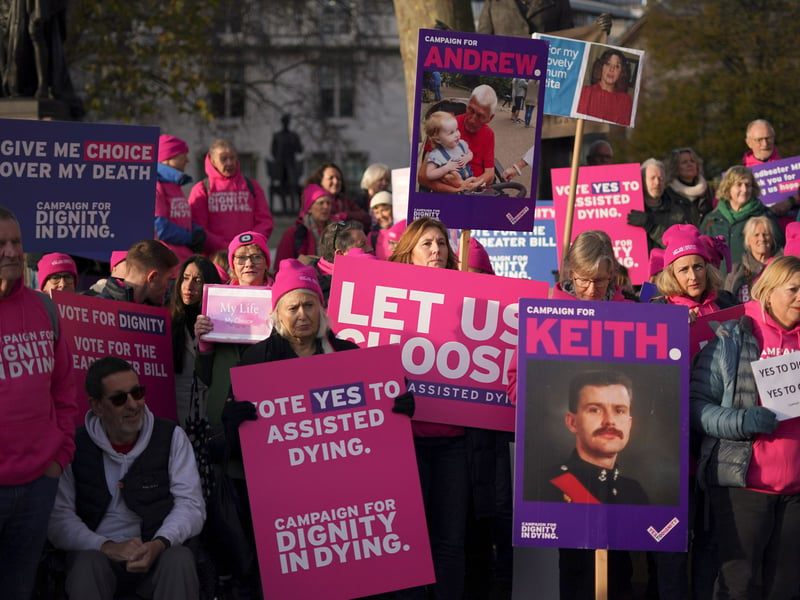
MANCHESTER, England — British lawmakers approved legislation Friday to allow terminally ill adults with six months or less to live to end their own lives.
The vote on the Terminally Ill Adults Bill in the House of Commons, Parliament’s lower chamber, followed hours of discussion and emotional debate, and now passes to the House of Lords for further scrutiny.
Politicians were allowed to vote according on their personal views, rather than party lines, with 314 voting in favor and 291 against.
Kim Leadbeater, the Labour politician who put forward the bill, told Parliament that it is “far safer and significantly more compassionate than what we have now.”
Some politicians feared that the bill would extend to include other groups of people. Conservative member of Parliament Wendy Morton spoke of how other countries who have legalized assisted dying have extended the law.
Labour legislator Beccy Cooper, a medical doctor specializing in public health, voted in favor of assisted dying. “We are often met with the slippery slope argument,” she told Parliament. “That’s not what’s in front of us today.”
Cooper added that, “Ultimately, a good death is something that we all want for ourselves and for those we love and care for.”
Since the previous vote on the bill in November 2024, a number of amendments have been added to strengthen safeguards.
These include stricter eligibility checks, a requirement for two independent doctors to provide medical assessments, and replacing a judge with a three-person panel consisting of a social worker, psychiatrist and legal expert, who would decide applications.
Another key change explicitly excludes individuals under 18 from eligibility, aimed at reassuring opponents who are concerned about the scope.
Fellow Conservative legislator Kit Malthouse, supported the bill, saying that it is “not about choosing death, it’s about choosing how to face it when death is already at the door.”
For some politicians, the debate touched on personal struggles.
Maureen Burke, a Labour MP, shared a story of her brother who was diagnosed with pancreatic cancer. In the final months of his life, he told Burke that if there were a pill he could take to end his life, he would do so.
She urged Parliament to make sure that no one would go through the same experience as her brother, who she said suffered in silent pain for weeks.
Munira Wilson, a Liberal Democrat, shared the story of her friend who became “unable to perform the most basic of human functions,” something which was “utterly devastating.”
Despite agreeing that terminally-ill adults should have the chance to “manage how they leave this world,” she said that the national health service is “nowhere near giving people that choice,” voting against the bill.
Labour politician Jen Craft opposed the legislation, with concerns over the potential impact on people with disabilities.
Craft told the chamber of her own experience with her daughter who has Down’s Syndrome. She said that when she found out about the diagnosis, her midwife told her she could book her an abortion within days.
She said she’s had to “fight for so many things” for her daughter as the “establishment does not see her life as valuable.”
Party leaders were divided on the bill, with Labour Prime Minister Keir Starmer voting in favor while Conservative leader Kemi Badenoch voted against. The Liberal Democrat leader, Ed Davey, abstained.
Following months of debate over safeguarding and the bill’s implementation, the vote was tighter than the previous reading, when 330 legislators voted in favor and 275 against.
The bill now goes to the House of Lords for further readings and scrutiny, before returning to the Commons for final approval.
 Follow @jayfranklinlive
Subscribe to our free newsletters
Our weekly newsletter Closing Arguments offers the latest about ongoing trials, major litigation and rulings in courthouses around the U.S. and the world, while the monthly Under the Lights dishes the legal dirt from Hollywood, sports, Big Tech and the arts.