
 Search Articles


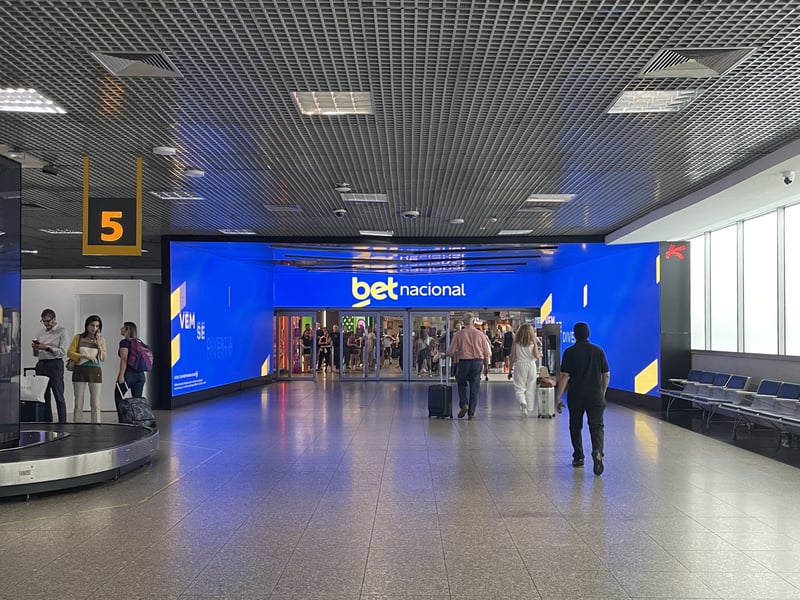
RIO DE JANEIRO (CN) — On Jan. 1, the online gambling industry in Brazil will see mandatory licensing, tax collection, advertising limits and measures for the prevention and treatment of gambling addiction. Around 50 companies will be authorized to continue operating in the country as of that first day.
The sector has operated without rules for six years, raising concerns over its social, economic and health implications.
“Online betting was fueled by an explosive combination of Brazilians’ passion for football with the betting culture, the idea of easy and quick enrichment in a society marked by profound social inequalities,” said Marcelo Pereira de Mello, a sociology professor at Universidade Federal Fluminense who studies the history and social aspects of gambling.
Brazil ranked first worldwide in visits to betting sites this year, accounting for 15% of global traffic, according to SimilarWeb. A survey by the newspaper Folha de S. Paulo found in 2023 that Brazilians spent around $11 billion on online gambling and betting. The country also consolidated itself as the seventh-largest market in terms of revenue, according to H2 Gambling Capital.
Online betting with fixed odds was legalized in 2018 in the last days of President Michel Temer’s term. However, the law stipulated that the next president would regulate the sector for a two-year period, extendable for another two.
“Bolsonaro’s government came in and didn’t regulate it for religious and conservative reasons,” said Magno José, president of the nongovernmental organization Instituto Brasileiro Jogo Legal. He added that besides companies licensed or authorized in other jurisdictions, Brazil also saw a surge of websites without any licensing whatsoever.
By the end of 2022, a new presidential administration identified this lack of compliance and began drafting regulations.
“We saw that, besides ignoring the law, the country was failing to collect taxes, prevent and treat gambling addiction, and regulate advertising. It was as if, in four years, gambling had grown in a completely wild environment,” said lawyer José Francisco Manssur, responsible for structuring the betting regulations. Manssur held nearly 500 meetings with the sector to gather information.
“It was interesting to see that operators were interested in being regulated,” he noted.
The result was Law No. 14790, the so-called “betting law,” sanctioned by President Luiz Inácio Lula da Silva in December 2023. Along with detailing and differentiating the types of allowed bets, the law requires companies wishing to operate in the country to pay concessions of about $5 million, mandates that a Brazilian citizen hold at least 20% of the company’s share capital, imposes a 12% tax on gross revenue and a 15% tax on prizes over $350, and prohibits minors under 18 from betting. It also bans bets on events involving only minors, such as youth sports categories.
Throughout 2024, the newly created Secretariat of Prizes and Bets, linked to the Ministry of Finance, issued 11 ordinances to address several issues — from approving certifying entities for betting sites to controlling and preventing money laundering. With the transition and adaptation period ending Jan. 1, 2025, the sector expects a drastic transformation. “From 2025 onward we will have a healthy market,” José said.
However, Brazilian society remains unconvinced. A November survey by the research institute Datafolha found that 65% of Brazilians believe betting should be prohibited.
This skepticism may stem from a series of scandals and concerns that emerged during the regulation debate: schemes involving match-fixing in football matches by players and directors, the relationship between influencers and non-fixed-odds online gambling sites, and cases of Brazilians who became addicted to betting have all dominated the media.
Another growing concern involves the use of social benefits for betting. A September study from the Central Bank of Brazil showed that 5 million Bolsa Família beneficiaries sent around $500 million to betting companies via PIX, the instant payment system.
In response, the government has launched investigations and inquiries. In April, the Senate set up a Parliamentary Commission of Inquiry (CPI) to investigate match-fixing in Brazilian football, with a completion deadline of February 2025. In November, the House established another CPI, the “CPI das Bets,” to determine how online virtual gambling influences Brazilian family budgets. This inquiry, expected to last 130 days, has already heard from influencers and betting site owners.
Meanwhile, three direct actions of unconstitutionality against Law No. 14790 are pending before the Federal Supreme Court. The Attorney General’s Office, the National Confederation of Commerce of Goods, Services and Tourism, and the Solidariedade Party — acting on behalf of governors who question provisions limiting the states’ role — claim the law contributes to family debt, compulsive gambling and the misuse of social program resources.
According to Eduardo Bruzzi, a partner at Rio de Janeiro’s BBL Advogados specializing in regulatory law, overturning the legal framework will not solve the plaintiffs’ cited problems, since the regulatory structure emerged to impose rules on an already existing economic activity. It is worth noting that the lawsuits — expected to be judged in the first half of 2025 — were not filed against the law that legalized online betting itself. If Law No. 14790 is deemed unconstitutional, Brazil would return to the previous situation: a legalized but unregulated market.
Bruzzi believes such a scenario is unlikely. “Although there may be room for improvements in the rules, the framework initially created seeks to regulate several important issues,” he said.
Manssur considers the government’s ability to prevent unauthorized companies from operating as crucial. He suggests that, over time, indicators such as a reduction in the number of addicts and indebted individuals, and increased awareness that betting is not a shortcut to riches will demonstrate whether the measures have yielded the expected results.
Lula, however, has issued a warning: if the regulations fail, he will scrap them altogether. “There is no control over the poorest people, over children with cellphones in their hands placing bets. We don’t want that,” the president told Metrópole Radio in October.
Subscribe to our free newsletters
Our weekly newsletter Closing Arguments offers the latest about ongoing trials, major litigation and rulings in courthouses around the U.S. and the world, while the monthly Under the Lights dishes the legal dirt from Hollywood, sports, Big Tech and the arts.