
 Search Articles


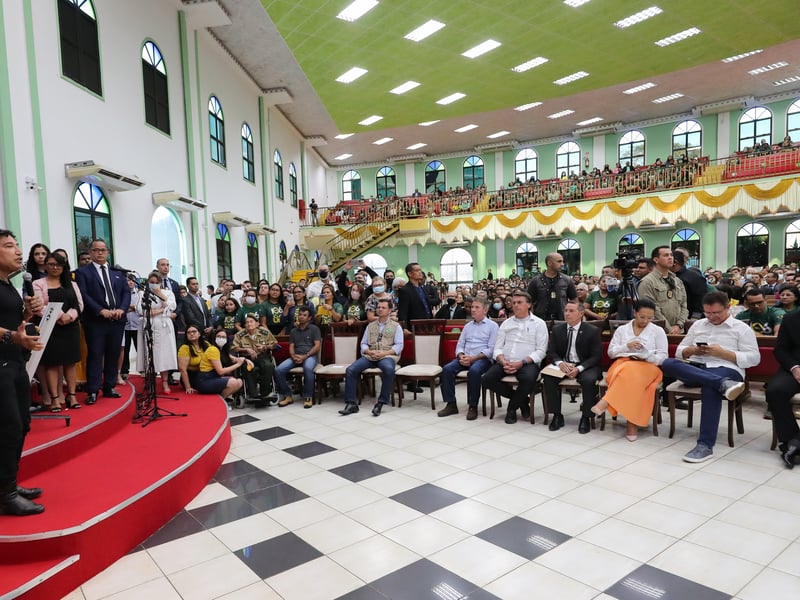
FLORIANÓPOLIS (CN) — It’s 8 p.m. on May 6, the eve of the conclave that elected American Cardinal Robert Francis Prevost, Leo XIV, as the successor to Pope Francis, who died on April 21. But that global event seems distant to the 15 people gathered at the Assembleia de Deus (Assemblies of God) temple in Campeche, a middle-class neighborhood in Florianópolis, capital of the southern Brazilian state of Santa Catarina.
Inside the brightly lit hall, congregants sing, raise their hands and shout “hallelujah” and “glory to God.”
Among them is Josiane Farias Silva Cássia, who runs a small catering business. Raised Catholic, she went through first communion and confirmation, but converted to the Assemblies of God in 2000. “I feel that here I found the truth, which is Jesus, and after I met Jesus, my life changed,” she said.
Cássia reflects a national trend: Between 1940 and 2010, Brazil’s evangelical population rose from 2.7% to 22.2%, driven partly by conversions from other faiths, especially Catholicism.
Once officially Catholic — the state religion until 1890, when Brazil broke from its Portuguese colonial heritage and declared itself secular — the country saw a rapid rise in Pentecostalism, which accelerated between 2000 and 2016.
According to tax data analyzed by the CEM/Cepid-Fapesp research center, Brazil had over 109,000 registered evangelical churches in 2019, nearly half Pentecostal, with the Assemblies of God as the fastest-growing denomination. Estimates by Datafolha, in partnership with retired Brazilian Institute of Geography and Statistics demographer José Eustáquio Alves, project that evangelicals will surpass Catholics by 2032 to become the largest religious group in Brazil.
Pentecostalism emerged in the United States in the early 20th century as a Christian movement emphasizing direct personal experience with God through the Holy Spirit, along with promises of prosperity and spiritual victory. In 1910, Swedish missionaries brought it to Brazil, founding the first Assemblies of God in Belém, a port city and capital of the northern state of Pará.
According to Ricardo Mariano, a sociology professor at the University of São Paulo and researcher on Pentecostalism, the movement only began to accelerate in the 1980s after Brazil’s return to democracy following military rule.
“With a missionary and revivalist style, this is a movement largely driven by lay members," he said. “They preach and engage in proselytism and evangelization. Services often focus on a living, powerful God who blesses and can transform the lives of his faithful in every way.”
This discourse resonated in the context of rapid urbanization and industrialization, said Magali do Nascimento Cunha, a researcher at the Institute for Studies on Religion.
“It made a difference, for example, for people who migrated to big cities and felt somewhat lost or lonely — they would find a church that welcomes them and offers the idea of a family of faith,” she said.
Maria das Dores Campos Machado, a retired professor at the Federal University of Rio de Janeiro and an expert on religion and politics, noted that churches also became spaces of protection and sociability for low-income families, filling roles the state failed to address, especially in the face of urban violence. She also points to the movement’s emphasis on individual responsibility for success or failure, aligning with expectations in a neoliberal society.
Since 1988, churches and religious temples have enjoyed tax immunity under Brazil’s Constitution, which makes opening a church simpler and cheaper than opening a business.
Experts summarize Brazil’s evangelical rise not as a sudden boom or simply the result of Catholic decline, but as a decades-long process tied to deep social and political currents. This rise has reshaped political alliances, fueled disputes in Congress and pressured the judiciary, inserting religious agendas into debates over abortion, education, freedom of expression and civil rights.
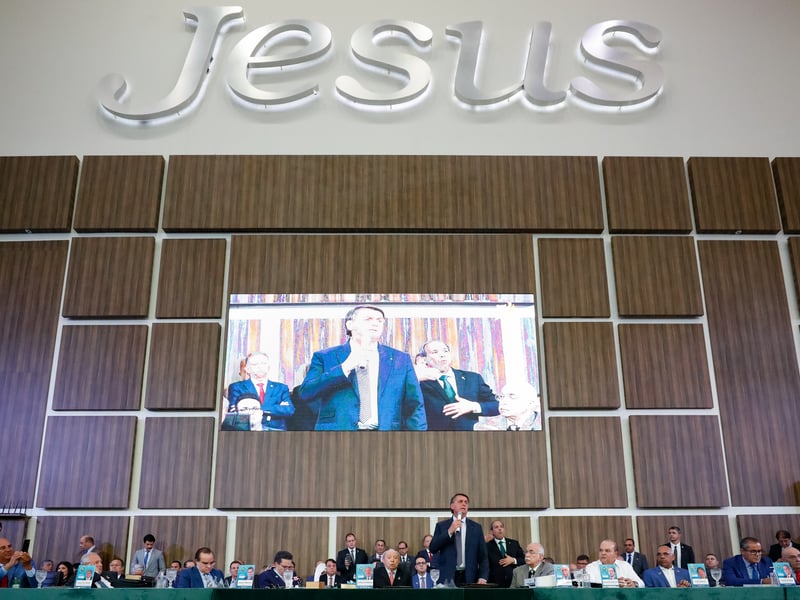
The Evangelical Parliamentary Front, a group of evangelical lawmakers, currently includes 244 members — 219 federal deputies and 25 senators — making it one of the largest and most influential caucuses in Brazil’s Congress. Its leadership is tied to the Assemblies of God, and its largest faction is aligned with former President Jair Bolsonaro. Although Bolsonaro is Catholic, his conservative agenda and evangelical wife, Michelle, have helped secure strong backing from evangelical leaders and voters.
In addition, massive investments in media have amplified evangelical influence. Churches like the Universal Church of the Kingdom of God have built communication networks — radio, television, newspapers and digital platforms — expanding their public reach and political clout. This media ecosystem allows them to mobilize followers and shape public debates, creating a national presence that extends far beyond the churches themselves.
“Politics and religion used to be topics people didn’t discuss, right? Today we see much more of it," Cássia said. “For example, the Assemblies of God in Florianópolis elected a city councilor, a true man of God. He’s helped a lot and has influenced projects. We elected him so he could veto some initiatives and not approve anything that goes against the word of God.”
According to Cunha, some groups have increasingly used religion as a political tool in recent years, seeking to impose particular religious views on society, compromising the secular nature of the state and religious freedom, both protected under Brazil’s 1988 Constitution. “We live with the tension of being a secular state, but with religious groups trying to impose certain conditions,” she said.
Because of this tension, Machado stresses caution when projecting evangelical growth. “We have to be very careful, because we don’t really know how this growth is playing out. For them, the idea that they have political power, that they can mobilize voters for this or that candidate, is important in negotiations with campaigns, used as a bargaining chip,” she said.
One issue she finds especially troubling is the proposed new Electoral Code, which would allow political-party expressions inside churches — currently prohibited by Brazil’s electoral court based on constitutional principles of equality and freedom of the vote.
Approved by the lower house on Sept. 16, 2021, the new code entered the Senate’s Constitution and Justice Committee in April. If approved, it will go to the president for signing and could overhaul Brazil’s entire electoral framework, altering rules on campaigns, financing, advertising and penalties for abuses of power, including religious abuse.
“We have to stop these changes. Brazilian society cannot allow a church rally to be treated as freedom of expression,” Machado said. She argues for mechanisms to prevent religious authorities from engaging directly in politics, citing Mexico as an example, where the constitution bars religious figures from running for public office.
“In a way, Brazilian society needs to push back and show that people can have their beliefs, but they cannot impose their way of believing, behaving or living their sexuality on everyone else,” she said.
Subscribe to our free newsletters
Our weekly newsletter Closing Arguments offers the latest about ongoing trials, major litigation and rulings in courthouses around the U.S. and the world, while the monthly Under the Lights dishes the legal dirt from Hollywood, sports, Big Tech and the arts.