
 Search Articles


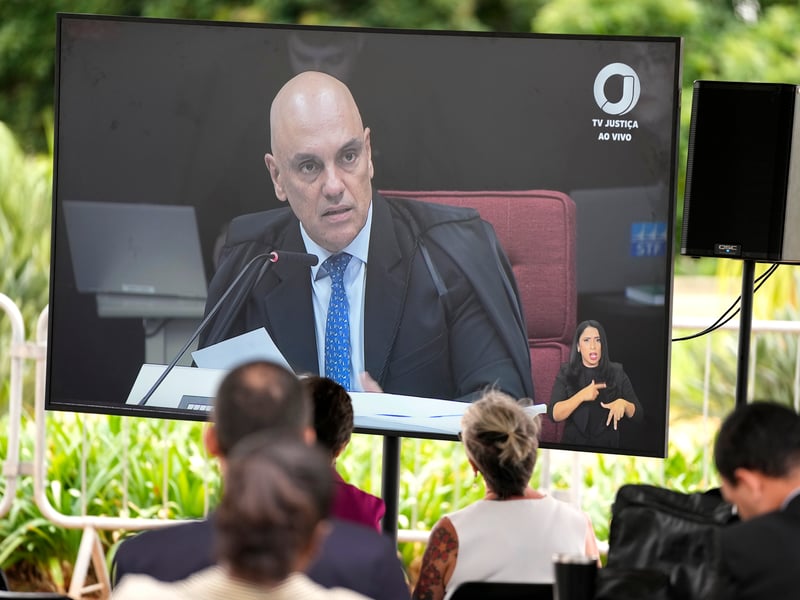
RIO DE JANEIRO (CN) — On a Monday morning last May, Matheus, a fourth-year student at the University of São Paulo Law School, stood in the hallway grumbling to a friend about his tax law class.
“I complained, ‘When does this damn class end?’ And right then a bald guy walked by, clearly heard it, and nodded at us,” Matheus said.
That “bald guy” was Alexandre de Moraes, a Supreme Court justice and one of Brazil’s most prominent judges.
“We have other famous professors. I’ve had classes with Justice [Ricardo] Lewandowski, for example, but no one is as famous as Alexandre de Moraes,” said Matheus, who is currently enrolled in a constitutional law course taught by the justice himself.
Since joining Brazil’s highest court in 2017, de Moraes has emerged as a central figure in the country’s ongoing democratic crisis — a period marked by rising political polarization, far-right attacks on institutions, and efforts by former President Jair Bolsonaro and his allies to undermine the legitimacy of the judiciary and the electoral system.
As rapporteur for sweeping investigations into digital militias, fake news and the Jan. 8, 2023, coup attempt, de Moraes has become both a symbol of institutional resilience and a lightning rod for controversy. Last year he temporarily banned Elon Musk’s X, formerly Twitter, in the country over the company’s failure to remove certain accounts. Musk eventually took them down and paid the fines de Moraes had imposed.
In 2022, he also presided over Brazil’s Superior Electoral Court during one of the most contentious elections since the country’s return to democracy.
Yet long before he took center stage in Brazilian politics and the country’s highest court, de Moraes was already famous among law students nationwide as the author of one of Brazil’s definitive textbooks on constitutional law. Understanding de Moraes through this academic lens offers important clues into his role today.
“If I had to sum up the philosophy of the current justice, I’d say he is a democrat and an enthusiast of the rule of law. He’s a doctrinal scholar of the constitution,” said Leopoldo Stefanno Leone Louveira, a criminal defense attorney with a master’s degree in criminal law from the University of São Paulo.
Matheus, the law student, agrees. “It seems to me he aligns with the idea of a stronger state presence, especially when it comes to fundamental rights. If more incisive intervention is necessary to protect fundamental rights and state sovereignty, he will always lean that way,” he said.
De Moraes was appointed to the Supreme Court in 2017 by then-President Michel Temer, filling a seat vacated by Justice Teori Zavascki, who was overseeing the Lava Jato corruption cases — the largest anti-corruption operation in Brazil’s history, uncovering billion-dollar bribery schemes involving construction companies, politicians and state-owned enterprises such as oil producer Petrobras.
By the time of his nomination, de Moraes already had an extensive public career, including roles in the São Paulo state government as public security secretary, as minister of justice in Temer’s administration and as the first jurist appointed by Brazil’s Chamber of Deputies to serve on the National Council of Justice.
At the time, his nomination drew resistance from part of the legal community and opposition groups wary of appointing someone closely connected to the government during a delicate moment in the Lava Jato investigation.
Felipe Recondo, co-founder of JOTA, a news platform focused on Brazil’s judiciary and politics, and author of several books about the Supreme Court, said that during de Moraes’ nomination process, critics argued he was too closely aligned with Temer’s administration.
During his first years on the court, de Moraes generally kept a low profile — though Recondo noted an exception early. In one of his very first plenary sessions, he intervened in the judgment of a Direct Action of Unconstitutionality — a legal challenge brought directly to the Supreme Court to strike down laws that supposedly violate the constitution — proposing a modulation of effects that the court’s majority ultimately accepted.
“Usually, new justices start more discreetly,” Recondo said.
It wasn’t until two years later, in 2019, that de Moraes truly stepped into the spotlight. At that time, the Supreme Court faced an onslaught of online threats and attacks involving disinformation campaigns and insults targeting justices. Dias Toffoli, the court’s then-president, invoked a rarely used internal rule allowing the court to launch investigations when directly attacked. Toffoli personally invited de Moraes to lead the inquiry.
The investigation broke with standard procedure: It wasn’t prompted by any external party, nor did it have clear limits. “De Moraes was given immense power to investigate fake news, a broad topic in a broad inquiry, without clearly defined boundaries or timelines,” Recondo said.
From that point on, the justice led a series of high-profile probes related to misinformation, funding of anti-democratic campaigns, networks aligned with former President Jair Bolsonaro, and eventually, the Jan. 8, 2023, coup attempt.
According to Lênio Streck, a professor at the University of Vale do Rio dos Sinos and a prominent expert on legal theory, nearly everything related to fake news, threats against the court or democracy itself became part of this inquiry.
“Everything is linked to this original inquiry, including the Jan. 8 attacks. That’s why all these people [who participated] are being prosecuted by the Supreme Court,” Streck said.
De Moraes’ role as head of the Superior Electoral Court, which oversees federal elections and enforces Brazil’s electoral laws, amplified his public visibility. During his tenure from 2022-23, he rejected multiple petitions to halt the runoff presidential vote, defended the reliability of Brazil’s electronic voting system, oversaw election integrity efforts and presided over President Luiz Inácio Lula da Silva’s official certification — becoming in the process a target of far-right extremists who questioned the election results.
From an institutional perspective, de Moraes’ approach consolidated a form of judicial authority unusual in Brazilian history. According to data from his office, by January 2024, he had already issued over 6,000 judicial decisions related to the Jan. 8 attack, including hundreds of arrest warrants, search and seizure orders, and requests for access to private communications.
This accumulation of power has raised criticism in legal circles and even among some of his colleagues, who privately question the amount of autonomy given to a single justice, the use of extraordinary judicial measures without involvement from public prosecutors and the sweeping nature of his unilateral decisions.
Streck, however, a fierce critic of judicial activism, argues that the Supreme Court’s recent actions reflect less activism and more a response to increased judicialization. “The Supreme Court doesn’t advertise itself, saying ‘please bring your cases here.’ It never acts on its own initiative, except in this unique 2019 investigation. The court has acted in what would be termed in Germany ‘defensive democracy,’ and Justice Alexandre de Moraes today represents a milestone in democracy’s resistance against its opponents,” Streck said.
According to Recondo, it is natural for some Supreme Court justices to become more prominent than others, depending on the issue and the historical moment. Brazil’s blurred lines between branches of government frequently place the court in the position of mediating political conflicts.
“This kind of negotiation exists and is sometimes necessary, but it can create problems for the court’s image, leading the public to view it as primarily political. It’s a permanent risk for the Supreme Court,” Recondo said.
To a certain extent, the tension between de Moraes as a legal scholar — respected academically and known for his commitment to the rule of law — and de Moraes the judge — seen by some as a centralizing, firm-handed figure occasionally accused of excess — reflects the broader contradictions facing Brazilian politics and institutions today. His trajectory is marked by his ability to navigate different worlds: academia, politics and high-impact judicial decision-making.
“As with any human being, he has contradictions. The justice must be cautious to ensure his own vanity doesn’t lead him into excess, risking becoming a dictator and precisely what democrats would hate him to become: someone arbitrary, disrespecting fundamental guarantees,” Louveira said.
Recondo and Streck emphasize that the Supreme Court imposes internal checks to prevent such excesses. “It’s a strong institution, larger than any single member,” Recondo said.
Yet Recondo warns against the tendency to portray de Moraes as a lone savior of Brazilian democracy. “We have this inclination to search for heroes, but this isn’t good for the country, nor the Supreme Court, nor de Moraes himself. Being a hero isn’t a judge’s role, and he isn’t seeking that. Once these investigations conclude, he’ll return to being a judge like any other member of the Supreme Court,” Recondo said.
De Moraes will also continue teaching at the University of São Paulo, where he was named a full professor of electoral law in 2024 after presenting a thesis titled “Electoral law and the new extremist digital populism: The voter’s freedom of choice and the promotion of democracy.”
Unlike his austere and imposing public persona — often compared by critics to fictional villains like Voldemort or a Sith Lord — he shows a lighter side in class.
“As much as possible, he’s approachable. He seems fully aware of what he represents politically, judicially and in the public imagination,” Matheus said. “He’s not stiff at all. He interacts with the class and makes jokes.”
One recent joke particularly captures the symbolism of his public stance at the Supreme Court.
“He said he doesn’t trust the Oscars because they use paper ballots. He said if voting were electronic, he’d trust it more — and the winner would have been Brazilian actress Fernanda Torres,” Matheus said.
Subscribe to our free newsletters
Our weekly newsletter Closing Arguments offers the latest about ongoing trials, major litigation and rulings in courthouses around the U.S. and the world, while the monthly Under the Lights dishes the legal dirt from Hollywood, sports, Big Tech and the arts.