
 Search Articles


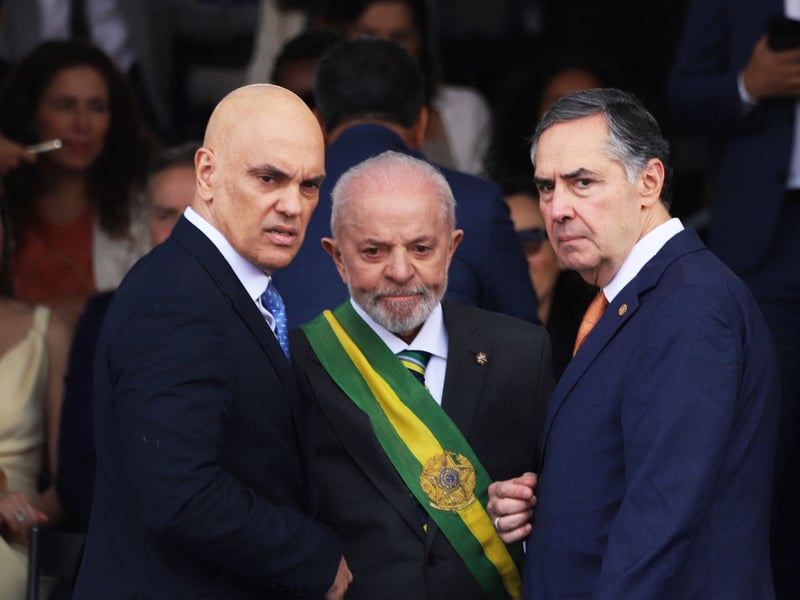
RIO DE JANEIRO (CN) — A constitutional standoff between Brazil’s three branches of government is unfolding over a presidential decree that raised a federal tax on financial transactions, with the president and lawmakers accusing each other of overreaching.
The measure on the IOF levy, issued by President Luiz Inácio Lula da Silva’s administration on May 22 to boost revenue and meet the government’s zero-deficit target for 2025, was swiftly overturned by Congress on June 25 in a 383-98 vote in the lower house. The Senate approved the repeal symbolically, without a roll call vote.
The constitutionality of the decree lies at the heart of the dispute, according to Tathiane dos Santos Piscitelli, an associate professor at the São Paulo Law School of Fundação Getulio Vargas.
While Brazil’s Constitution allows the executive to adjust IOF rates via decree — given the tax’s regulatory nature on credit, foreign exchange, insurance and other transactions — its use as a revenue-raising tool has triggered legal challenges over whether the president overstepped constitutional limits.
“Saying the IOF is meant to regulate economic, monetary or fiscal policy doesn’t erase the fact that, like any tax, it also raises revenue,” Piscitelli said.
She argues that the main legal issue stems from the decree’s expansion of the tax base to cover operations that were previously not taxed — a move that, in her view, can only be done through legislation.
Executive takes Congress to court
In response to the congressional repeal, the attorney general appealed to the Supreme Court on Tuesday. In an interview with TV Bahia, Lula called Congress’s decision “absurd” and said, “If I don’t go to the Supreme Court, I can’t govern the country.”
On Friday, Brazil’s Supreme Court temporarily suspended both the presidential decree and the congressional resolution that overturned it, restoring the tax framework to its previous state. Justice Alexandre de Moraes, the case’s rapporteur, called a conciliation hearing for July 15, summoning the presidents of the Republic, the Senate and the House, as well as representatives from the attorney general’s office and the solicitor general’s office.
The attorney general argues that the decree falls within the constitutional powers of the executive branch, given that the IOF is considered an extra-fiscal tax — one intended to allow swift interventions in credit and currency markets. The core of the government’s defense is that the changes were aimed at correcting distortions, aligning the tax system more coherently, and ensuring greater tax neutrality and fairness.
The Ministry of Finance maintains that because the IOF applies to sensitive areas of the economy — such as credit and foreign exchange — the ability to recalibrate it by decree is essential for timely responses to economic shifts.
The government also argues the decree sought to standardize the tax treatment of similar financial operations and address discrepancies that, according to its economic team, undermined the IOF’s regulatory logic. The changes included, for instance, aligning the taxation of credit operations by banks and credit unions, and bringing new types of financing — previously left untaxed due to regulatory inertia — under the tax’s scope.'
‘Intense pressure to cut spending’
Congress, however, contends that the decree lacked a regulatory purpose and was primarily aimed at raising revenue to meet the government’s goal of eliminating the fiscal deficit by 2025 — thereby exceeding the scope of executive authority. Lawmakers say it wasn’t intended to influence credit or foreign exchange markets, but to increase the tax burden, which in their view undermines the IOF’s extra-fiscal character and requires legislative approval.
They also flagged a more technical concern: The decree created new taxable events not previously covered under IOF rules. The most contentious point, according to the House, is the attempt to impose the tax on transactions not previously classified as credit operations by the Federal Revenue Service — such as reverse factoring transactions, known locally as “risco sacado,” and contributions to private pension products similar to U.S. variable annuities, known in Brazil as VGBL plans.
“The change was clearly made to shore up public finances at a time when the executive branch is under intense pressure from both Congress and the public to cut spending and balance the budget,” said Victor Hugo Scandalo Rocha, legal director at Destrava Brasil, a think tank focused on economic reform and fiscal responsibility.
Francisco Leocádio, a tax attorney, partner at SouzaOkawa Advogados and professor at the Pontifical Catholic University of São Paulo, warned that such abrupt shifts undermine legal certainty for businesses.
“Companies plan based on existing tax rules. When those rules change mid-game — or worse, flip back and forth depending on the courts — it creates an environment of deep legal insecurity,” he said.
Rocha added that the IOF has drifted from its regulatory role and now serves primarily as a source of revenue.
“Brazil’s tax system is in urgent need of structural reform,” he said. “But none of that will matter unless the government also addresses the spending side of the equation.” In his view, “the IOF is a small piece of the larger puzzle and can be applied more predictably and effectively when there is greater fiscal responsibility from public officials.”
Tax justice v. ‘disastrous strategy’
Denise Lobato Gentil, an economics professor at the Federal University of Rio de Janeiro, pointed to past examples of the IOF’s regulatory use, particularly in credit and foreign exchange operations where it has served to manage speculative capital flows.
“In 2011, for instance, the government raised the IOF on foreign capital inflows to curb an excessive appreciation of the Brazilian real,” she said. “Or during economic crises, like in 2008–2009 and the Covid-19 pandemic, when the government slashed the IOF rate to encourage consumer credit.”
According to Gentil, the IOF case has given momentum to the broader debate over using taxation as a tool for income redistribution — a narrative the government has recently amplified through social media campaigns calling for higher taxes on the super-rich.
Gentil argues, however, that because the IOF is an indirect tax that doesn’t differentiate between taxpayers, it fails to promote tax justice and effectively amounts to a sharp hike in interest rates.
“It’s an outright disastrous strategy,” she said. “Raising the IOF directly increases the cost of credit. It hits the middle class, microentrepreneurs, small business owners who rely on short-term loans, and low-income workers who live on credit.”
She believes the government’s push for tax fairness should focus primarily on revisiting income tax exemptions for those earning up to $1,000 a month.
More broadly, she criticized the spending cap imposed by Brazil’s fiscal framework as the real driver of economic inequality and sluggish growth. “It’s the fiscal framework that’s leaving low-income people unprotected by capping spending growth at 2.5% a year,” she said.
Rocha said the government’s decision to challenge Congress in court only exposes the deep rift between the executive and legislative branches.
Piscitelli described the situation as “politically delicate” and said the court should take a strictly legal approach, focusing on the limits of presidential authority under the Constitution.
She also noted that the court’s ruling could have significant real-world consequences: A finding of unconstitutionality could pave the way for taxpayers to reclaim money already paid. If upheld, the decree would remain in force, and Congress would suffer a political setback.
The conciliation hearing scheduled for July 15 will serve as the next institutional stress test. Until then, the IOF’s future remains in limbo.
Subscribe to our free newsletters
Our weekly newsletter Closing Arguments offers the latest about ongoing trials, major litigation and rulings in courthouses around the U.S. and the world, while the monthly Under the Lights dishes the legal dirt from Hollywood, sports, Big Tech and the arts.