
 Search Articles


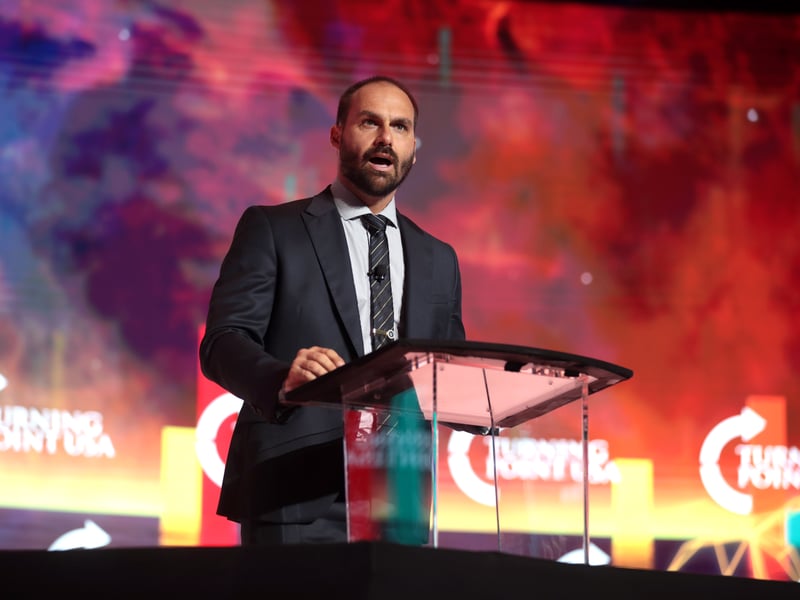
RIO DE JANEIRO (CN) — Brazil’s Supreme Court has opened a criminal inquiry into Congressman Eduardo Bolsonaro, son of former President Jair Bolsonaro, over accusations that he sought to obstruct justice by lobbying American authorities to sanction a sitting Supreme Court justice.
The inquiry was authorized late Monday by Justice Alexandre de Moraes, who is both the target of Bolsonaro’s international campaign and the judge overseeing the ongoing criminal case against Jair Bolsonaro for his alleged role in a failed coup attempt.
Eduardo Bolsonaro, who took a leave of absence from Congress in March, has been based in Florida, where he has held meetings with Republican lawmakers and appeared at events organized by Donald Trump allies. He has positioned himself as a leading voice in the international defense of his father, framing the Brazilian investigations as political persecution and calling Moraes an authoritarian.
According to the request filed by Prosecutor General Paulo Gonet, Bolsonaro’s actions in the United States — including meetings with lawmakers, speeches at conservative events and public statements urging sanctions against Moraes — amount to an effort to intimidate investigators and interfere in the judicial process.
The charges under consideration include obstruction of justice, coercion in the course of judicial proceedings and violent abolition of the democratic rule of law, the same offense for which his father is currently on trial.
Gonet had previously rejected a request to open an investigation but reversed his position after recent comments by the U.S. Secretary of State Marco Rubio, who acknowledged that sanctions against Moraes were being considered. According to Brazilian media, the remarks were seen as evidence that Bolsonaro’s lobbying was having concrete diplomatic consequences, not just rhetorical impact.
In the petition, Gonet wrote that Bolsonaro “demonstrates a clear intention to interfere, through threats, with the full functioning of constitutional powers,” describing the campaign as a grave act of interference in the regular exercise of judicial, police and prosecutorial duties.
Gonet also asked that Lindbergh Farias, a congressman from President Luiz Inácio Lula da Silva’s Workers’ Party who filed a related complaint earlier this year, and Brazilian diplomats based in the United States be called to testify during the investigation.
In response, Bolsonaro accused the Prosecutor General’s Office of acting politically, claiming that the justice system “depends on the client” and “on political events.” He defended his lobbying campaign as part of a broader effort to “defend the freedoms of Brazilians,” something he said is “almost impossible to do in Brazil today.”
According to Gabriela Rollemberg — a lawyer, political scientist and cofounder of Brazil’s Electoral and Political Law Academy — the inquiry does not imply guilt but opens the way for further procedural steps.
Prosecutors must first complete the inquiry, then file and have a formal complaint accepted before a criminal case can proceed. Only after a trial and a final conviction could Bolsonaro lose his seat, since criminal convictions result in the suspension of political rights.
“The timeline will depend heavily on him, whether he cooperates with the investigation or tries to avoid testifying,” Rollemberg said, adding that she finds it unlikely the case will reach a final ruling before the end of his current term in 2026.
Rollemberg described the situation as legally and politically complex. “If no action is taken, it risks allowing someone to carry out maneuvers and take steps that are not legal,” she said. “But at the same time, this process can strengthen Bolsonaro’s narrative by giving him exactly what he wants: a platform to draw attention to his cause.”
Subscribe to our free newsletters
Our weekly newsletter Closing Arguments offers the latest about ongoing trials, major litigation and rulings in courthouses around the U.S. and the world, while the monthly Under the Lights dishes the legal dirt from Hollywood, sports, Big Tech and the arts.