
 Search Articles


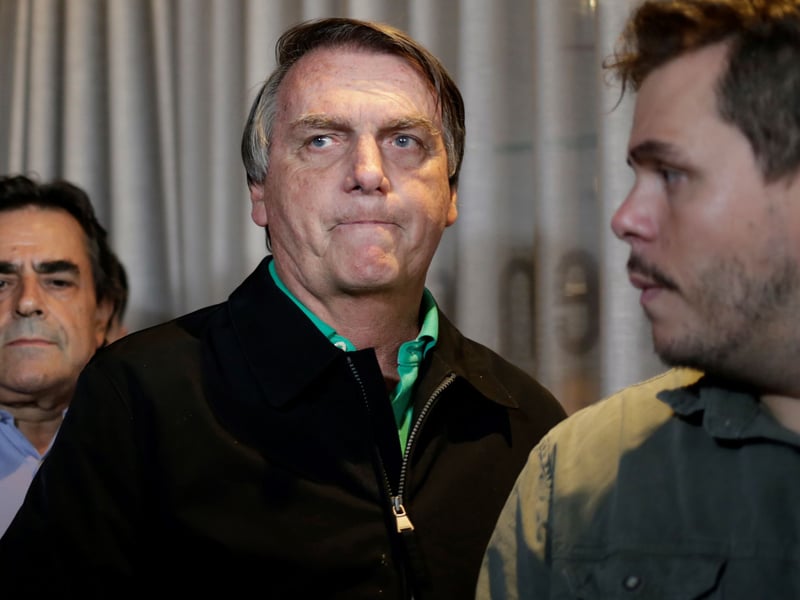
RIO DE JANEIRO — Nearly two years after thousands of supporters of former President Jair Bolsonaro stormed Brazil’s National Congress, the presidential palace and the Supreme Court, the country is edging closer to directly linking the right-wing nationalist Bolsonaro to the Jan. 8, 2023, events.
The attack, strikingly similar to the Jan. 6, 2021, Capitol attack in the United States, caused about $3.5 million in damage — most of it at the court.
Bolsonaro, a vocal supporter of U.S. President-elect Donald Trump, is already banned from running for office until 2030. Now, the attorney general’s office must analyze police documents accusing him of taking part in planning a coup and decide whether to file charges with the Supreme Court.
Often described as far-right, Bolsonaro embraced conservative social values and a combative style mirroring Trump’s tactics. He frequently questioned established institutions and voiced skepticism of electoral systems. During the Covid-19 pandemic, he downplayed the disease, opposed lockdowns, promoted unproven treatments, and ultimately refused vaccination.
In late November, the Federal Police released an investigation accusing 37 people, including Bolsonaro, of attempted coup and criminal conspiracy. On Dec. 14, the Federal Police arrested General Braga Netto — Bolsonaro’s former defense minister and vice-presidential candidate — on charges of interfering in the investigations.
Police say they uncovered a draft of a coup plan involving the assassination of key government figures, including then-President-elect Luiz Inácio Lula da Silva and Supreme Court Justice Alexandre de Moraes. Investigators also concluded that Bolsonaro and his allies played a central role in the Jan. 8 acts of vandalism.
“At the time, viewed in isolation, the event didn’t appear to have the capacity to overthrow the government, so for many people, it came across less as a coup attempt and more as a clumsy effort to mimic the American case,” said Rodrigo Stumpf González, a political science professor at the Universidade Federal do Rio Grande do Sul. However, he believes it is now possible to view the episode as part of a broader sequence of events aimed at creating unrest to justify a coup.
The Joint Parliamentary Commission of Inquiry, which met from May through October 2023, came to similar conclusions. Bringing together 32 senators and 32 deputies to investigate the Jan. 8 episode, the commission wrote in its 1,755-page report that the attack “was not a spontaneous or disorganized movement. The idea was to make it possible to declare a state of siege, or impose another legal instrument that would produce similar effects.” In that document, 61 people were recommended for indictment, including Bolsonaro and 10 others named a year later by the Federal Police.
González traces the start of the supposed coup plot to July 18, 2022, when Bolsonaro hosted ambassadors from different countries and openly questioned the security of electronic voting machines, making unfounded criticisms of the Brazilian electoral system.
The next stage, González said, was the establishment of pro-Bolsonaro camps in front of military barracks nationwide following Lula’s election on Oct. 30, 2022. In Brasília, supporters gathered outside the army headquarters.
Military intervention
For political science professor Mayra Goulart, from the Universidade Federal do Rio de Janeiro, the role of the military distinguished Brazil’s crisis from that in the United States.
“Since the Paraguayan War, Brazil has maintained a tradition of military protagonism in domestic politics,” she said.
The Paraguayan War of 1864-70 saw a fight over territory between Paraguay and the alliance of the then-Empire of Brazil, Argentina and Uruguay. The alliance won, giving the Brazilian army a confidence boost and contributing to a moment some historians see as more of a military coup that kicked off the Brazilian Republic.
Goulart added that the military formed the basis of Bolsonaro’s electoral rise and had financial interests in his leadership. She believes this deeper involvement justified the more forceful response by Brazilian institutions compared to the U.S.
“Here the risk was greater than in the United States, as Brazil has a tradition of military coups,” she said, adding that the country is still very dependent on political authorities to protect the rule of law.
One day after the Jan. 8 attacks, the Federal Police arrested 2,151 people, releasing 745 after identification and granting provisional freedom to 884. By Nov. 8, 2024, 741 defendants had already been held criminally responsible.
In June 2023, the Superior Electoral Court convicted Bolsonaro for abuse of power and misuse of the media, focusing on the same meeting with ambassadors. The ruling rendered him ineligible to run for office through the end of the decade.
“Democracy in Brazil is younger than in America, but it has provided a more effective solution to those responsible than what we’ve seen in the United States,” said Carlos Pereira, a political science professor at Fundação Getúlio Vargas and author of “Por que a democracia brasileira não morreu?” or “Why hasn’t Brazilian democracy died?” published in June.
Meanwhile, Jefferson Rodrigues Barbosa, a political science professor at Universidade Estadual Paulista in Marília and author of “Extremismo Políticos e Direitas, Bolsonaro, Trump e a Crise das Democracias” (“Political Extremism and the Right: Bolsonaro, Trump, and the Crisis of Democracies”), published in 2022, argued that the punishments are “moving slowly and very mildly given the gravity of what happened.”
Scott Mainwaring, a political science professor at the University of Notre Dame who studies Latin American politics, questioned what he described as excessive interventionism by some Brazilian judges. “Although I generally agree with the decisions, I believe that by American standards, these are behaviors that exceed what is appropriate and could be a problem if they become the norm,” he said.
At the same time, he faulted the U.S. system for a “very, very slow response,” noting that “most of the criminal cases against Donald Trump never went to trial,” partly, in his view, because the U.S. Supreme Court helped protect him.
Brazilian courts’ response to the Jan. 8 attacks has stirred debate over possible judicial overreach. Many of the more than 2,000 people who were arrested shortly afterward face charges that could lead to extended prison terms. Most rioters have been charged with vandalism or conspiracy to undermine democratic institutions, with sentences varying based on the degree of involvement — from monetary penalties or probation-like conditions for lesser offenses to potential prison time for more serious charges. As investigations continue to uncover alleged coup plots, prosecutors have also weighed more severe offenses against those suspected of orchestrating or financing the unrest.
Observers note the prominent roles of the Supreme Federal Court (STF) and the Supreme Electoral Court (TSE) — then led by Justice Alexandre de Moraes — in both criminal and electoral matters, an approach supporters say is warranted by Brazil’s history of coups but critics contend risks infringing due process. Unlike the decentralized U.S. system, where courts at various levels handle election disputes, Brazil’s TSE draws judges from its highest courts, consolidating authority in a single body.
González acknowledged that at the time of the attacks, the Brazilian judiciary “seemed to act excessively,” but considered the Supreme Court the “guarantor of the transition process,” necessary to ensure order.
“Unlike the United States, where the office itself has a sense of value and is almost sacred, in Brazil it is very easy to replace presidents,” he said. “Political institutions have a low level of credibility; people trust the president personally, not the presidency.”
If charged and convicted, Bolsonaro could face up to 28 years in prison; that maximum might jump to 70 if charges involving vaccination card fraud, the illegal sale of jewelry received from Saudi Arabia and unauthorized surveillance of authorities are combined.
González, however, thinks imprisonment is unlikely. “The process could drag on, and Bolsonaro has certain advantages — including his age — that make prison less likely. In the end, it’s more probable this will end his political career than land him in jail,” he said.
Despite the legal pressures, analysts believe Bolsonarismo — a political movement marked by nationalism, social conservatism and anti-establishment rhetoric — remains a significant political force, and they do not rule out further attempts to target government institutions.
The most recent of these incidents took place on Nov. 13, when a suicide bombing at the landmark Praça dos Três Poderes in Brasília claimed only the life of its perpetrator — a city council candidate from Bolsonaro’s party.
“We are not and have never been free from coup attempts. Even though Brazil had a few years of relative democratic stability, the idea of a coup is always in the air,” González said.
Pereira remains somewhat optimistic: “Will we be free from coup attempts and autocrats? No. But we are sure that if attempts come, we will be ready.”
Subscribe to our free newsletters
Our weekly newsletter Closing Arguments offers the latest about ongoing trials, major litigation and rulings in courthouses around the U.S. and the world, while the monthly Under the Lights dishes the legal dirt from Hollywood, sports, Big Tech and the arts.