
 Search Articles


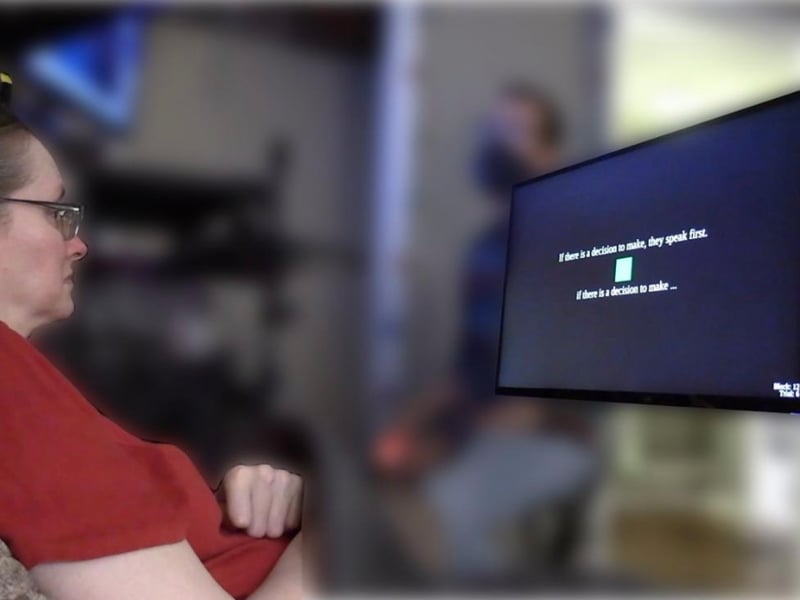
(CN) — Brain-computer interfaces that connect the brain’s electrical activity with an external device have been able to help those with cognitive or motor impediments — including, researchers now say, by giving back a voice to those who aren’t able to speak audibly.
Stanford University researchers, in a study published Thursday in the journal Cell, investigated the ability to decode attempted speech for impaired individuals with one such brain-computer interface, or BCI, designed to interpret a person’s unsaid thoughts into written language.
“We wanted to know whether a BCI could work based only on neural activity evoked by imagined speech, as opposed to attempts to physically produce speech,” Frank Willett, a co-author of the study and the co-director of Stanford’s Neural Prosthetics Translational Laboratory said in an email.
The researchers studied four disabled people — diagnosed with amyotrophic lateral sclerosis, also known as ALS, or experienced a brainstem stroke — using micro-electrode arrays around their heads where the brain activates motor skills.
“We found that inner speech evoked clear and robust patterns of activity in these brain regions,” said Willett. “These patterns appeared to be a similar, but smaller, version of the activity patterns evoked by attempted speech. This gives us hope that future systems could restore fluent, rapid and comfortable speech to people with paralysis via inner speech alone.”
The decoding of inner speech is currently 74% accurate, according to the researchers — not quite at the threshold of deciphering attempted speech, but Willet and his co-authors are confident that with advancing technology the percentage will continue to increase.
However, this may raise some questions about privacy and what people may and may not want others to know.
“The existence of inner speech in motor regions of the brain raises the possibility that it could accidentally ‘leak out,’ in other words, a BCI could end up decoding something the user intended only to think, not to say aloud,” Willett said. “While this might cause unintended output in current BCI systems designed to decode attempted speech, BCIs do not yet have the resolution and fidelity needed to accurately decode unconstrained inner speech, so this would probably just result in garbled output.”
Additionally, the patterns in neural activity between inner and attempted speech were different enough during the study it may be possible to distinguish between the two and instruct BCIs to disregard inner speech, if the participant doesn’t want their inner monologue known.
Willett and the research team are continuing to address the privacy concerns for the next generation of BCIs by using a password-protection system — where only when a person thinks a certain word or phrase, with Willet giving the example of “as above, so below,” or another a rare phrase that would not otherwise be accidentally imagined, the BCI will start to decode the following inner speech.
“We are also interested in exploring brain regions outside of the motor cortex which might contain higher-fidelity information about imagined speech,” he said. The regions Willett refers to are traditionally associated with language and hearing.
And in the future the BCI system could be wireless and implanted, with more reliability and accuracy. The hardware, according to Willett, could be available in the next few years.
Subscribe to our free newsletters
Our weekly newsletter Closing Arguments offers the latest about ongoing trials, major litigation and rulings in courthouses around the U.S. and the world, while the monthly Under the Lights dishes the legal dirt from Hollywood, sports, Big Tech and the arts.