
 Search Articles


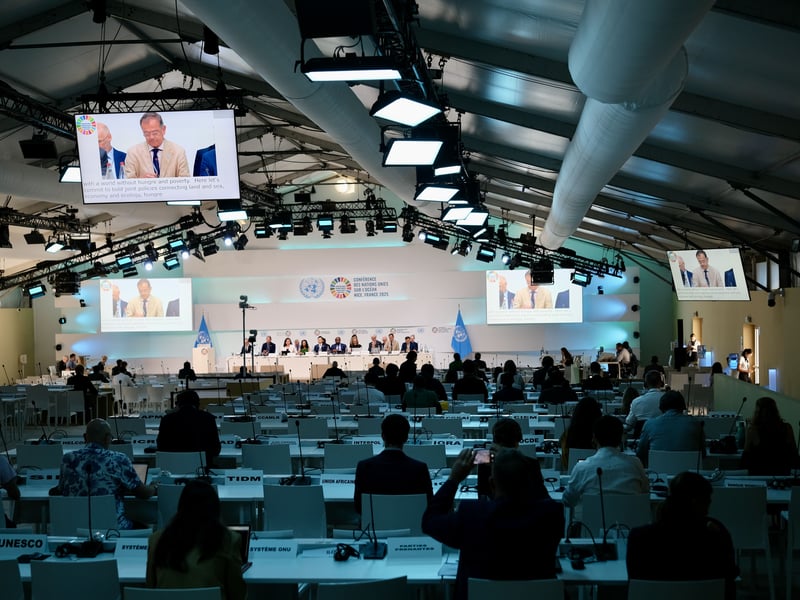
NICE, France (CN) — The future of blue foods surged to the forefront of the discussion this week at the U.N. Ocean Conference in Nice, the largest ever of its kind, uniting 15,000 heads of state, delegates and scientists on the Mediterranean.
“The issue of malnutrition is something we should address,” Paubert Mahatante, the minister for fisheries and the blue economy of Madagascar, said in a panel on Wednesday. “We think and believe that as long as we exchange knowledge, we share experiences, and we try to find a common vision on how to tackle this issue through aquatic blue foods, I think we can improve the situation in Madagascar, Africa and across the globe.”
Across the world, over 3 billion people need blue foods — like fish, seafood and seaweed — for essential nutrition. The cultivation of these foods affects the livelihoods of roughly 11% of the world’s population. And, especially for developing countries and coastal communities, independent access to blue foods can serve as a buffer against risks to food supply and insecurity.
Although the topic was constantly on the table at the conference in Nice, governments and organizations were short on details about how to sustainably increase blue food production on a big scale. But experts say the sector hasn’t reached its full potential, and a recent shift in thinking might require more time to fully take hold.
“Demand for blue foods is expected to double in the next 25 to 30 years,” Beth Polidoro, a research director at the Marine Stewardship Council, told Courthouse News. “Meeting this future demand will depend on the continued development of sustainable aquaculture and sustainably certified wild-caught fisheries.”

On the terrace of a café near the venue site, on Nice’s harbor, Laura Gabriele Elsler, a research associate at Harvard’s T.H. Chan School of Public Health, explained that there’s been a recent paradigm shift in how experts address the potential of seafoods.
“For a long period of time, fisheries were just a contribution to GDP, and now there’s a shift in thinking towards how fisheries contribute to human health and nutrition,” she said while sipping an espresso. “Generally speaking, the richness of micronutrients and nutrients more generally in aquatic species tends to be much higher than in terrestrial meats — so if we’re only talking protein, then the difference is not so extreme, but the human body and physiology depends on much more than only proteins.”
Blue foods are rich in vitamins like B12, omega-3s, zinc and iron — among an array of other beneficial nutrients. Laura Anderson, a project manager at Stanford’s Center for Ocean Studies, told Courthouse News that one study from the Blue Food Assessment estimated that increasing the sustainable production of these species by just 8% could prevent 166 million micronutrient deficiencies in the next five years.

And the case for food security is clear after the recent global case study of the Covid pandemic. When trade networks shut down, having independent access to key food sources was, and will be, vital.
“The fisheries minister of Sierra Leone, for example, was saying [on Wednesday] that without fisheries there would have been so much suffering during Covid in Sierra Leone, because all of a sudden, they were not provided with what’s been previously coming in through imports, a lot of that had stopped,” Elsler said. “They were very lucky in a way to have that capacity to be able to address their immediate food needs, because that’s a bit the point — we don’t realize how fragile humans are.”
Elsler, who researches international trade systems around food supply, said that although we’re hyper dependent on these systems, we’re not entirely sure of how stable they are.
“I think Covid was a bit of a wake-up call for understanding, that there’s a great value in keeping production systems small and localized to be able to sustain themselves, just to have a buffer as well,” she said.
One of the solutions to boost cultivation is the further development of aquaculture, which is the raising or growing of water-based foods, on both small and large scales. But there are still big challenges.
“In aquaculture, certain operations have destroyed habitats, caused water pollution, and used large quantities of wild fish for feed, which isn’t sustainable in the long run,” Anderson said. “There’s huge potential in blue foods, but it really depends on how they are managed; if done poorly, blue food production can cause serious environmental harm … Right now, about one-third of marine fisheries are overfished, and some fishing practices can damage ecosystems, contribute to climate change, or harm marine life.”

Some countries have announced action plans to include more blue foods specifically in their state-sponsored programs for children. In an action panel on Friday morning devoted to the topic, delegates from both Mexico and Indonesia announced they’d begin integrating more of these foods into their school lunch programs.
The U.N.’s Food and Agriculture Organization has also been working on including more fish in school programs, according to Anderson, which has helped to boost kids’ nutrition. But creating global frameworks remains tricky.
“We’ve also seen that we are relatively slow when it comes to legislation; there are many countries that are discussing together that need to come all in agreement … Often these are mostly around high sea stocks or fish that are migrating — fish don’t respect the borders that we tend to draw over our oceans,” Elsler said. “So you will always have to have a lot of collaboration, and we’re seeing that from the local scale all the way up to the international scale.”
 Follow @lilyradz
Subscribe to our free newsletters
Our weekly newsletter Closing Arguments offers the latest about ongoing trials, major litigation and rulings in courthouses around the U.S. and the world, while the monthly Under the Lights dishes the legal dirt from Hollywood, sports, Big Tech and the arts.