
 Search Articles


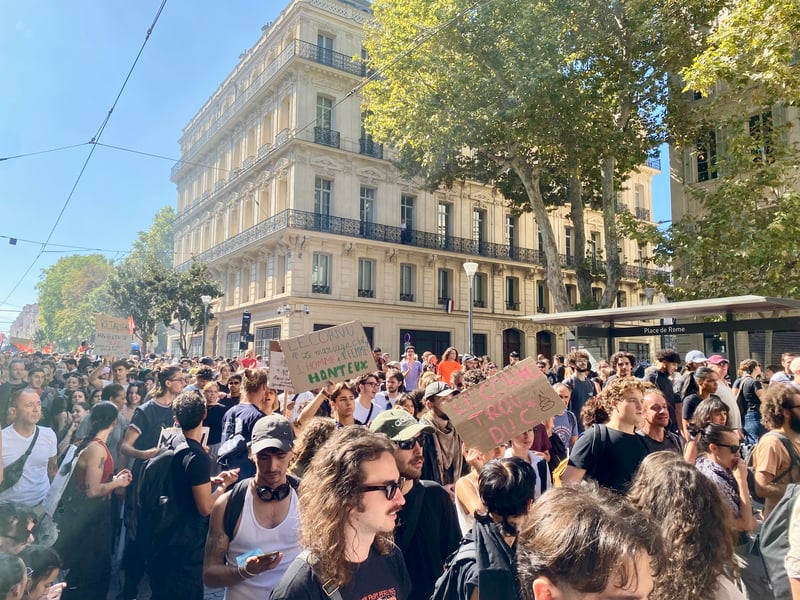
MARSEILLE, France (CN) — On Wednesday morning, one man whistled the tune to “Bella Ciao” — the Italian resistance anthem — as he strolled past riot police wielding shields and armor under the Marseille sun.
A few steps away, thousands of demonstrators marched through the city as part of the “Block Everything” movement, which has no centralized leadership and gained momentum on social media throughout the summer amid growing anger toward the French government.
Initially, “Bloquons tout” was largely aimed at François Bayrou, the prime minister who was ousted in a confidence vote on Monday. But his departure didn’t deter demonstrators — Wednesday’s movement revealed a broader anger with President Emmanuel Macron and Sébastien Lecornu, Bayrou’s replacement.
In the shadow of the central Réformés Canebière church, the meeting point of the demonstration, Martine Dupuy — the departmental secretary and spokesperson for the far-left Worker’s Party — was handing out leaflets titled “Bayrou left, all of his anti-worker reforms and projects should leave with him!”
“Bayrou resigned, but his plan still exists,” Dupuy told Courthouse News. “Lecornu, who was the minister of the armed forces, became prime minister, so it’s evident that this plan will continue to be implemented.”
The budget was the final nail in the coffin for Bayrou, whose fiscal proposals included scrapping two public holidays and cutting public sector hiring, which fired up both ends of the political spectrum.
The Worker’s Party is calling for a general strike and complete overthrow of France’s current political regime. It aims to bring together workers and young people, “all those who are exploited” in Dupuy’s words, and fight to end capitalism and implement a socialist workers’ government.
“A sovereign constituent assembly of people’s delegates who will make decisions,” she said. “All political parties remain prisoners of the Fifth Republic.”
Throughout the demonstration, numerous chants — including “Macron resign!” and “We are all children of Gaza!” — rang through the streets. Whenever the CRS — the police force deployed for crowd and riot control — walked alongside protesters, participants chanted, “Everyone hates the police!”
The government has deployed over 80,000 officers nationwide to suppress the protests. There were numerous clashes between demonstrators and police in the capital; tear gas was deployed outside of the Gare du Nord — the busiest train station in Europe — which was evacuated, prompting serious traffic disruptions. Officers stopped roughly 1,000 protesters from forcing their way into the station.
Videos circulating on social media also show police charging crowds in other areas of the city.
Sometimes in France, black blocs — the noncentralized, anarchist group of protesters — attend protests with the intent of clashing with police and destroying infrastructure.
On Wednesday, one man, a 77-year-old former doctor who asked not to be named, was holding a cane as he marched in Marseille. He told Courthouse News that he has been an activist for decades as the cortege moved up a hill.
“I have 50 years of anger … If I was 20 years old, I would be a black bloc — that’s my position,” he said. “My hopes are that young people continue.”
By 1 p.m., over 200 arrests had been made while Lecornu was at the Hôtel de Matignon, the prime minister’s residence in Paris, to begin the transfer of power ceremony. The number of arrests has been growing since then.
In Marseille, one demonstrator held a cardboard sign that said “Lecornu trou du cul,” meaning “Lecornu asshole." The new prime minister — a Macron loyalist, and the only minister who has remained in his government since he became president — comes from a right-wing background, which has fueled many voters’ frustrations.
Despite the left-wing New Popular Front winning the most seats in 2024’s snap legislative elections, Macron has yet to appoint a leftist leader for the role. Some feel the president isn’t listening to the voice of the people and continues to select the same type of politician despite months of political chaos and numerous government collapses.
One protester, who asked not to be named, said she hoped for one thing: “Change.”
“I feel less alone going to events whose goals I share, even though I’m retired,” she told Courthouse News. “Since I’m quite old, I’m mostly thinking about the next generation, about young people, more than myself.”
It’s unclear whether ‘Block Everything’ will gain similar momentum to the Yellow Vest movement, which began in October 2018 and saw months of protests. Although the movements echo each other — both were catalyzed by ordinary people on social media — Olivier Costa, a political scientist and director at the Center for Political Research at Sciences Po, told Courthouse News that this movement risks alienating right-wing voters.
While the extreme-right National Rally, known as RN, largely appropriated the Yellow Vest protests, Costa argues that this time, the extreme-left France Unbowed is trying to rally support behind it.
“The difference this time is that the far left, particularly France Unbowed, tried to co-opt the movement, telling themselves that they had missed [an opportunity] at the time of the Yellow Vests and that it was a mistake,” he said. “And in my opinion, that’s going to be a limitation of this movement because a lot of people who might have demonstrated aren’t going to because they don’t want to play into the hands of that party.”
 Follow @lilyradz
Subscribe to our free newsletters
Our weekly newsletter Closing Arguments offers the latest about ongoing trials, major litigation and rulings in courthouses around the U.S. and the world, while the monthly Under the Lights dishes the legal dirt from Hollywood, sports, Big Tech and the arts.