Search Articles


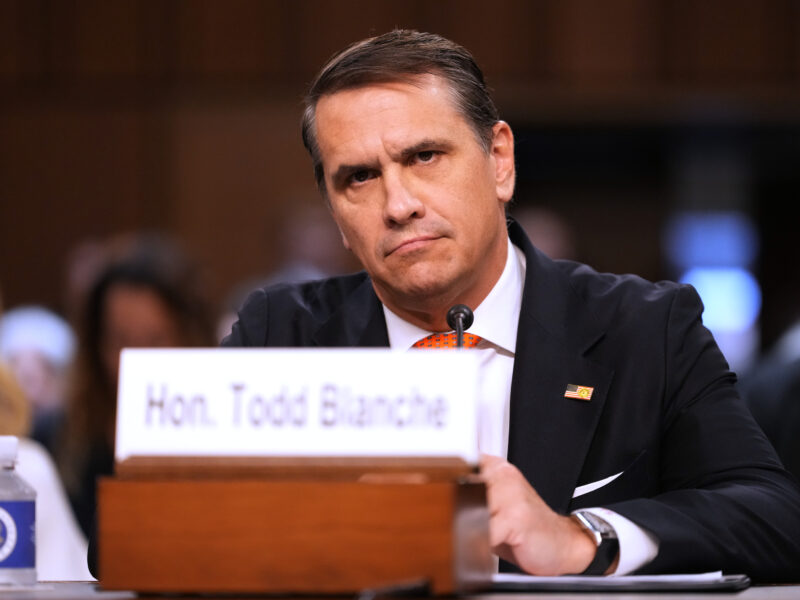
WASHINGTON (CN) — Todd Blanche on Wednesday embarked on a crucial step toward becoming President Donald Trump’s next attorney general as he sought to sway the Senate Judiciary Committee and win over a group of key Republican lawmakers skeptical of his leadership.
But it was an uphill battle from the start for Blanche — deputy attorney general and the Justice Department’s acting head since the spring — as Democrats dialed in on his loyalty to the president, his oversight of a controversial government slush fund and his handling of the Jeffrey Epstein files.
As he entered the cavernous Judiciary Committee chamber Wednesday morning for what promised to be an hourslong hearing, Blanche had his work cut out for him. The former federal prosecutor and member of Trump’s personal legal team riled lawmakers on both sides of the aisle in recent weeks, and some Republicans on the powerful Senate panel have yet to commit to supporting his nomination.
Addressing the committee in an opening statement, Blanche staked out a largely nonpartisan position as he focused on the Justice Department’s safety record and appealed to both Democrats and Republicans on the dais.
“Seventeen months ago, I sat at this table as the nominee to be the deputy attorney general and I told you that serving in the Department of Justice was my American dream,” he told lawmakers. “Since then, I have helped lead it, first as deputy and now as acting attorney general. I’m here today to earn your trust once more.”
Blanche also acknowledged that there were “fair questions” from members of the committee about “the hard debates of the past year.”
Some of those debates reared their heads almost immediately Wednesday morning.
The attorney general nominee sparred with Illinois Senator Dick Durbin, the top Democrat on the Judiciary Committee, over his handling of the Epstein files and their congressionally mandated publication by the Justice Department. The agency has faced bipartisan criticism for several redaction errors in the Epstein documents that revealed images and names of victims.
Blanche, for his part, took responsibility for redaction issues. “There were mistakes that were made,” he told Durbin, adding that around 1% of redactions in the published Epstein files needed to be fixed and the Justice Department “immediately” fixed errors.
“That doesn’t excuse the mistakes, for which I take responsibility, but it does mean that we tried to fix them,” said the attorney general nominee.
Blanche added that if the Justice Department learned of individuals named in the Epstein documents whom it could investigate, indict and prosecute, “you better believe we will.” But he stopped short of committing to meeting personally with survivors of the late financier and convicted sex offender, telling the Judiciary Committee he was legally prohibited from doing so and offering a deputy for the job.
Though the Epstein files were a hot topic for Democrats, Blanche faced even tougher questioning from committee Republicans concerned about the Justice Department’s moribund “anti-weaponization” fund established in the wake of Trump’s May settlement with the Internal Revenue Service.
The acting attorney general earlier this summer dismantled the $1.8 billion slush fund — designed as an avenue for people believed to be victims of “government weaponization” to seek restitution from the Justice Department — after significant backlash, particularly from some Senate Republicans who worried the fund could be used to award people convicted of violent crimes.
But while Blanche has long insisted that the weaponization fund is dead, some lawmakers remain concerned that Trump could reanimate the program.
Questioning the attorney general nominee on Wednesday morning, Texas Senator John Cornyn pointed out neither Blanche nor the president formally rescinded the weaponization fund. He cited language from Trump’s settlement with the IRS which he argued could allow him or other plaintiffs in the case to revive the program through a future lawsuit.
Blanche, however, denied such a possibility.
“I suppose they could bring a lawsuit, and we would litigate it,” the nominee told Cornyn. “But even if we were litigating it, there’s no fund and the results of such litigation would not be the revival of the fund.”
The Texas senator, who has said he remains undecided on Blanche’s nomination and has put the weaponization fund at the center of his concerns, did not appear convinced by the acting attorney general’s explanation.
“The president of the United States, who was a plaintiff in this lawsuit, has not agreed in writing to delete the weaponization fund, and there’s no guarantee that he or one of the other plaintiffs might raise that issue by way of a breach of contract lawsuit in the future,” Cornyn said.
Blanche, meanwhile, also defended the terms of Trump’s IRS settlement, which emerged from the leak of his tax returns in 2019. A memo attached to the settlement precluded the government from opening any new investigations into the president’s tax returns or those of his family or businesses.
The nominee told Durbin that while the circumstances of the tax information leak were novel, the block on future probes was not.
“I think President Trump and his family are the first that had their tax returns taken illegally,” he said. “That is unique to President Trump — but this type of settlement is not unique to the Justice Department or the IRS.”
A Florida federal judge scrapped the entire IRS settlement Monday, writing in a scathing opinion that executive agencies had engaged in “collusive” behavior to secure legal immunity for Trump and create the $1.8 billion fund. Blanche told Durbin during a private meeting on Tuesday that he thought the ruling was a “hit job.”
As of Wednesday morning, Blanche continued to answer questions from lawmakers on the Senate Judiciary Committee. The process could last hours — each senator on the panel has 10 minutes to grill the attorney general nominee.
Blanche can’t afford to lose any Republican votes on the Judiciary Committee. In addition to Cornyn, North Carolina Senator Thom Tillis has also signaled skepticism about the nominee.
 Follow @BenjaminSWeiss
Subscribe to our free newsletters
Our weekly newsletter Closing Arguments offers the latest about ongoing trials, major litigation and rulings in courthouses around the U.S. and the world, while the monthly Under the Lights dishes the legal dirt from Hollywood, sports, Big Tech and the arts.