
 Search Articles


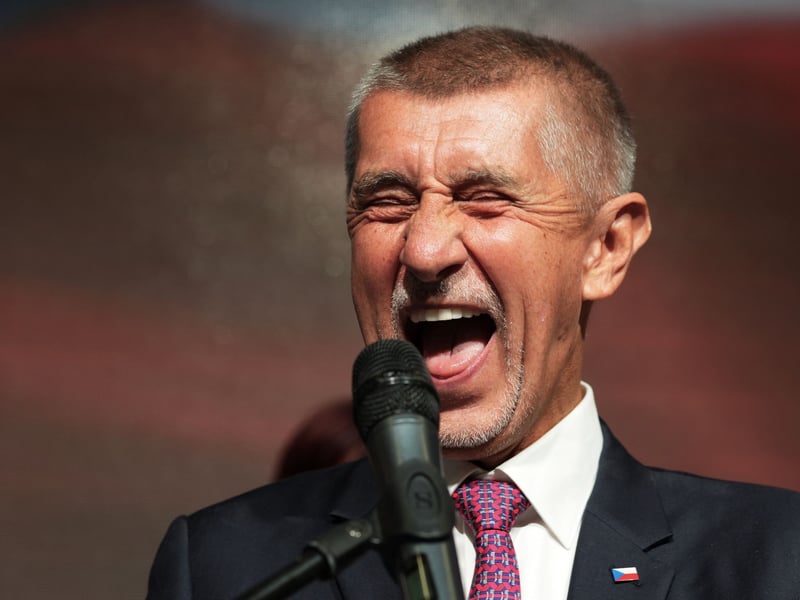
(CN) — Andrej Babiš, a former Czech prime minister and tycoon often likened to U.S. President Donald Trump and Italy’s Silvio Berlusconi, is back.
After a high-turnout parliamentary election this weekend in the Czech Republic, Babiš proclaimed his win “the pinnacle of my career” and now faces the task of forming a government — possibly a minority one — that could reshape Czech politics and rattle Brussels.
His victory returns one of Europe’s most controversial populists to power, reviving questions about corruption, conflicts of interest, and the stability of liberal democracy in the region.
His catch-all conservative movement ANO — an abbreviation of Action of Dissatisfied Citizens that also means “Yes” in Czech — scored a decisive victory by obtaining 35.5% of the vote, making it one of the most convincing wins in decades in Czechia.
“Czech interests first,” Babiš declared on election night, flanked by supporters waving Czech flags and wearing red baseball caps that read Silné Česko — “Strong Czechia.” The echo of Trump’s “Make America Great Again” was unmistakable.
Babiš’s victory was built on anger over inflation and welfare cuts, fatigue with the Ukraine war, and distrust of policies coming from Brussels on migration, climate change and fiscal austerity.
It also marked another step in Central Europe’s turn away from the European Union mainstream and posed a major headache for the EU, with Prague now likely to align with Budapest and Bratislava as a bloc resistant to Brussels’ authority.
By Monday, ANO appeared ready to govern in a coalition with two parties on the extreme right, Freedom and Direct Democracy and the Motorists for Themselves, a fledgling political movement born from anti-environmentalism and opposition to the EU’s move to phase out combustion engine vehicles.
The result was not a surprise to those watching Czech politics. The governing coalition led by Prime Minister Petr Fiala and his center-right alliance Spolu (“Together”) had become deeply unpopular. Fiala’s approval ratings were among the lowest in Europe. The Together alliance came in second with 23% of the vote.
The dominant issue, analysts agreed, was the economy. Inflation, energy costs and stagnant wages defined the campaign far more than foreign policy.
“The overwhelming factor in the election — and the main focus of Babiš’s successful campaign — was the economy, specifically the prices of basic goods and energy, inflation, and fears of further inflation,” said Sean Hanley, a Central European politics expert at University College London, in an email.
Hanley said Babiš promised to raise social benefits and pensions and to increase the salaries of public sector workers, while Fiala’s government failed to tackle the economic anxieties poorer and younger Czechs felt.
Beset by Europe’s economic crisis following the coronavirus pandemic and Ukraine war, Fiala imposed austerity measures — raising the retirement age, limiting pension increases and hiking taxes.
“Substantively, it handled these issues reasonably well given the circumstances,” said Filip Kostelka, a political scientist at the European University Institute, in an email. “However, its communication was poor.”
Kostelka said Fiala failed to convince voters about his government’s achievements. Compounding his problems, the outgoing government was damaged by several high-profile scandals, he added.
During campaign tours of Czechia, Babiš emphasized the economic pain felt in the country and his message that Czechia needed a leader who would “put its people first” hit home.
Babiš’s appeal rests on a blend of populist style and economic pragmatism, said Vlastimil Havlík, a professor of political science at Masaryk University and member of the National Institute for Research on Socioeconomic Impacts of Diseases and Systemic Risks.
Originally a party of technocratic populists promising to fight corruption and streamline governance, ANO has evolved to fill the space formerly occupied by left-wing parties such as the social democrats and communists, Havlík said in an email. Many voters perceive Babiš as a leader who can run the economy, he added.
ANO has “effectively replaced left-wing parties when it comes to its economic agenda and support,” Havlík said.
“ANO’s discourse has moved toward the radical right,” Havlík noted. “It adopted soft sovereignist and euroskeptic tones and occasionally employed xenophobic and anti-immigration claims.”
But at its base, he said, ANO has succeeded in positioning itself as the party that can deliver higher pensions and raise wages for teachers, police and firefighters.
For people struggling to make ends meet, “Babiš represents competence and protection,” Havlík said.
But it’s far from clear whether Babiš can fulfill his promises, with economists worried they are unaffordable, especially given he’s pledged to cut taxes too.
Hanley said increased spending on infrastructure projects and investment in poorer regions could yield economic benefits.
“Much will depend on what he does in practice, which is hard to predict,” Hanley said.
Babiš, 71, is an agrochemical magnate and media mogul who is one of Czechia’s wealthiest men. Nonetheless, he has managed to style himself as an outsider as comfortable in hoodies and track suits as tailored suits.
He has cultivated the image of a blunt, no-nonsense businessman in contrast to Fiala — a former academic who looked the part of a serious statesman but struggled to connect with ordinary voters.
During his first term as prime minister from 2017 to 2021, Babiš presided over steady economic growth and generous social spending. But he faced corruption scandals and scrutiny over his communist-era past. He has been accused of collaborating with the communist-era secret police in what was then Czechoslovakia.
Meanwhile, investigations into possible EU subsidy fraud involving his Agrofert conglomerate remain ongoing. Czech President Petr Pavel may consider vetoing Babiš’s nomination as prime minister because of the Agrofert case. In such an event, Babiš could name an ally to lead the government.
Despite the shadow of corruption hanging over him, Babiš’s supporters, many of whom are in rural and industrial regions, see him as a canny, self-made leader defending ordinary citizens.
Havlík said the corruption scandals have not tarnished Babiš’s image because he has so far avoided prosecution. Also, Babiš remains attractive because his supporters see few “relevant electoral alternatives,” he added.
Babiš has capitalized on his legal troubles too by casting himself as the victim of a “plot against him” by established politicians who want to “get rid of him,” Havlík said.
In recent years, Babiš has shifted rightward and joined the far-right Patriots for Europe bloc in the European Parliament. The group is dominated by Hungarian Prime Minister Viktor Orban, France’s Marine Le Pen and the Netherlands’ Geert Wilders. He has also proudly called himself a “Trumpist.”
Besides the economy, the war in Ukraine loomed over the election. Fiala’s government had been one of Kyiv’s staunchest backers, sending weapons and spearheading EU efforts to supply ammunition. But after more than three years into the war, many Czechs have grown weary of the cost and are fearful of escalation.
Babiš positioned himself as the voice of restraint and argued that Czechia’s support for Ukraine had come at too steep a cost. Besides weapons shipments, Czechia has taken in nearly 400,000 Ukrainian refugees.
While he insists he is no friend of Moscow, Babiš’s stance unsettles allies. Brussels and Kyiv see his return as a blow to European unity against Russia.
On the campaign trail, he said he opposed giving Ukraine EU membership before the war ends; he also wants NATO to take over Czechia’s role in ammunition shipments to Ukraine.
Despite his rhetoric, analysts caution against lumping Babiš too neatly with Orbán or Slovakian Prime Minister Robert Fico, both of whom have met with Russian President Vladimir Putin and called on the EU to urge Ukraine to make concessions to end the war.
“He is unlikely to be as extreme as Orbán or Fico, and he almost certainly will not travel to Moscow to pay tribute to Putin,” Kostelka said.
An overriding concern, though, is whether a second Babiš government may end up more aggressively antidemocratic, especially given the likelihood it may include the two smaller far-right parties.
“Populist leaders who return to power after an electoral defeat tend to be more aggressive toward democratic institutions,” Kostelka said. “The main risk is that the new government might attempt to weaken certain institutional features of Czech democracy that it perceives as disadvantageous or threatening.”
Hanley said the hope is that Czechia’s constitutional safeguards will be able to constrain Babiš’s “tendency to centralize power and bypass checks and balances.”
Courthouse News reporter Cain Burdeau is based in the European Union.
 Follow @cainburdeau
Subscribe to our free newsletters
Our weekly newsletter Closing Arguments offers the latest about ongoing trials, major litigation and rulings in courthouses around the U.S. and the world, while the monthly Under the Lights dishes the legal dirt from Hollywood, sports, Big Tech and the arts.