
 Search Articles


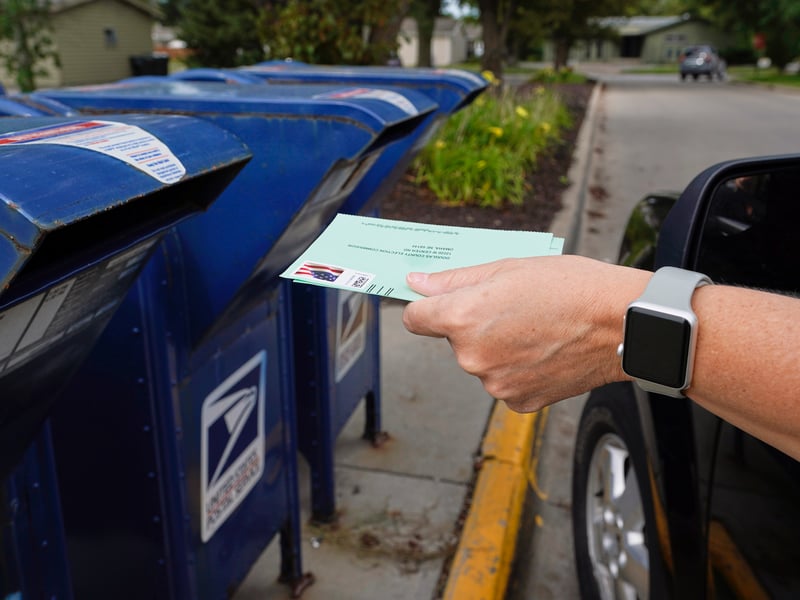
(CN) — A Seventh Circuit panel on Wednesday ended an effort by an Illinois congressman and two political activists to block the state from counting mailed ballots up to two calendar weeks after Election Day.
In a divided ruling, the three-judge panel determined the plaintiffs — Michael Bost, a Republican member of Congress representing Illinois’ 12th Congressional District, and two Republican political activists — lacked standing and affirmed the a federal judge’s dismissal of the case.
Bost and the two other plaintiffs, who served as presidential electors in 2020, sued the Illinois State Board of Elections in May 2022 seeking to enjoin a state law that allows mail-in ballots to be counted up to two calendar weeks after Election Day.
U.S. District Judge John Kness tossed their case in July 2023, finding the plaintiffs lacked standing. Kness said the injuries Bost and his fellow plaintiffs claim they’ve suffered under the law — spending more on their campaigns, dilution of votes, the specter of voter fraud — were too hypothetical to justify the suit.
The Seventh Circuit’s decision affirming Kness was written by U.S. Circuit Judge John Lee, a Joe Biden appointee, and joined by U.S. Circuit Judge Michael Brennan, a Donald Trump appointee. U.S. Circuit Judge Michael Scudder Jr., also a Trump appointee, dissented.
In seeking an injunction against enforcement of the late-arriving mail ballots, the plaintiffs argued their votes would be diluted by “untimely” ballots. But, in considering the plaintiffs’ standing to bring their action, the majority found that even if it were to accept the premise that including those ballots would cause vote dilution, their votes would be diluted in the same way as every other vote cast prior to Election Day. “Thus, to the extent laintiffs would suffer any injury, it would be in a generalized manner and not ‘personal and individual’ to plaintiffs, as the Supreme Court requires,” Lee wrote for the majority.
The plaintiffs also argued they would be harmed as political candidates by the delay in counting mail ballots. Bost said he would have to fund his campaign for two additional weeks after Election Day to challenge any ballots and send poll watchers to each of the 34 counties in his district to monitor the ballot counting for the extended period.
This, the plaintiffs argue, is evidence of harm to justify standing in this case. But the Seventh Circuit panel disagreed, pointing out that the U.S. Supreme Court has held that “to confer Article III standing, a plaintiff’s injury must not only be ‘concrete and particularized’ but also ‘actual or imminent.’ The latter requirement for standing ‘ensure[s] that the alleged injury is not too speculative for Article III purposes.’”
While joining the panel majority in rejecting most of the plaintiffs’ theories of standing, Scudder wrote in his dissent that Bost has a “concrete stake in the resolution of this lawsuit” because the extended deadline will increase his campaign costs in November.
That happened after Illinois extended its deadline in 2013 for accepting mail-in ballots, Scudder wrote. “This change in law had an immediate impact on candidates’ election-monitoring operations. To ensure that all mail-in ballots were accurately tallied, Congressman Bost had to recruit, train, assign, and coordinate poll watchers and keep his headquarters open for an additional two weeks. This took substantial time, money, and resources, as Bost explained in his complaint and sworn declaration.”
Bost’s office did not respond to a request for comment by press time Wednesday. A spokesperson for the Illinois State Board of Elections declined to comment.
 Follow @roxalaird16
Subscribe to our free newsletters
Our weekly newsletter Closing Arguments offers the latest about ongoing trials, major litigation and rulings in courthouses around the U.S. and the world, while the monthly Under the Lights dishes the legal dirt from Hollywood, sports, Big Tech and the arts.