
 Search Articles


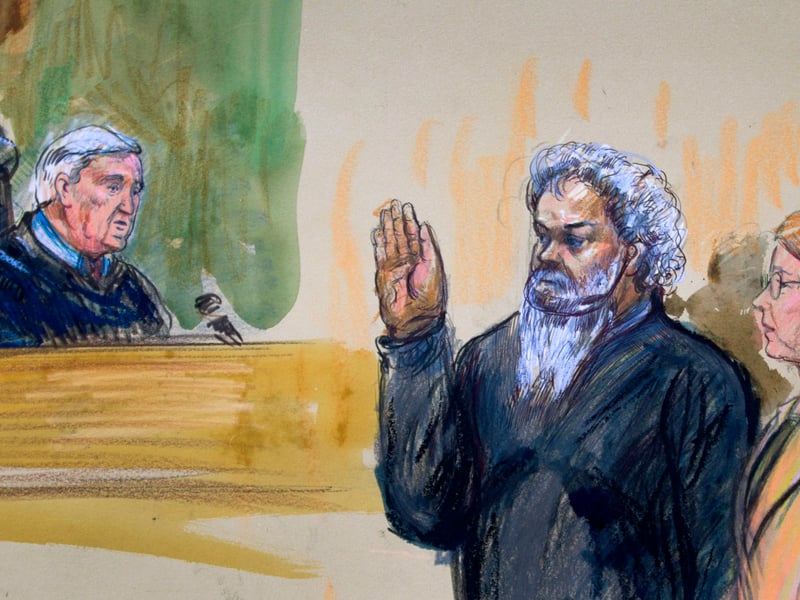
WASHINGTON (CN) — A Libyan man who helped plan the 2011 attack on the U.S. diplomatic compound in Benghazi was resentenced to 28 years in prison on Thursday after a D.C. Circuit panel ruled his prior 22-year sentence was “unreasonably low.”
Ahmed Abu Khatallah was convicted on four counts by a jury in November 2017 but was acquitted of the most serious charges related to the deaths of Ambassador Christopher Stevens, Glen Doherty, Sean Smith and Tyrone Woods.
Speaking to a packed Washington courtroom — including to nine family members of the deceased who were in attendance — U.S. District Judge Christopher Cooper said that he understood his decision was likely a disappointment but that he had to honor the jury’s verdict.
“This is meant to respect our jury system, the crown jewel of our justice system,” the Barack Obama appointee said after passing down the new sentence. “We judges frequently have to disregard certain evidence and our personal views in order to uphold the Constitution. That was part of Stevens’ and the other public servants’ mission in Libya.”
Cooper’s decision brings a close to a case that began more than 12 years ago, after assailants overran the Benghazi compound on the night of Sept. 11, 2012, and set it ablaze.
The fire ultimately killed Stevens, the first U.S. ambassador to be killed in the line of duty since 1979, and Smith, a foreign service officer, via smoke inhalation.
Khatallah was convicted on four counts: conspiracy to provide material support to terrorists, providing material support to terrorists, property destruction that endangered others and using a semiautomatic weapon during a crime of violence.
The jury acquitted him of the remaining 14 counts, including those connected to a later mortar attack on the compound on the morning of Sept. 12. That later attack killed Doherty and Woods, both CIA contractors working at the Benghazi complex.
In July 2022, U.S. Circuit judges Patricia Mellett, Greg Katsas and Naomi Rao — an Obama appointee and two Donald Trump appointees, respectively — overturned Khatallah’s previous sentence because it was “substantively unreasonably low in light of the gravity of his crimes of terrorism,” they wrote in a per curiam opinion.
The Justice Department had urged Cooper to resentence Khatallah to a term between 30 years and life in prison, expressing concerns that the lower sentence failed to properly reflect the gravity of the crimes or deter similar conduct.
Glen Doherty’s brother, Greg Doherty, urged Cooper to accept the government’s recommended range. He said he had reflected on the case in the six years since original sentencing and felt it was a test case over whether justice for such acts of terrorism “should be settled on the battlefield or in the courts.”
Doherty said he appreciated the judicial process for bringing facts of the case to light. Still, he argued that sentencing was “where the rubber hits the road” and that Cooper’s initial prison sentence was too light.
John Crabb of the U.S. Attorney’s Office argued the government’s range was well-warranted for the crime, especially considering the unique nature of the conduct and Khatallah’s intent to commit terrorism.
He quoted the 2013 opinion in U.S. v. Tarek Mehanna , in which a First Circuit panel affirmed a 17-year sentence for Mehanna on terrorism charges. In that decision, the panel likened terrorism to bubonic plague and said it was an existential threat.
Crabb said that Khatallah had shown no remorse for his actions and was more prone to reoffend if released from prison too soon.
During the 2011 uprising against Libyan dictator Muammar Gaddafi, Khatallah formed a militia of about two dozen fighters.
Trial evidence showed he directed armed militia members to attack the Benghazi compound. He later arrived himself, also armed, where he prevented U.S.-allied forces from responding to the attack.
Cooper cited that evidence as his reasoning for applying a so-called terrorism enhancement, applied to crimes of violence intended to influence or retaliate against U.S. policies. He also applied a leadership enhancement, which further contributed to the longer sentence.
Nonetheless, Cooper noted Thursday that the government had failed to prove beyond a reasonable doubt that Khatallah’s actions were directly connected to the fire that killed Stevens and Smith. Thus, he felt it was inappropriate to order a sentence above 30 years.
Jeffrey Robinson of the Washington firm Lewis Baach, who defended Khatallah at trial, argued that Cooper should reimpose the 22-year sentence. All Cooper had to do differently, Robinson said, was adequately explain how he decided on the sentence based on what the jury decided.
“The court balanced the test of our system and balanced the verdict of the jury,” Robinson said. “We only ask that you affirm the sentence.”
Khatallah, who followed the proceedings via an interpreter in the room, did not make a statement to the court.
Before adjourning, Cooper said he hoped his decision was “the end of the road in this case.” Even so, he acknowledged the possibility of another appeal.
 Follow @Ryan_Knappy
Subscribe to our free newsletters
Our weekly newsletter Closing Arguments offers the latest about ongoing trials, major litigation and rulings in courthouses around the U.S. and the world, while the monthly Under the Lights dishes the legal dirt from Hollywood, sports, Big Tech and the arts.