
 Search Articles


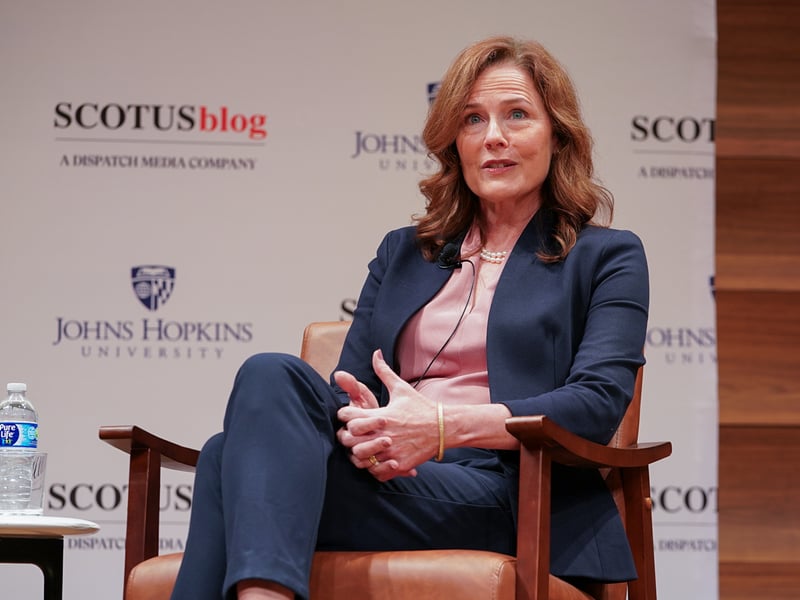
WASHINGTON (CN) — Justice Amy Coney Barrett tried to turn down the temperature after a series of rulings in favor of President Donald Trump ginned up claims of bias for the Republican White House.
“I want people to understand, agree or disagree with the decisions that the court reaches, that we are engaged in a legal enterprise,” Justice Amy Coney Barrett, a Trump appointee, said during a legal conference in D.C. on Thursday.
Barrett sat for an hourlong sit-down with Judge Patrick Bumatay of the Ninth Circuit Court of Appeals. Bumatay, also a Trump appointee, asked Barrett about any public misconceptions about the court that she would like to correct.
Barrett took on claims that the Supreme Court operates like the other political branches.
“I want people to appreciate — in ways that you can’t appreciate just from a hit in a news article — that this is the result of legal analysis and not just kind of knee-jerk policy preferences, as you see in our friends across the street,” Barrett said, referring to Congress.
The Supreme Court has faced increased scrutiny as the conservative majority issued a series of emergency docket rulings favorable to Trump. The spate of wins has drawn comparisons to high court losses suffered by former President Joe Biden.
Those same critiques have featured in many of the dissents accompanying Trump’s emergency docket wins. Justice Ketanji Brown Jackson, a Biden appointee, claimed her colleagues were engaged in Calvinball jurisprudence with a twist.
“Calvinball has only one rule: There are no fixed rules. We seem to have two: that one, and this administration always wins,” Jackson wrote in a dissent to an order gutting health grants.
Bumatay mostly steered clear of the topic, instead centering their discussion around Barrett’s new book, asking questions about her life and early career. He offered effusive praise for Barrett’s opinions, calling attention to her majority opinion in the birthright citizenship case from last term.
“I have to say it was beautifully written,” Bumatay said. “I confess, I was a little depressed when I read it because I just don’t think I can ever write an opinion so well.”
The questions about Barrett’s love for New Orleans, tenure as a professor and restaurant preferences were a stark departure from other discussions at the event hosted by SCOTUSblog.
The panel of legal experts and professors preceding Barrett’s appearance discussed how the court’s rulings reflect broader societal divides over race in America and whether the justices are tempering their decisions to avoid a confrontation with the Trump administration.
The panelists posed a series of questions they’d ask a justice if given the opportunity.
“What I’d really love is to be able to sit down with one or more of them and say, ‘Are you worried about what’s going on?’” Dan Epps, a law professor at Washington University, said.
“We are in the middle of the biggest presidential attempt to have a de facto constitutional revolution since the New Deal …where we’re just seeing an attempted avulsive change in the law,” Epps said. “Whether you like the direction of that change or not, it’s a big deal.”
Legal observers have characterized Barrett as the swing vote because she has joined Chief Justice John Roberts and the high court’s three liberal justices in a handful of rulings. Barrett rejected this depiction, viewing it as describing swings in her jurisprudence.
“My approach to judging is to not focus on it,” Barrett said. “It’s not like I’m thinking about an outcome, and I’m trying to figure out a way to get there. I’m just kind of playing it straight.”
 Follow @KelseyReichmann
 Follow @kelseyreichmann.bsky.social
Subscribe to our free newsletters
Our weekly newsletter Closing Arguments offers the latest about ongoing trials, major litigation and rulings in courthouses around the U.S. and the world, while the monthly Under the Lights dishes the legal dirt from Hollywood, sports, Big Tech and the arts.