
 Search Articles


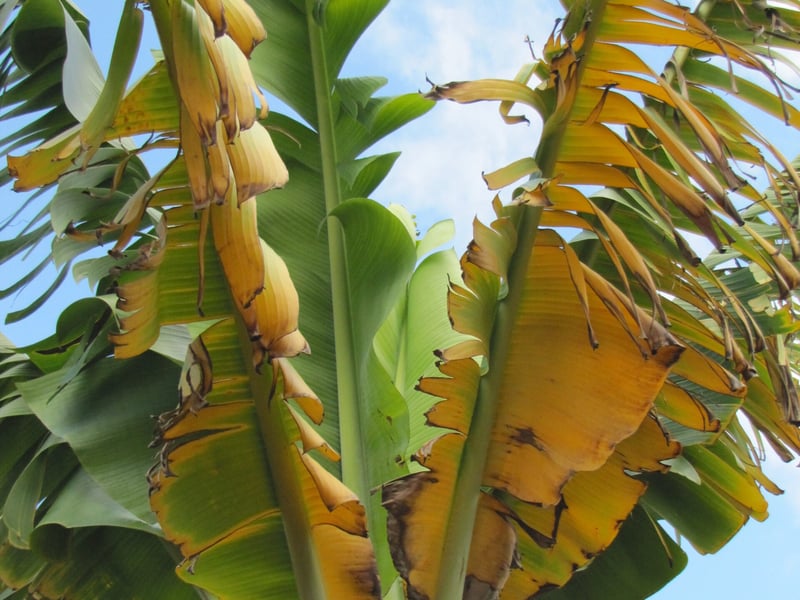
(CN) — The most popular variety of bananas may be headed for extinction thanks to a spreading fungal pathogen called Fusarium wilt, researchers say. But they’re hoping to prevent that fate.
A team of scientists have spent the last 10 years studying the fungal pathogen and published their research Friday in the journal Nature Microbiology, offering promising insight for the creation of methods to slow or control the spread of the fungal disease threatening the banana crops.
If bananas being wiped out from a fungal infection sounds familiar, it’s because it is. In the 1950s, an outbreak of the fungal pathogen Fusarium oxysporum wiped out an earlier variety of bananas, called Gros Michel.
“The kind of banana we eat today is not the same as the one your grandparents ate. Those old ones, the Gros Michel bananas, are functionally extinct, victims of the first Fusarium outbreak in the 1950s.” Li-Jun Ma, professor of biochemistry and molecular biology at the University of Massachusetts Amherst and the paper’s senior author, said in a statement.
After the loss of the Gros Michel bananas, a new variety called Cavendish was bred to be disease-resistant. The Cavendish variety is the most popular banana commercially available. Even though it was created to be less susceptible to disease, the Cavendish faced its first brush with extinction in the 1990s.
“There was another outbreak of banana wilt,” lead author Yong Zhang said in a statement. “It spread like wildfire from South-East Asia to Africa and Central America.”
For the last 10 years, Ma has been studying Fusarium oxysporum, which is the driving force behind the disease Fusarium wilt of banana. Ma characterized the fungal pathogen as a “species complex” that has hundreds of varieties that target different plant hosts. Fusarium wilt of banana is caused by Fusarium oxysporum f.sp. cubense (Foc) tropical race 4 (TR4).
While the outbreak is concerning for banana lovers around the world, there is some good news.
“We now know that the Cavendish banana-destroying pathogen TR4 did not evolve from the race that decimated the Gros Michel bananas,” Ma said. “TR4’s genome contains some accessory genes that are linked to the production of nitric oxide, which seems to be the key factor in TR4’s virulence.”
Ma, Yong and a team of coauthors from China and South Africa sequenced and compared 36 different strains of the fungal pathogen to reach that conclusion. The team discovered that the strain responsible for the latest banana wilt outbreak uses certain additional genes to both produce and detoxify nitric oxide.
The researchers determined that the virulence of the fungal pathogen was able to be reduced when two genes controlling nitric oxide production were removed.
“Identifying these accessory genetic sequences opens up many strategic avenues to mitigate, or even control, the spread of Foc TR4,” Yong said.
Part of the problem facing the Cavendish banana can be traced back to monocropping, Ma said.
“When there’s no diversity in a huge commercial crop, it becomes an easy target for pathogens,” she said.
Monocropping is the practice involving growing the same crop on the same plot of land for multiple years.
“Next time you’re shopping for bananas, try some different varieties that might be available in your local specialty foods store,” Ma said.
Subscribe to our free newsletters
Our weekly newsletter Closing Arguments offers the latest about ongoing trials, major litigation and rulings in courthouses around the U.S. and the world, while the monthly Under the Lights dishes the legal dirt from Hollywood, sports, Big Tech and the arts.