
 Search Articles


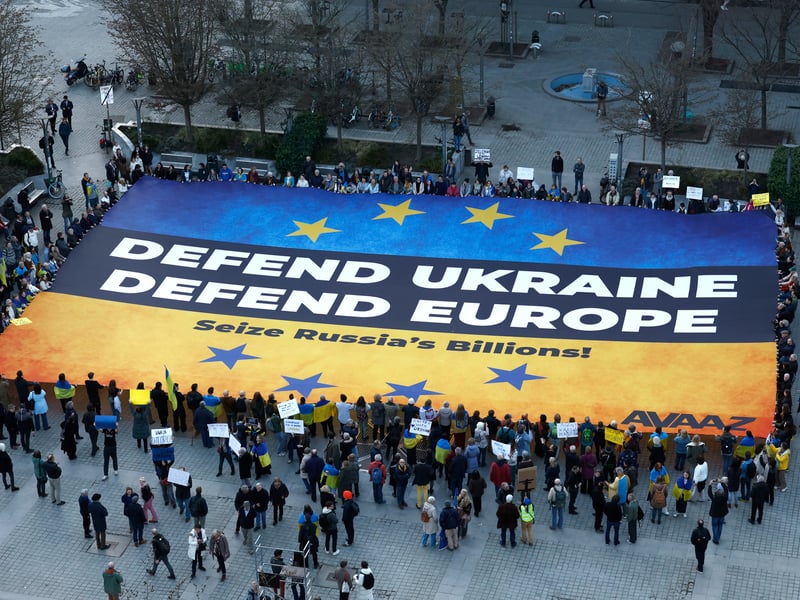
BRUSSELS (CN) — European leaders spent Wednesday demanding a voice in Ukraine peace talks they warn could endanger the continent, even as U.S. officials met separately with Russian and Ukrainian delegations in Abu Dhabi to finalize a deal Brussels had no hand in drafting.
At the heart of the dispute: Washington wants a quick deal to stop the fighting, while European leaders warn that weak terms would simply let Moscow regroup and attack again — potentially targeting NATO’s eastern members.
The alarm across European capitals centers on a leaked 28-point American proposal that would cap Ukraine’s military at 600,000 soldiers, cede all of Donetsk to Russia, close the door to NATO membership and abandon war crimes prosecution.
Weekend negotiations in Geneva between U.S. and Ukrainian officials produced a revised framework of 19 points, with the military cap raised to 800,000 personnel and language regarding amnesty for wartime conduct dropped. But European officials remain unconvinced the revised terms would prevent future Russian aggression.
Ursula von der Leyen, president of the European Commission — the EU’s executive arm — addressed the European Parliament Wednesday in Strasbourg, laying out red lines: No caps on Ukraine’s military, no legitimizing territorial conquest.
“As a sovereign nation, there can be no limitations on Ukraine’s armed forces that would leave the country vulnerable to future attacks,” von der Leyen said. “If today we legitimize and formalize the undermining of borders, we open the doors for more wars tomorrow.”
Others were more blunt about Washington’s original framework. “What was published last week was a disgrace, and not only in the making of it without Europe and without Ukraine at the table, but also in the content,” said Terry Reintke, co-chair of the Greens group. “What was written in this plan was a de facto capitulation plan for Ukraine.”
‘We will be next’
“An agreement negotiated between great powers without the consent of Ukraine and without the consent of the Europeanswill not be the basis for a genuine, sustainable peace in Ukraine,” German Chancellor Friedrich Merz told the Bundestag budget committee Wednesday. “Europe is not a pawn, but a sovereign actor for its own interests and values.”
The eastern flank’s worries reflect geographic reality. Poland, Finland, Estonia and Lithuania share borders with Russia or its ally Belarus. A weakened Ukraine would leave them exposed.
“They have this sense of urgency that they will be next who will be attacked by Russia,” Niklas Helwig, leading researcher at the Finnish Institute of International Affairs, told Courthouse News.
“If there is an extremely badly implemented peace deal in Ukraine — which limits the numbers of troops that Ukraine has, that has very limited and unprecise security guarantees, that enables Russia basically to take a step back and reenergize their military forces — this will actually, in the medium term, not lead to peace in the region, but just will incentivize Russia to attack again.”
The Kremlin made its view clear Wednesday. “The Europeans meddling in all these affairs is, as I see it, completely unnecessary,” Putin aide Yuri Ushakov told Russian state TV.
Ian Bond, director of foreign policy at the Centre for European Reform, said Putin has shown no interest in compromise. In an email exchange with Courthouse News, Bond predicted that Trump’s envoy will hear in Moscow that the proposal is merely “a good starting point” but that the “root causes” of the conflict need addressing — meaning, in Putin’s view, Ukraine’s sovereignty and right to make independent foreign and security policy choices.
“I am certain that had the 28-point plan been accepted by Ukraine and its European partners, Putin would have asked for more,” Bond said.
Trump’s envoy Steve Witkoff is set to travel to Moscow next week to meet Putin directly, while Ukrainian President Volodymyr Zelenskyy may travel to the United States in the coming days to work through final sticking points with Trump. U.S. Army Secretary Dan Driscoll has been meeting separately with Russian and Ukrainian representatives in Abu Dhabi since Monday.
Trump has dropped his Thanksgiving deadline for a deal. “The deadline for me is when it’s over,” he told reporters aboard Air Force One on Tuesday, adding that negotiators were making progress and Russia had agreed to unspecified “concessions.”
European officials disputed that characterization. “Russia is not winding down, but ramping up,” the EU’s chief diplomat Kaja Kallas told reporters Wednesday after an extraordinary meeting of EU foreign ministers. “That is a threat to us all.”
Europe’s leverage
Von der Leyen made the case that Washington cannot finalize any deal without European consent because implementation would fall largely to the EU.
“Whatever the design of a future peace treaty, it is clear that much of the implementation will come down to the European Union and the NATO partners,” she said. “Whether it’s on security guarantees or on sanctions, financing of Ukraine’s reconstruction, the integration in the single market, or EU membership.”
Helwig said the original American proposal touched on several areas of exclusive EU competence that cannot proceed without Brussels’ approval.
“Frozen assets — that’s one. Another one is that it stated Ukraine would become part of the EU,” he said. “Another aspect was that Russia should be reintegrated in the global economy, sanctions should be credibly lifted. These are all aspects that cannot be done without the European Union accepting it.”
Valérie Hayer, president of the liberal Renew Europe group, questioned whether Washington was demanding anything of Moscow in return for Ukrainian concessions.
“We can ask what the real intentions are behind the Americans’ moves because there’s a whole raft of concessions from Ukraine,” Hayer said. “But what are we asking of Russia?”
Troops on the ground
The Coalition of the Willing— roughly 30 countries backing Ukraine — announced Tuesday a new working group on security guarantees, led by France and Britain, with Turkey and — for the first time — the United States participating. French President Emmanuel Macron floated deploying French, British and Turkish troops to rear areas like Kyiv or Odesa the day a peace deal is signed.
Bond said questions remain about real commitments. “President Macron referred to ‘security and training’. That sounds like quite a small operation,” Bond said. “It is unclear whether Macron agreed his line with the U.K. and Turkey before he spoke or if he is just speculating.”
The coalition is deliberately operating outside NATO structures to avoid triggering Moscow’s insistence that alliance troops have no place in Ukraine. But Bond warned this distinction may be meaningless in practice.
“This will make no difference to Russia’s attitude: They will view ’troops from NATO countries’ as a synonym for ‘NATO troops,’” he said. In any case, without NATO’s collective defense guarantee, Russia will likely “test Western resolve by attacking any troops in Ukraine.”
For now, the greater danger may be that Trump loses patience with the process entirely. “That’s why we see this active engagement of Ukraine and Europeans to work together with the U.S. on this, because they really want to keep the Americans involved,” Helwig said.
Behind the security discussions lurks an equally fraught question: Who pays for Ukraine’s future?
EU member states remain deadlocked over a proposal to leverage roughly 185 billion euros in frozen Russian central bank assets — the bulk of which sits in Belgium — as backing for a 140 billion loan to Kyiv. The Belgian government has refused to sign off without ironclad risk-sharing commitments from other member states.
Von der Leyen announced the commission is ready to present a legal text, one of Belgium’s key demands. “I cannot see any scenario in which the European taxpayers alone will pay the bill,” she told lawmakers.
But even allies acknowledged the bloc isn’t ready. “We have currently, to be honest, no clear idea how to finance the needs of Ukraine,” said Manfred Weber, chair of the center-right European People’s Party. EU leaders are treating the December summit as a deadline to resolve the standoff.
For now, European leaders are betting that Washington cannot finalize a deal without them — and that delaying a bad peace is better than accepting one that invites the next conflict.
Courthouse News correspondent Yuval Molina is based in Brussels, Belgium.
Subscribe to our free newsletters
Our weekly newsletter Closing Arguments offers the latest about ongoing trials, major litigation and rulings in courthouses around the U.S. and the world, while the monthly Under the Lights dishes the legal dirt from Hollywood, sports, Big Tech and the arts.