
 Search Articles


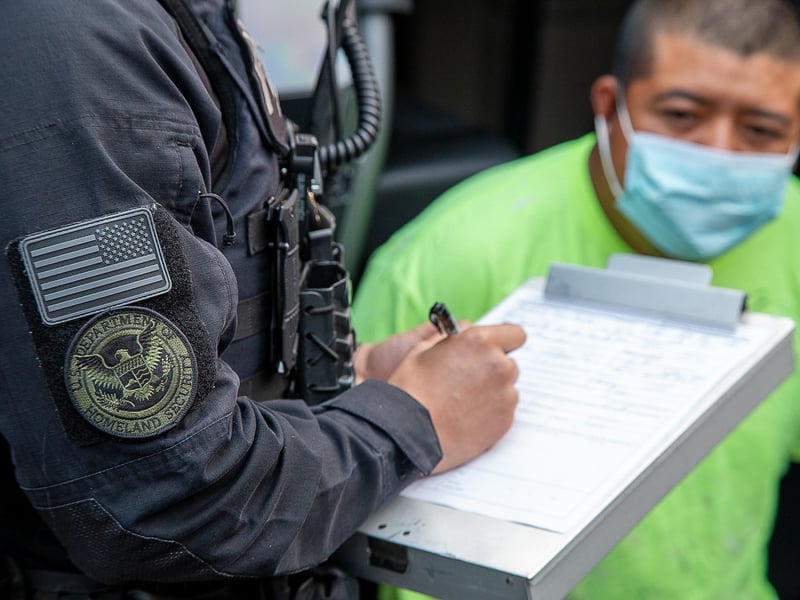
LOS ANGELES (CN) — A group of immigrant rights advocates on Thursday asked a federal judge to order the government to allow them access to Immigration and Customs Enforcement detainees held at a processing center in downtown Los Angeles.
Mark Rosenbaum, senior special counsel for strategic litigation at Public Counsel representing the Coalition for Humane Immigrant Rights and the Immigrant Defenders Law Center, argued that detainees in a holding area in the basement of the downtown federal building are kept in for days in coercive conditions and forced to fill out self-deportation forms they don’t understand without legal assistance.
Detainees swept up in the ICE immigration enforcement raids are kept in rooms without beds, pillows or blankets, and sleep on dirty, freezing floors while only getting vending machine food, Rosenbaum told U.S. District Judge Maame Ewusi-Mensah Frimpong.
“These are inherently coercive conditions that heighten the need for access to counsel,” Rosenbaum said.
Frimpong, a Joe Biden appointee, had issued a tentative ruling, which wasn’t made publicly available, that granted the legal aid organizations’ request for a preliminary injunction. However, she didn’t adopt her tentative at the hearing and said she wanted to consider additional evidence provided by the government before making a final decision.
The judge had issued two temporary restraining orders, a short-term remedy, in July in the wake of the roving patrols that ICE unleashed on Southern California in which masked agents in unmarked cars stopped and detained local residents, including U.S. citizens, who looked Latino and dressed like laborers at bus stops, carwashes, tow yards and Home Depot parking lots where day laborers gather to find jobs.
One temporary restraining order barred ICE from apprehending people based only on their work, appearance, language or location, without a reasonable suspicion that they are in the country without proper authorization, in light of local residents’ Fourth Amendment rights to be free of unreasonable searches and seizures.
While the Ninth Circuit Court of Appeals rejected the government’s request to stay that temporary restraining order while its under appeal, the U.S. Supreme Court stepped in last month and stayed it.
The second temporary restraining order Frimpong issued in July pertained to the detainees’ right to counsel under the Fifth Amendment. She ordered ICE to allow lawyers access to people held at the “B-18” facility in downtown LA at least eight hours a day during weekdays and four hours a day on weekends and holidays. She also ordered ICE to notify lawyers ahead of time when the facility would be closed to them.
In their request for a preliminary injunction, which offers a remedy for the duration of the litigation, the legal aid groups claim the Trump administration has ignored the judge’s order.
“Defendants reacted with a metaphorical thumb of the nose,” the organization said in their July 28 filing. “They promised that none of the government’s operations “are going to change,” have closed B-18 to legal visits without notice as recently as July 26, 2025, and have ignored the court’s directive regarding unmonitored attorney-client calls entirely.”
At Thursday’s hearing, Justice Department attorney Jonathan Ross, argued that the plaintiffs’ evidence in support of their bid for a preliminary injunction was “stale” and that at least since Sept. 10 the government has been meeting the requirements set out by the judge.
Ross acknowledged that there had been a “learning curve” for the government to get up to speed after the tumultuous protests in June and the judge’s July order, but he insisted that it wasn’t the government’s policy to deny the detain access to counsel.
“The Fifth Amendment doesn’t require immediate access to counsel,” Ross said. “It requires meaningful access.”
Frimpong still was concerned whether detainees could meet confidentially with their attorneys and whether they could make confidential phone calls to counsel.
“My obligation is to look at the preponderance of the evidence, and the plaintiffs have made very specific assertions while the government has only provided a general declaration,” she noted.
At the urging of the Justice Department’s attorney, she agreed to consider the additional evidence the government filed last month before making a final decision.
Meanwhile, the judge earlier this month denied the government’s request to stay all the proceedings before with respect to the plaintiffs’ Fourth Amendment claim and allowed the plaintiffs to request information for the government to support their claims.
“Although it is true that the Supreme Court’s grant of the stay of the TRO necessarily means that it found that the defendants had a likelihood of success on appeal of the TRO, it says nothing about whether the defendants have a likelihood of success on the merits of the underlying case particularly where the defendants have not even answered the complaint, discovery has not begun, and the plaintiffs and intervenors are seeking to supplement the record on the motion for preliminary injunction,” she wrote.
 Follow @edpettersson
Subscribe to our free newsletters
Our weekly newsletter Closing Arguments offers the latest about ongoing trials, major litigation and rulings in courthouses around the U.S. and the world, while the monthly Under the Lights dishes the legal dirt from Hollywood, sports, Big Tech and the arts.