
 Search Articles


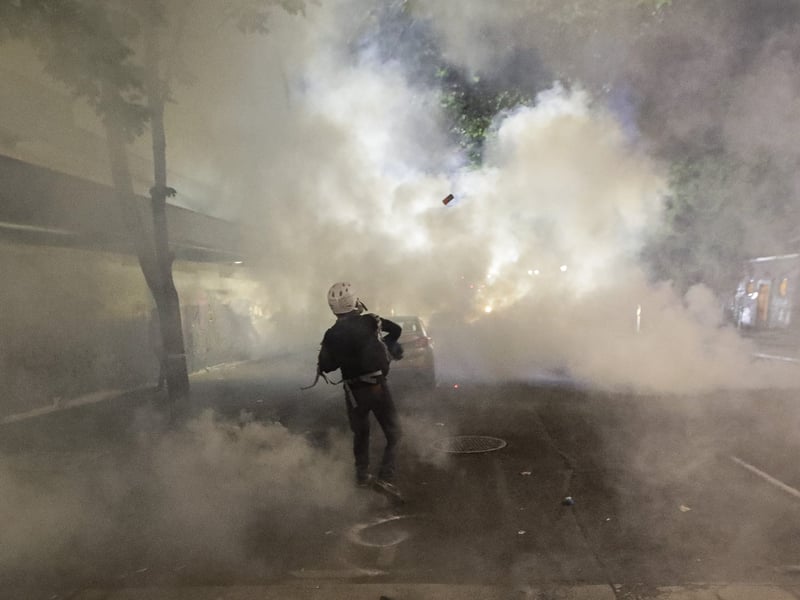
PORTLAND (CN) — A move by Portland authorities to have a class action against them dismissed mostly hinged Thursday on the measures they took to protect inmates’ safety when tear gas, deployed against protesters outside a government building, seeped into a local jail.
Multnomah County and individual defendants hope to convince U.S. Magistrate Judge Stacie Beckerman to dismiss the suit filed against them by people jailed in 2020 during the George Floyd protests. It was during those protests that officers used tear gas outside the Multnomah County Justice Center, which houses the Multnomah County Detention Center.
For over a week, the building’s ventilation system pumped tear gas and smoke into the jail. That caused inmates and detainees to cough, gag and have irritable eyes, along with significant fear, the plaintiffs have said.
“Night after night, Multnomah County jail deputies ignored cries for help, stopped responding to emergency calls, and left the men and women trapped in their cells to suffer,” the class argues in its complaint.
Seeking to have the class action dismissed, attorney Christopher Gilmore spent much of Thursday’s hearing arguing that the steps his client took to mitigate the tear gas were reasonable.
Beckerman made no decision on Thursday.
“We were not the ones who deployed this tear gas,” Gilmore said. “This is a 16-floor building, and you have tear gas coming into that.”
Gilmore said the legal standard is one that’s objectively reasonable. Also, more than one reasonable option could exist.
Administrators chose to close the building’s dampers to keep the gas out, though Gilmore wasn’t certain if they remained closed each night. The class has said that closing the dampers proved ineffective, though the county counters there’s no evidence of that.
Additionally, Gilmore said officials placed portable air filter fans throughout the building, targeting spots with heavy concentrations of tear gas.
Gilmore also argued that, when considering whether his clients were deliberately indifferent, the judge should give deference to local authorities’ decisions over safety issues. He noted that not only detainees and inmates were inside the building, but others as well.
“Why wouldn’t they take reasonable care when it has to deal with their own health and safety?” he asked. “All those people would be affected by that.”
Anticipating his opponent’s argument, Gilmore said taking reasonable action didn’t hinge on whether it proved successful or significantly reduced the harm. Instead, the legal standard is based on what people knew at the time.
Arguing for the class, attorney Nadia Dahab said life and safety should take priority over security concerns. Officials discussed evacuating the building but opted against it.
“The central concern there was not to protect [detainees] from harm,” she added.
A sheriff’s captain who offered an evacuation plan received no response about it, and the issue was never revisited. That made people like former Sheriff Michael Reese, who’s a defendant, liable for the inaction, Dahab said.
Jail authorities could have relocated detainees, checked the building for leaks or used fans to direct air away from inmates. She noted the mobile air filter fans Gilmore mentioned but said officials didn’t place them in the jail’s housing unit.
The county has argued staffing issues caused limitations, like it couldn’t allow more showers for detainees because it lacked the manpower, Dahab said.
“That made it more important to do other things,” she added, arguing there’s a question of whether the county’s response was reasonable.
Posing her own questions, Beckerman asked if officers could hear the screams of class members. She also questioned whether an action taken by officials that proved ineffective would qualify as a reasonable option.
Gilmore said one person was in the area and that if screaming occurred, he would have heard it.
Whether closing the dampers worked, Gilmore said, depended on the definition of “effective.”
“It’s not black and white,” Gilmore said, adding moments later: “I think this has to be looked at in context.”
Subscribe to our free newsletters
Our weekly newsletter Closing Arguments offers the latest about ongoing trials, major litigation and rulings in courthouses around the U.S. and the world, while the monthly Under the Lights dishes the legal dirt from Hollywood, sports, Big Tech and the arts.