
 Search Articles


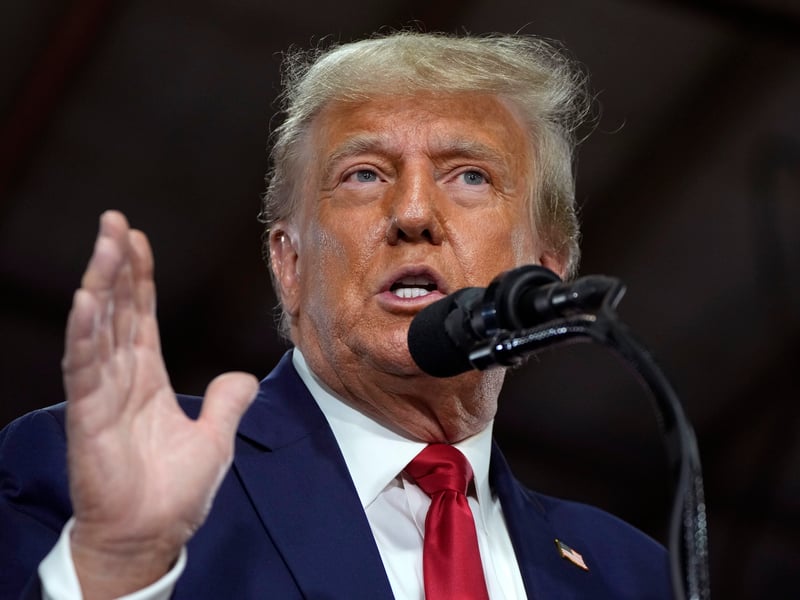
MANHATTAN (CN) — Rosemary Vrablic opened her Wednesday testimony at Donald Trump’s civil fraud trial in Manhattan by describing who the former president was to her — a customer.
While true, it’s perhaps a bit of an understatement. Vrablic, a former executive at Deutsche Bank, was considered Trump’s longtime private banker and the Trump Organization’s primary point of contact at the German lender.
Her ties with the Trump family run deep. Deutsche Bank was the largest single lender to the Trump Organization from 2011 to 2021, the dates in which the state attorney general is accusing Trump of rampant fraud to swindle lenders like Deutsche. During that time frame, Vrablic was largely responsible for helping the Trump Organization secure some of its biggest loans.
It all started with a 2011 phone call between her and Trump’s son-in-law Jared Kushner about buying the Doral golf club in Miami, a detail corroborated by the attorney general’s office earlier in the trial. Once Trump was on her radar, Vrablic boasted to her colleagues about the potential of getting his business.
“We are whale hunting,” she said in an email to her now-former colleague Marcus Mitchell.
Vrablic testified that “whale hunting” was a term used to describe the pursuit of customers with “very high net worth.”
Weeks later, Ivanka Trump reached out to Vrablic to spark the budding relationship between Deutsche Bank and the Trump Organization, according to emails admitted into evidence.
“My father and I are very much looking forward to meeting with you tomorrow to discuss Doral,” Ivanka said in the email from December 2011.
Throughout her roughly four-hour testimony, Vrablic described the yearslong bond Deutsche Bank developed with the Trump Organization, starting with the Doral loan. Guided by direct examination from defense attorney Jesus Suarez, Vrablic spent much of her time at the stand explaining gushing emails she sent to and about the Trumps.
In one 2012 memo, she called Deutsche Bank’s relationship with the Trumps a “top 5 relationship in terms of revenue.” In an email to Ivanka Trump, Vrablic said that the Trump family “is in the top 10 revenue-generating names of asset and wealth management,” and that her boss at the bank is “thrilled” with how the relationship has grown.
“I try to be fair and I think in this case, both you and the bank are happy,” Vrablic said in an additional email to Ivanka Trump.
In showing these communications to the court, the defense attempted to prove that Deutsche Bank was always satisfied in its relationship with the Trumps. Even though they overstated their net worth and the value of their assets, the Trumps still qualified for and complied with the loan agreements offered to them by Deutsche Bank.
One email from Vrablic expressed that she was concerned the bank’s other customers would find out about the favorable loan terms given to Trump, suggesting Deutsche Bank gave him preferential treatment because of the relationship it wanted to cultivate with him. That supports the defense’s continued argument that Trump’s asset inflation didn’t matter to the banks; he would have gotten the same loan terms even if the numbers were closer to Earth.
But according to the attorney general’s office, Trump’s inflated financial worth cost banks an estimated $168 million in lost interest — money the banks would have earned if Trump’s net worth was more accurately stated.
Trump and his co-defendants were already found to have committed fraud before the trial began. According to a September ruling from Judge Arthur Engoron, the Manhattan justice overseeing the bench trial, Trump had engaged in “persistent and repeated fraud” by regularly inflating his assets’ values on annual statements of financial condition. Trump then sent those documents to banks and insurers to be used in various business transactions.
The former president has repeatedly downplayed the importance of those financial statements. He claimed in his own testimony that lenders are expected to do their own due diligence, regardless of what the statements say.
On Tuesday, testimony from another Deutsche Bank executive showed that the banks did, in fact, do their own due diligence before issuing Trump loans. David Williams, a managing director at the bank, said that large discrepancies in net worth were sometimes even expected.
Engoron said that might not matter, though. Remaining counts in the attorney general’s case involve the fabrication of fraudulent business documents, which could have happened regardless of if the banks did their own research and were satisfied with the deals.
“I would point out that the mere fact that the lenders were happy doesn’t mean that the statute wasn’t violated, doesn’t mean that the other statutes weren’t violated,” Engoron said Tuesday.
Vrablic was excused from the witness stand Wednesday afternoon after a brief cross-examination by state attorney Kevin Wallace.
 Follow @Uebey
 Follow @uebey.bsky.social
Subscribe to our free newsletters
Our weekly newsletter Closing Arguments offers the latest about ongoing trials, major litigation and rulings in courthouses around the U.S. and the world, while the monthly Under the Lights dishes the legal dirt from Hollywood, sports, Big Tech and the arts.