
 Search Articles


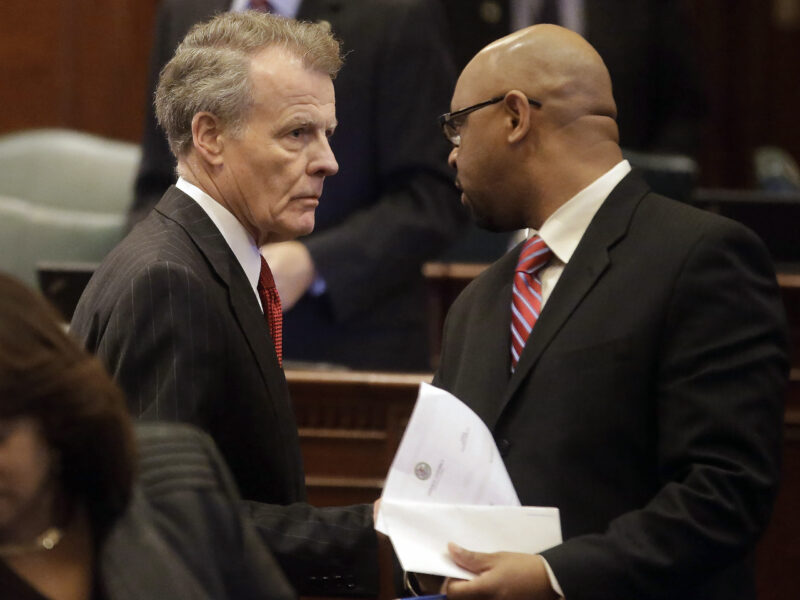
CHICAGO (CN) — The second week of testimony in ex-Illinois House Speaker Mike Madigan’s corruption trial thus far has consisted of extensive questioning of just one man: Tom O’Neill, former general counsel for energy utility Commonwealth Edison, more commonly known as ComEd.
O’Neill spent all Monday and most of Tuesday on the witness stand answering questions about ComEd’s efforts to pass key legislation in Illinois between 2010 and 2016. Federal prosecutors accuse Madigan — in one of the five “episodes” to which his 23 bribery, fraud, racketeering and conspiracy charges are related — of helping to pass those bills in exchange for ComEd helping secure jobs and contracts for those in his political network.
ComEd needed the help, O’Neill told federal prosecutor Sarah Streicker on Monday. He testified to the utility’s poor financial situation prior to the 2011 passage of the so-called Smart Grid bill, which overhauled how customers’ energy rates were calculated. The act’s passage, along with a subsequent 2013 trailer bill, resulted in increased energy rates for many customers but also provided ComEd with more stable income to upgrade its electric grid.
Both the Smart Grid bill and the trailer bill passed the Illinois General Assembly and survived vetoes from Democratic then-Governor Pat Quinn, with Madigan’s support. Behind the scenes, O’Neill said ComEd worked to appease the then-house speaker, noting his influence over state lawmakers.
“What’s important to the Speaker is important to ComEd,” O’Neill said he remembered ComEd ex-CEO Anne Pramaggiore saying.
What was important to Madigan also concerned his co-defendant Mike McClain, a former Democratic Illinois state representative turned ComEd lobbyist. McClain and Madigan had a close relationship going back years, but prosecutors further accuse McClain of acting as the former speaker’s confidant and lieutenant. Some of the pressure Madigan put on ComEd to find his associates work, prosecutors say, was exerted through McClain.
During direct examination on Monday, O’Neill told Streicker that while ComEd was working on what would become the 2011 Smart Grid bill, McClain and another ComEd lobbyist, John Hooker, pressured O’Neill to hire the law firm Reyes Kurson for legal work. The law firm was headed by Victor Reyes, an ally of Madigan’s.
“I felt pressured to do it, and they did impact the timing” of the contract, O’Neill said of McClain and Hooker’s efforts.
O’Neill further testified that the contract was unusual because it promised the firm no less than 850 hours of work per year. He nevertheless signed off on it, shortly before the Smart Grid bill passed both state chambers to overcome the governor’s veto in October 2011. When the contract was up for renewal several years later, ComEd insiders recommended reducing those hours, and ran into pushback from McClain.
“I know the drill and so do you,” McClain wrote in a January 2016 email to Pramaggiore, which jurors saw Monday. Referring to Reyes, he wrote, “If you do not get involved and resolve this issue of 850 hours for his law firm per year then he will go to our Friend. Our Friend will call me and then I will call you. Is this a drill we must go through?”
O’Neill testified that he understood McClain’s references to “our friend” to mean Madigan. McClain continued to pressure O’Neill and other ComEd leaders over the issue for months before ComEd arrived at a new agreement to retain the firm with reduced hours in the summer of 2016.
O’Neill told Streicker he felt “worn down” by McClain at that point, especially as he was also working on the company’s efforts to pass the Future Energy Jobs Act. That act secured subsidies for two Illinois nuclear power plants operated by ComEd’s parent company Exelon, and passed the legislature in December 2016.
Reyes Kurson did no work aiding the passage of the Future Energy Jobs Act or the earlier Smart Grid bill, O’Neill said.
On Tuesday, O’Neill further testified that Madigan recommended a man named Juan Ochoa to fill a 2017 vacancy on ComEd’s board which paid nearly $80,000 per year. O’Neill said he had reservations about Ochoa after a background check showed he had a property foreclosure on his record, and had filed a lawsuit claiming harassment by his political opponents.
Ochoa also had ties to disgraced former Illinois Governor Rod Blagojevich; in January 2007 Blagojevich named Ochoa CEO of the Metropolitan Pier and Exposition Authority, which manages Chicago’s McCormick Place complex. O’Neil said there was a feeling that appointment was thanks for Ochoa helping fundraise for Blagojevich.
The company went ahead with Ochoa anyway; by the spring of 2019 he was a member of the board and stayed on for one term. O’Neill testified that during a November 2018 meeting Pramaggiore said keeping a good relationship with Madigan “was an important factor” in the decision.
On cross-examination, which began mid-morning Tuesday and continued through 4 p.m., Madigan and McClain’s attorneys recontextualized their clients’ actions, trying to show that both men were only doing their jobs.
Madigan attorney Dan Collins asked O’Neill about the discussions Madigan’s office had with ComEd regarding the Smart Grid bill and Future Energy Jobs Act, claiming the speaker’s team was primarily concerned with making sure the bills benefitted Illinois residents.
Madigan’s office was concerned “in making sure ComEd did what we said we were going to do,” O’Neill said.
He also confirmed that ComEd didn’t get everything it wanted in the legislation, deflating prosecutors’ assertion in opening arguments that “ComEd wanted, ComEd gave and ComEd got.”
“ComEd wanted, ComEd did not get,” Collins told O’Neill on Tuesday.
“That’s fair,” O’Neill agreed.
McClain’s attorney Patrick Cotter, meanwhile, painted McClain as a talented lobbyist who was supposed to help build the relationship between ComEd and Madigan’s office.
“That was literally his job,” Cotter said.
McClain, along with Hooker and Pramaggiore, was among the “ComEd Four” who were convicted in May 2023 on separate corruption charges surrounding their activities with Madigan and the Illinois legislature between 2011 and 2019. ComEd itself admitted in 2020 to attempting to influence Madigan in the same time frame and agreed to pay a $200 million fine in a deferred prosecution agreement.
 Follow @djbyrnes1
Subscribe to our free newsletters
Our weekly newsletter Closing Arguments offers the latest about ongoing trials, major litigation and rulings in courthouses around the U.S. and the world, while the monthly Under the Lights dishes the legal dirt from Hollywood, sports, Big Tech and the arts.