
 Search Articles


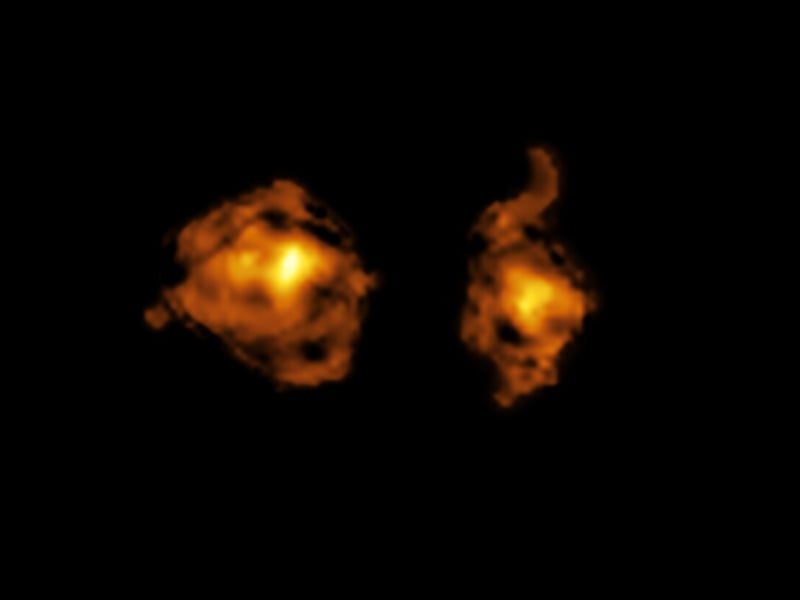
(CN) — In a corner of the early universe, two galaxies are locked in a cosmic clash. For the first time, astronomers say they’ve caught one blasting the other with a beam of radiation so powerful it’s interfering with the galaxy’s ability to form stars.
The discovery, published Wednesday in the journal Nature, reveals what researchers are calling a “cosmic joust” between two merging galaxies.
One galaxy is home to a quasar — the intensely bright core of a galaxy powered by a supermassive black hole. Researchers say it’s using that quasar like a weapon, shooting radiation into its partner and disrupting the dense gas clouds needed to create new stars.
“Here we see for the first time the effect of a quasar’s radiation directly on the internal structure of the gas in an otherwise regular galaxy,” said Sergei Balashev, co-lead author of the study and a researcher at the Ioffe Institute, in a press release.
The research team combined observations from the Atacama Large Millimeter/submillimeter Array, or ALMA, and the European Southern Observatory’s Very Large Telescope, or VLT, both in Chile.
Together, the instruments gave scientists a clear view of the violent interaction, which took place more than 11 billion years ago. Because light from the galaxies took that long to reach Earth, astronomers are seeing them as they were when the universe was only 18% of its current age.
According to researchers, the quasar’s radiation strips away much of the gas and dust in the companion galaxy, leaving behind only small, dense clumps that are likely too compact to kick off star formation.
Without the ability to replenish its stellar nurseries, the galaxy undergoes a dramatic change, from a fertile environment to one in decline. However, this interaction isn’t just damaging the companion galaxy. Researchers say it’s also helping to fuel the quasar’s fire.
“These mergers are thought to bring huge amounts of gas to supermassive black holes residing in galaxy centres,” Balashev said.
As the two galaxies collide and exchange material, the black hole at the center of the quasar gets more fuel to consume, which in turn boosts its radiation output, and the damage continues.
Astronomers were able to isolate the two galaxies and clearly see the interaction in detail. In past observations, researchers say they appeared as a single object.
ALMA’s high resolution helped distinguish between the two galaxies, while the VLT’s X-shooter instrument allowed scientists to analyze how the quasar’s light passed through the gas in the companion galaxy.
According to researchers, this helped them understand how the radiation was changing its structure. Observations with larger, more powerful telescopes could reveal more about collisions like this.
“A telescope like ESO’s Extremely Large Telescope will certainly allow us to push forward a deeper study of this, and other systems, to better understand the evolution of quasars and their effect on host and nearby galaxies,” said co-lead author Pasquier Noterdaeme of the Institut d’Astrophysique de Paris and the French-Chilean Laboratory for Astronomy, in the press release.
Subscribe to our free newsletters
Our weekly newsletter Closing Arguments offers the latest about ongoing trials, major litigation and rulings in courthouses around the U.S. and the world, while the monthly Under the Lights dishes the legal dirt from Hollywood, sports, Big Tech and the arts.