
 Search Articles


(CN) — For thousands of years, astronomers have attempted to understand the construction of the cosmos and how it has evolved into the universe we know today. A large part of research into the universe has focused on documenting mysterious dark matter and how its presence, despite our difficulties detecting it, has shaped the universe from the time of the Big Bang.
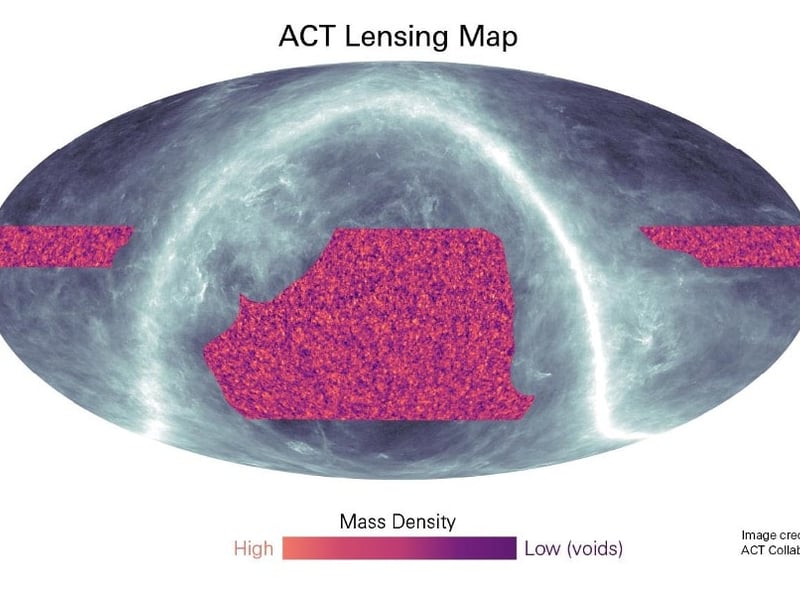
An international team of researchers have rendered new observations from the Atacama Cosmology Telescope into the most detailed map to date of dark matter across a quarter of the universe, indicating the shape and expansion rate of the universe since its creation.
Although dark matter is theorized to make up around 85% of the universe, it is usually invisible to astronomers, as it does not interact with light or electromagnetic radiation. Instead, dark matter only seems to interact with gravity, an interaction that Atacama telescope researchers took advantage of to create their map.
Presented Tuesday at “Future Science with CMB x LSS”, a conference at the Yukawa Institute for Theoretical Physics at Kyoto University in Japan, this new map depicts the usually invisible dark matter by measuring how diffuse light known as cosmic microwave background radiation warps around dark matter in a way that also confirms Albert Einstein’s theory of general relativity.
“We have mapped the invisible dark matter across the sky to the largest distances, and clearly see features of this invisible world that are hundreds of millions of light-years across," University of Cambridge cosmology professor Blake Sherwin said in a statement.
Einstein’s theory of general relativity, which describes how gravity may affect the fabric of space and time, indicated that massive structures in space could grow and bend light with their gravitational force, distorting it in a way that would allow researchers to see the winding path of cosmic background radiation from the beginning of the universe 14 billion years ago until now.
“When I first saw them, our measurements were in such good agreement with the underlying theory that it took me a moment to process the results,” Cambridge doctoral student and ACT team member Frank Qu said in a statement. “It will be interesting to see how this possible discrepancy between different measurements will be resolved.”
Cosmic microwave background radiation, the light emitted during the dawn of the universe, has been studied as evidence for the Big Bang as a theory for the origin of the universe.
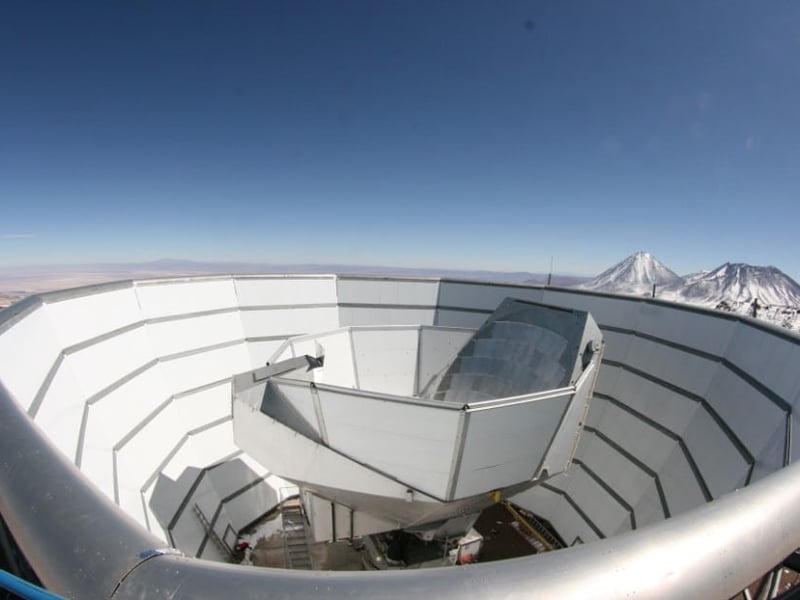
The Atacama Cosmology Telescope measures what the universe looked in this period, mere thousands of years after the beginning of the universe, using an array of mirrors and cameras that are able to look back in time to measure light from billions of years ago.
“We’ve made a new mass map using distortions of light left over from the Big Bang,” said professor Mathew Madhavacheril, from the University of Pennsylvania’s Department of Physics and Astronomy, in a statement. “Remarkably, it provides measurements that show that both the ‘lumpiness’ of the universe, and the rate at which it is growing after 14 billion years of evolution, are just what you’d expect from our standard model of cosmology based on Einstein’s theory of gravity."
The map was produced using gravitational lensing, which occurs when light travels past a massive object, like galaxies or dark matter, and is subsequently warped by the object. When telescopes like Atacama receive the image, it will reflect the degree of distortion to show where cosmic structures have been and how they have changed in 14 billion years.
Research was done through a collaboration between the National Science Foundation, University of Pennsylvania, University of Cambridge, the University of British Colombia, and Princeton University.
This dark matter map is some of the last observations to come from the Atacama Cosmology Telescope, which was decommissioned in September 2022. Located in mountains of Chile’s Atacama Desert, the telescope will be replaced by the Simons Observatory and a new telescope currently under construction that is anticipated to be able to map the skies at 10 times the speed of the former telescope.
Subscribe to our free newsletters
Our weekly newsletter Closing Arguments offers the latest about ongoing trials, major litigation and rulings in courthouses around the U.S. and the world, while the monthly Under the Lights dishes the legal dirt from Hollywood, sports, Big Tech and the arts.