
 Search Articles


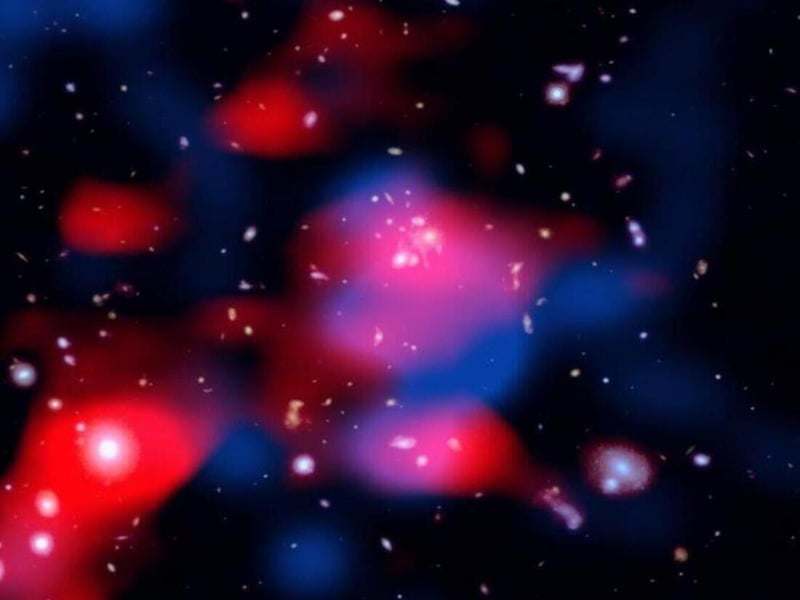
(CN) — In the depths of space, 10 billion light-years from Earth, astronomers have spotted something extraordinary: a vast cloud of energetic particles wrapped around a cluster of galaxies like a cosmic shroud. It’s the most distant “mini halo” ever discovered.
The find suggests that these galactic neighborhoods — among the largest structures in the universe — have been bathed in high-energy particles for nearly their entire existence, far longer than scientists had realized.
“It’s as if we’ve discovered a vast cosmic ocean, where entire galaxy clusters are constantly immersed in high-energy particles,” Julie Hlavacek-Larrondo of Universite de Montreal, who co-led the research team, said in a statement.
The discovery, detailed Thursday in The Astrophysical Journal Letters, offers a glimpse into what the early universe looked like when it was just a quarter of its current age. Back then, galaxy clusters were already being sculpted by the same forces that shape them today.
The international research team, led by Hlavacek-Larrondo and Roland Timmerman of Durham University’s Institute for Computational Cosmology, made the discovery using the Low Frequency Array, or LOFAR — a radio telescope network of more than 100,000 small antennas scattered across eight European countries.
While studying a galaxy cluster called SpARCS1049, the researchers detected a faint but widespread radio signal that wasn’t coming from any individual galaxy. Instead, it emanated from a million-light-year-wide region of space filled with charged particles racing through magnetic fields at tremendous speeds.
This diffuse radio glow is the telltale sign of a mini halo, a phenomenon that astronomers had only been able to observe in our cosmic backyard until now.
“It’s astonishing to find such a strong radio signal at this distance,” Timmerman said. “It means these energetic particles and the processes creating them have been shaping galaxy clusters for nearly the entire history of the universe.”
How do such enormous clouds of high-energy particles form? The researchers have two leading theories,
The first involves the supermassive black holes that lurk at the centers of galaxies within these clusters. They can blast streams of particles into space at nearly the speed of light. But researchers are still unsure about over how these particles manage to travel so far from their black hole origins while retaining so much energy.
The second explanation is more like a high-speed crash. Within the scorching plasma that fills galaxy clusters, charged particles occasionally slam into each other at near-light speeds, breaking apart into the highly energetic fragments that can be detected from earth.
The discovery provides a rare window into the infancy of galaxy clusters, revealing that they have been energized by violent processes for billions of years longer than previously thought. It suggests that black holes and high-energy collisions were already enriching these environments when the universe was young.
Future telescopes, including the planned Square Kilometer Array (SKA), will be sensitive enough to detect even fainter signals from the early universe, allowing astronomers to probe deeper into the role of magnetic fields and other phenomena.
“We are just scratching the surface of how energetic the early Universe really was,” Hlavacek-Larrondo said. “This discovery gives us a new window into how galaxy clusters grow and evolve, driven by both black holes and high-energy particle physics.”
 Follow @JeremyYurow
Subscribe to our free newsletters
Our weekly newsletter Closing Arguments offers the latest about ongoing trials, major litigation and rulings in courthouses around the U.S. and the world, while the monthly Under the Lights dishes the legal dirt from Hollywood, sports, Big Tech and the arts.