
 Search Articles


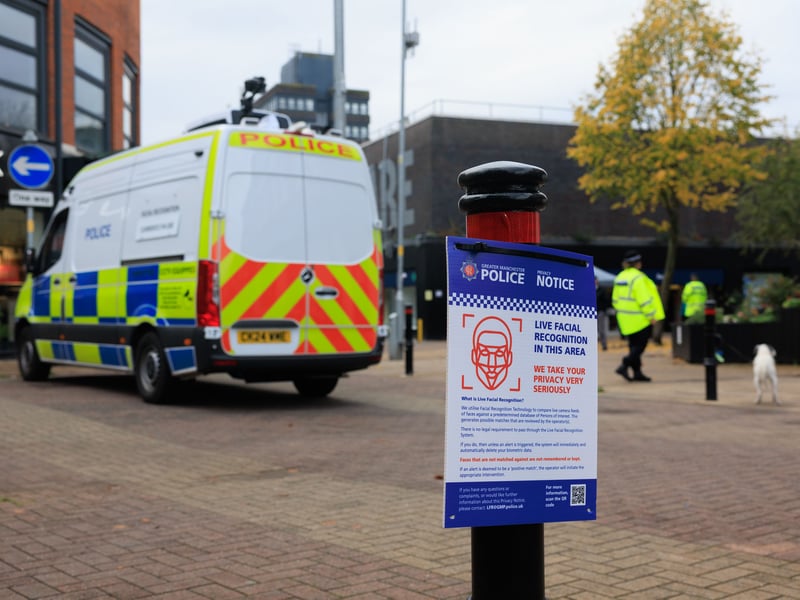
MANCHESTER, England (CN) — Live facial recognition technology is spreading from city streets to supermarket aisles, with police and major retailers ramping up the use of the surveillance tool.
Between London and Greater Manchester alone — home to roughly 11 million people, or about one-fifth of England’s population — millions are now potentially being scanned each year.
The Metropolitan Police have announced it is scaling up its use of live facial recognition technology in the coming months, increasing deployments with additional support from officers.
The Met’s annual report found that between September 2024 and September 2025, the technology led to 962 arrests, bringing the total since the rollout began to more than 1,400. More than 1,000 people have been charged or cautioned, the force said, including those wanted by courts and offenders breaching conditions.
Police claim the technology has not led to any wrongful arrests, but they also concede the system has produced false alerts for 10 people, eight of whom were Black.
From streets to supermarkets
The technology is now entering retail spaces.
Sainsbury’s, the U.K.’s second-largest supermarket, has begun an eight-week trial of facial recognition cameras in two stores, one in south London and one in Bath, to identify repeat shoplifters and violent customers.
Other businesses are already using the technology, but Sainsbury’s is the biggest retailer to deploy it so far.
The system, provided by Facewatch, alerts staff when known offenders enter a store.
If the trial goes well, it may roll it out to other stores.
“The retail sector is at a crossroads,” said chief executive Simon Roberts, citing rising abuse, antisocial behavior and violence against staff.
According to the Office for National Statistics, 530,643 shoplifting offenses were recorded in England and Wales in the year to March 2025 — a 20% rise, the highest level in more than two decades.
Sainsbury’s said in a statement that privacy is “at the heart of the trial,” stressing that only people with records of aggression or theft are flagged and that “all other data generated by the software is instantly deleted.”
Birmingham law professor Karen Yeung, who has advised Parliament on the technology, said the spread of facial recognition in shops reflects how easily the technology can now be deployed.
“Facial recognition technology is now cheap and out of the box and easy to use,” she said. “Combined with the rise in shoplifting associated with the cost of living crisis and austerity, it is an attractive tool for retail outlets.”
‘Chilling’ technology
Privacy campaigners say the expansion is racing ahead without oversight.
Big Brother Watch, which is backing legal action to stop police and retail use of facial recognition, called Sainsbury’s move “deeply disproportionate and chilling.”
The group said the technology “turns shoppers into suspects,” warning that people are “being falsely accused, grossly mistreated and blacklisted from shops, despite being entirely innocent.”
It added: “Facial recognition is dangerously out of control in the U.K. Sainsbury’s should abandon this trial and the government must urgently step in to prevent the unchecked spread of this invasive technology.”
Its petition calling for a ban has drawn nearly 53,000 signatures.
Sam Grant, director of external affairs at the civil liberties organization Liberty, urged Parliament to pass laws setting “robust safeguards around our rights,” noting that other democracies already regulate such systems.
“Walking past a camera is like showing your ID at a checkpoint, something most of us don’t want to have to do in order to go to the shops," he said.
Unlike the U.K., the EU imposes strict legal limits on its use.
Yeung noted that: “With the exception of authoritarian states, such as China and Saudi Arabia, for example, the U.K. is a strong early adopter of facial recognition technology among self-described democratic states.”
Public unaware of weak rules
Despite the warnings, the public appears broadly comfortable with facial recognition.
A King’s College London survey found 66% of people felt comfortable with police use of the technology, often citing safety and crime prevention. Two in five said they trusted police to use it ethically, and many saw “no real difference” from traditional CCTV.
Yet the study also found little awareness of how minimally the technology is regulated.
A separate Alan Turing Institute poll found support for police use remained high, but concern rose sharply when respondents were told private companies could share and store facial data. Many expressed anxiety over the level of safeguards currently in place.
As facial recognition spreads across public and private spaces, privacy advocates warn that without clear laws and oversight, millions of people could be monitored with little transparency or recourse.
Giving evidence to the House of Lords in December 2023, Yeung noted that 144,000 faces were scanned in London that year with only eight arrests. “That is a prima facie violation of the privacy of 144,000 people in public settings.”
There is currently no dedicated piece of legislation to set out comprehensive rules for facial recognition technology use by police or retailers.
Courthouse News reporter James Francis Whitehead is based in England.
 Follow @jayfranklinlive
Subscribe to our free newsletters
Our weekly newsletter Closing Arguments offers the latest about ongoing trials, major litigation and rulings in courthouses around the U.S. and the world, while the monthly Under the Lights dishes the legal dirt from Hollywood, sports, Big Tech and the arts.