
 Search Articles


SACRAMENTO, Calif. (CN) —The California Legislative Analyst’s Office released a preliminary assessment Tuesday raising concerns over the Golden State’s proposed overhaul of its technology project approval process, particularly for initiatives involving generative artificial intelligence.
The new framework, known as the Project Delivery Lifecycle (PDL), is set to replace the existing Project Approval Lifecycle (PAL) in the coming years. However, in its assessment, the office cautions that the framework’s accelerated implementation, slated for July, may be premature due to a lack of comprehensive evaluation and transparency.
PDL will change how big tech projects are approved by allowing teams to try small versions of a project first, called a proof of concept, before doing the full version. This is meant to help with newer technologies, like generative AI, that are harder to plan for in advance.
But the state’s budget advisors are worried that the state is moving too quickly.
Despite the potential benefits, the office notes that the initial round of generative AI proof-of-concept projects has not progressed beyond the planning stages, leaving the California Legislature without sufficient data to assess the PDL’s effectiveness. Moreover, the new process may limit access to critical information, such as baseline costs and project scopes, which are currently available under the existing framework.
To address these concerns, the office wants lawmakers to slow down, and recommends that through the end of the 2025-26 fiscal year, PDL only be used for current test projects that are using generative AI, not new projects.
The office is also asking lawmakers for regular updates and wants to continue monthly meetings between legislative staff and the administration to monitor generative AI developments and the PDL’s implementation.
These measures aim to ensure that the PDL is thoroughly evaluated and refined before it becomes the standard for all state technology projects, thereby safeguarding public resources and maintaining legislative oversight.
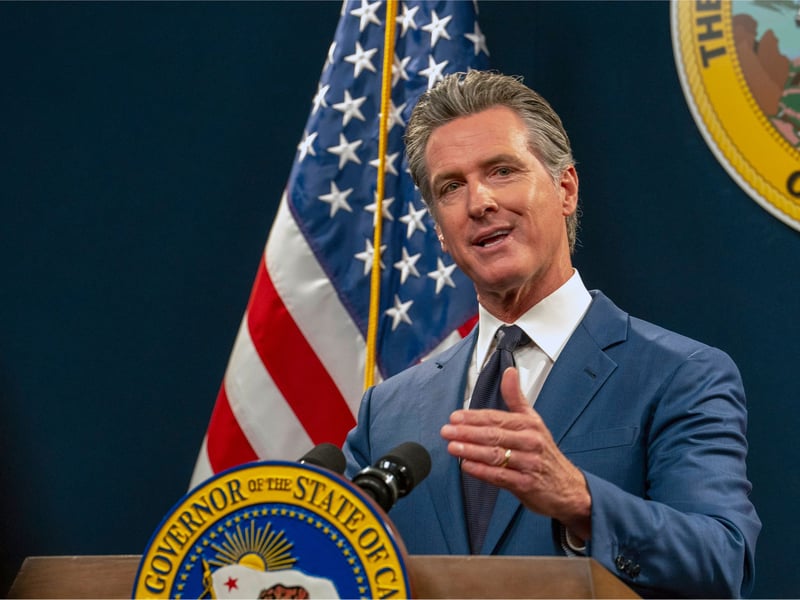
The report comes the same day as California Governor Gavin Newsom, along with other state leaders, touted generative AI in downtown Los Angeles describing new ways the technology can improve California’s operations.
In 2023, Newsom issued an executive order directing state agencies to utilize generative AI to improve state services and help solve the most important problems facing the state.
On Tuesday, Newsom said that the state, with the support of state workers, is entering into three new agreements for utilizing generative AI to reduce freeway and road congestion, improve safety on the roads and enhance customer service and efficiency for Californians who need to use state systems such as the Department of Motor Vehicles.
“GenAI is here, and it’s growing in importance every day. We know that state government can be more efficient, and as the birthplace of tech it is only natural that California leads in this space. In the Golden State, we know that efficiency means more than cutting services to save a buck, but instead building and refining our state government to better serve all Californians,” Newsom said.
Newsom said that California’s use of AI is not happening at the same scale in any other state in the country.
The governor added that a California Department of Transportation project will use generative AI to analyze real-time and historical data from roadways to predict traffic bottlenecks, detect incidents faster and identify locations for safety enhancements, reducing traffic delays across the state.
“We want to use generative AI to identify the bottlenecks and solutions to be able to address those bottlenecks along our transportation system throughout the state,” said California Transportation Secretary Toks Omishakin, noting that the use of AI can reduce what used to be months of work to mere days.
The California Department of Transportation will also be using Google’s Gemini AI tool to analyze datasets such as crash records to help the department better protect drivers and pedestrians. In the next phase, the tool will expand upon the datasets to better identify and address locations across the state that are in need of safety upgrades.
Newsom said that the California Department of Tax and Fee Administration will also use generative AI to swiftly search more than 16,000 pages of reference materials and assist staff in providing responses to taxpayers via telephone and live chat, making for a quicker, more pleasant experience.
Subscribe to our free newsletters
Our weekly newsletter Closing Arguments offers the latest about ongoing trials, major litigation and rulings in courthouses around the U.S. and the world, while the monthly Under the Lights dishes the legal dirt from Hollywood, sports, Big Tech and the arts.