
 Search Articles


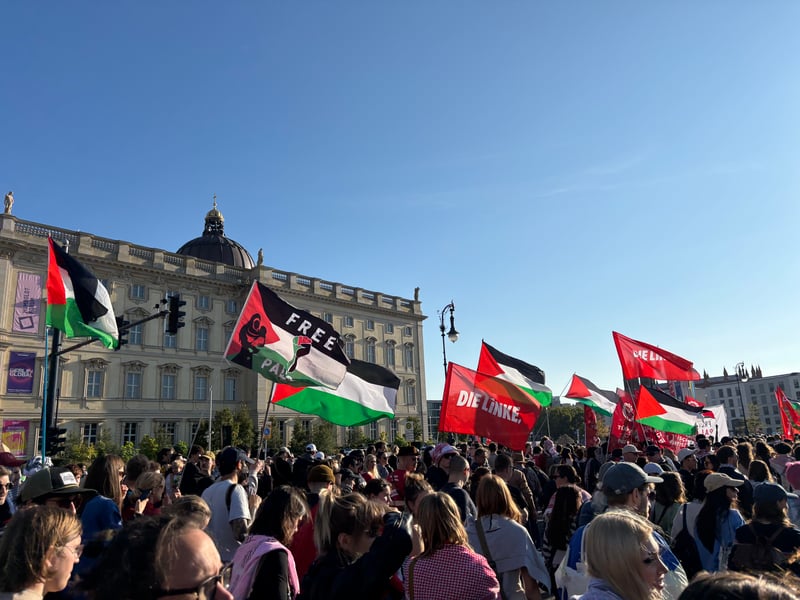
BERLIN (CN) — Though German Chancellor Friedrich Merz’s reaction to the ceasefire in Gaza largely rests on the prospects of long-term peace in the region, he expects an impact back home too.
“I hope this will also bring some calm on the domestic front. Especially that Jewish citizens will once again feel safe and that these intolerable antisemitic incidents will be relegated to the past,” Merz recently told a German public broadcaster. He did not elaborate on which incidents he was referring to.
“There’s no more reason for Palestinians in Germany to demonstrate,” he added.
Merz is hoping that Germany has escaped the domestic political maelstrom that grew out of the crisis in Gaza, where increasingly popular and well-supported pro-Palestinian demonstrations were at direct odds with his government.
Many in Germany’s Palestinian solidarity movement have uttered a cautious optimism in the wake of the ceasefire, but protests have continued.
“Of course we welcome deescalation and an end to mass death,” Laura, an activist at the Berlin-Based organization Eye4Palestine, told Courthouse News. “But the joy is accompanied by fear that the ceasefire won’t be respected.”
Even prior to Merz taking office, Germany has struggled to balance what it sees as a historic responsibility to the state of Israel, its commitment to human rights abroad and domestic rights around protest and freedom of assembly.
Shifting sentiment, static policy
German public sentiment has shifted significantly in the last two years. Recent polling saw a majority of Germans demand tighter controls on arms exports to Israel and the vast majority of the country describing Israel’s military response in Gaza as “unjustified.” Merz has also rejected the proposition of recognizing a Palestinian state, despite support from a majority of Germans.
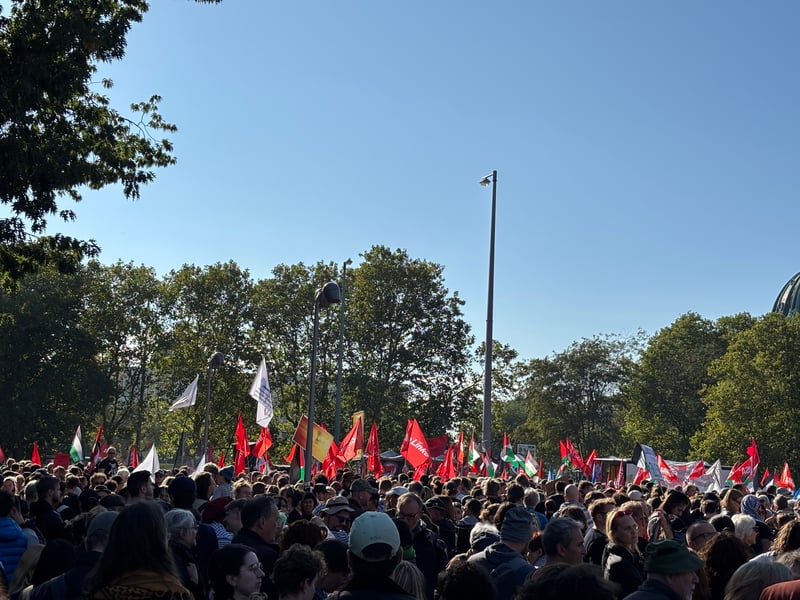
And though there has been a torrent of protest since Oct. 7, 2023 — with nearly 700 pro-Palestinian protests in Berlin alone — they only began seeing mass support this autumn, culminating in roughly 100,000 marching in Berlin in late September.
“About a year ago the demonstrations were way smaller. I’ve been going to a lot of these and never seen anything so big,” William, a 22-year-old student told Courthouse News at a Sept. 28 protest in Berlin.
While Merz noted that “Palestinians” no longer have a reason to demonstrate given the ceasefire, mass demonstrations with tens of thousands of protestors have brought in a wide range of German society.
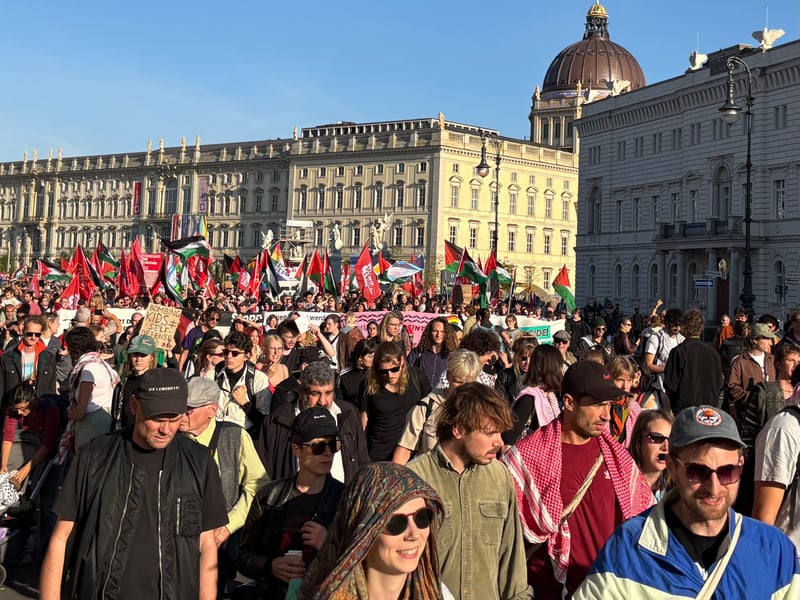
“I think things have changed,” Ingrid, a protester in her 80s who has long been attending pro-Palestinian protests in the German capital, told Courthouse News.
“I think more people are becoming aware of the atrocities in Gaza and are beginning to have a sense of responsibility because of German policies,” she continued.
Mohamad, a 22-year-old student, believes Germany’s trepidation around criticizing Israel or recognizing a Palestinian state compared to other European countries motivated Germans to take to the streets.
“We see what other countries are doing and know things need to change in Germany too,” he said. “I’m hopeful there, especially when I see so many teenagers and young people like myself here. They’ve changed how they feel about Palestine.”
Ingrid, who argued Israel was committing a genocide in Gaza, said Germany’s history meant it had to withdraw support for Israel. “It’s so disheartening. We Germans were so horrible to the Jews, and now Israel is doing something similar to the Palestinians. It has to stop,” she said.
A repressive response?
The German state has taken a starkly different interpretation of history. Germany considers Israel’s security its “reason of state” due to the nation’s historical responsibility for the Holocaust.
This is frequently borne out by interpreting any criticism of Israel or its policies as antisemitic — a stance that hardened during the war in Gaza and has guided the nation’s approach to protest.
This led to an aggressive approach from German authorities to protests, sparking numeroushigh-profile accusationsof police violence.
“We have definitely seen an increase in very harsh, and in my view, disproportionate responses by the state to protests that arose in Berlin after Oct. 7,” Paula Zimmermann, legal advisor to Amnesty International Germany, told Courthouse News.
Zimmermann noted that this includes both individual cases of police violence, which “very deliberately create chilling effects to prevent people from protesting next time,” and also reflects the state’s wider response to pro-Palestinian speech.
Numerous blanket bans on pro-Palestinian demonstrations were rolled out in Germany, particularly early in the war. Events including a pro-Palestinian conference were forcibly cancelled and shut down by police.
An aggressive approach to pro-Palestinian speech is nothing new in Germany. In 2019, the German Parliament passed a resolution banning the Boycott, Divest and Sanction movement and Berlin began banning Nakba Day demonstrations outright in the early 2020s.
These positions have only intensified in the last two years, culminating in last year’s controversial antisemitism resolution and Germany weighing the removal of citizenship for dual citizens for anyone accused of antisemitism.
Zimmermann argues these policies, as well as the removal of funding for cultural institutions tied to pro-Palestinian movements and attacks on academic freedom, have created a widespread chilling effect.
“I think there’s a climate of uncertainty and fear where people ask ‘what can I say? What protest can I attend? Will they label me an antisemite?’” she said. “This doesn’t just apply to very outspoken activists, but in society more broadly. It’s also tied to foreign policy, where public opinion has shifted and is quite clearly opposed to the government regarding arms exports or the blockage of humanitarian aid.”
Policy changes on the horizon?
Though Merz has been a bit more vocal in his criticism of Israeli policy than his predecessor Olaf Scholz, it seems German material policy evolved little in the last year of the war.
Though Germany announced a halt on weapons exports to Israel “for use in Gaza” in August, this reportedly did little to quell the flow of arms. Germany has already signaled it will officially lift the arms embargo in the wake of the ceasefire.
And though Merz is optimistic the ceasefire will quell the mass protest, those who took to the streets in the last two years — or the many who stayed home but held views at odds with the German state — are unlikely to forget his government’s positions.
Meanwhile, Germany’s pro-Palestinian activists, many of whom were active prior to Oct. 7, have not stopped with the ceasefire.
“Over the last two years, the end to the genocide was the priority of our protest, but that was never our only goal,” Laura said.
“The systemic oppression, displacement and murder of Palestinians has a 77-year history. We’ll keep pushing even harder for Palestinian self-determination now,” she added.
 Follow @braneck
Subscribe to our free newsletters
Our weekly newsletter Closing Arguments offers the latest about ongoing trials, major litigation and rulings in courthouses around the U.S. and the world, while the monthly Under the Lights dishes the legal dirt from Hollywood, sports, Big Tech and the arts.