Search Articles



(CN) — It’s dubbed the “flamingo revolution” — a surge of anger and protest against longtime Albanian Prime Minister Edi Rama and his cozy relationship with Jared Kushner and Ivanka Trump as they seek to turn a pristine part of Albania’s coast known for its flamingos and beautiful beaches into a vast luxury resort.
The $1.4 billion Trump-Kushner resort is slated for construction on a remote island and the nearby delta of the Vjosa River, a shelter for an assortment of wildlife, including about 3,000 flamingos, Dalmatian pelicans, Loggerhead sea turtles and critically endangered Mediterranean monk seals.
The Vjosa, one of Europe’s last wild rivers, empties into the Adriatic Sea in southwestern Albania with its delta composed of the ample Narta Lagoon, sand dunes, beaches and wetlands. Just over 5 miles offshore from the lagoon sits Sazan Island, a large but uninhabited island with two high peaks. It served as a naval base during the Cold War and is covered in a network of bunkers and tunnels.

In early 2024, Kushner revealed plans to turn Sazan Island and areas around the Narta Lagoon into a resort. The scheme involves Kushner’s Affinity Partners, Saudi investors and others.
The plans are vast: Reports describe as many as 10,000 hotel rooms and villas spread across Sazan Island and the Vjosa-Narta coastal area near Vlorë, a city of about 115,000 people.
Kushner is a real-estate billionaire who serves as a top adviser to U.S. President Donald Trump, his father-in-law. He is also spearheading the president’s campaign to turn parts of the Gaza Strip into a luxury resort.
Kushner said he first visited Sazan Island with his wife, Ivanka Trump, during a yacht trip with their friend and financier Nathaniel “Nat” Rothschild, a member of the famous English banking family.
In a recent interview, Ivanka Trump said they swam from the yacht to the island, and walked barefoot up to a summit. Angering Albanians, she described Sazan as a “private island” despite it belonging to Albania.
“We were just captivated and it just stayed with us ever since,” Trump said, speaking on a podcast. She said they wanted to “help it [the island] realize its potential.”
“We have not only the island but we have 5 miles of beachfront directly across from the island,” she said, speaking about the resort. “This beautiful peninsula with a lagoon on the one side, the ocean on the other, beautiful white sand beaches.”
She said the resort, which would be designed by world-renowned architects, was a “culmination” for her and came after “a lot of reflection on how I want to live, how I think people increasingly are wanting to live.”
But those plans are now in doubt as protests grow in Albania over what many see as an unlawful land grab of a national nature preserve orchestrated with the consent of Rama, the country’s prime minister since 2013 and leader of the center-left Socialist Party. He once famously declared, “Albania needs luxury tourism like a desert needs water.”
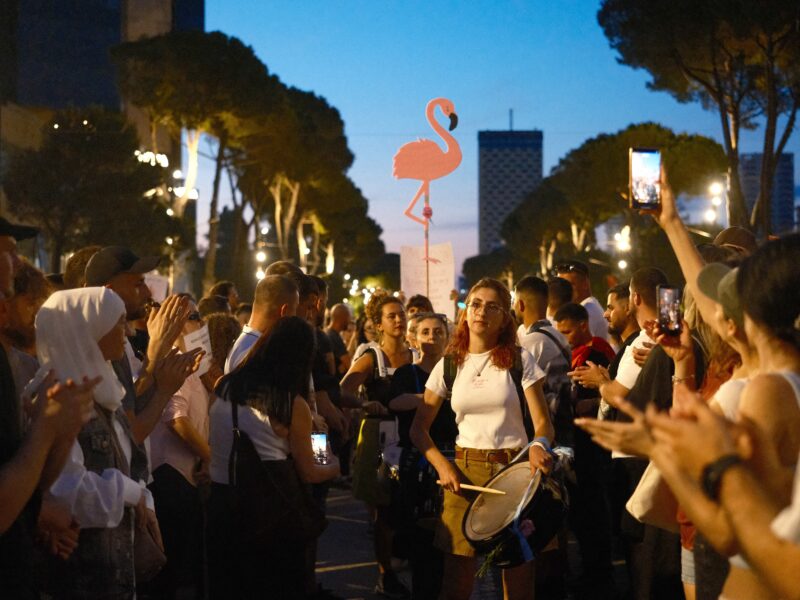
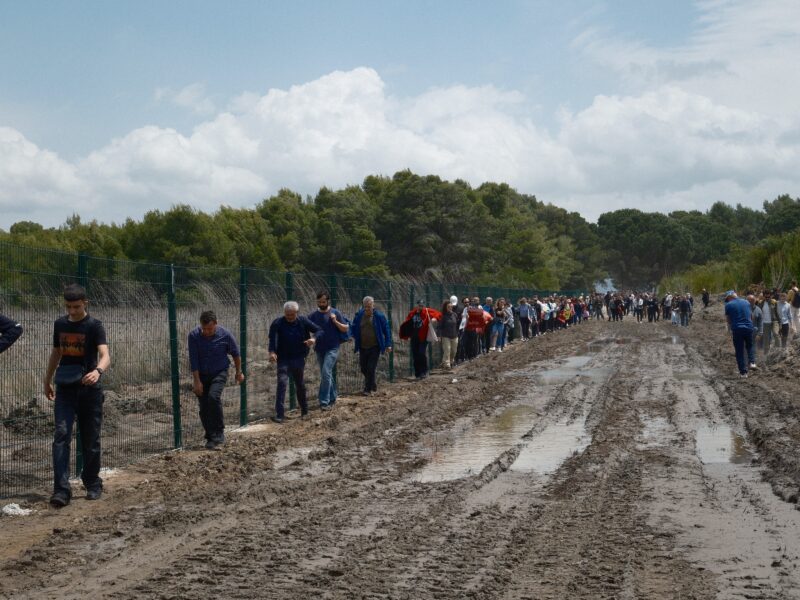
For the past week, a growing mass of protesters has taken to the streets of Tirana, the Albanian capital, to express outrage after work began in late April on the resort even before the Albanian government had approved environmental permits.
“No environmental assessment has been done for these projects,” said Denisa Kasa, a project manager with Protection and Preservation of Natural Environment in Albania, an environmental group leading the protests. Besides not undergoing environmental reviews, she said the work was unlawful because it had not been vetted by the public.
Initial work has involved erecting fences and bringing in bulldozers and dump trucks to lay roads made with gravel and rocks over beaches and through sand dunes.
The delta enjoys protected status, but in 2024 the Albanian Parliament passed special legislation to reclassify Sazan Island and the Pishë Poro–Narta area to allow for large-scale luxury development.
The move was heavily criticized by environmental groups and opposition parties, who argued the changes were made to accommodate foreign investors, particularly those linked to Kushner and Ivanka Trump.
The reclassification allowed the Albanian government to grant “strategic investor” status to Kushner’s companies, fast-tracking approvals and providing tax incentives for the projects. On Dec. 30, 2024, Rama granted preliminary approval to the venture.
Anger has been fueled by images showing heavy machinery tearing into sand dunes in the Vjosa delta and security guards at the site confronting protesters and dragging at least one across a beach.

Adding to the outrage, local small-time property owners accuse developers of barring them from properties they claim are theirs. The resort project is tied up in a series of property disputes stemming from expropriations carried out under Albania’s Stalinist-style communist dictatorship.
The protest movement has grabbed headlines as crowds bring inflated flamingos, flamingo-shaped cardboard cut-outs on sticks and signs denouncing the destruction of a nature preserve for the benefit of luxury tourism. The signs commonly read: “Cancel the project,” “Albania is not for sale” and “Ivanka, go home.”
On Wednesday, demonstrations turned ugly with police spraying water cannons at crowds. Tensions were high because the protests overlapped with a contentious soccer match between Albania and Israel.
“This dispute appears to have become a proxy for broader frustrations about governance, transparency and the concentration of economic power,” said Miguel Roán, a Balkans expert who runs Balcanismos, a Spanish website dedicated to the region.
“The environmental arguments matter,” he said, “but the emotional force behind the protests seems to come from a feeling that important national assets are being decided upon without meaningful public involvement, and instead by local politicians and foreign investors.”
Protests are expected to continue into the weekend with organizers planning to hold rallies outside Albanian embassies and consulates in several European cities.

Making matters worse for Rama, this week Albania’s special corruption prosecutors, known as the SPAK agency, launched a formal investigation into the legal and environmental changes that enabled the project.
They said they were focusing on accusations of corruption, land reclassification and funds used to acquire land titles.
“There are certainly enough questions to justify investigation,” Roán said. “Whether actual violations occurred remains unclear, but the process appears irregular enough to fuel public concern.”
The protests and corruption probe are an embarrassment for Rama and undermine his efforts to bring Albania into the European Union. In the wake of the controversy, Brussels has emphasized that Albania must uphold EU environmental laws if it wants to be admitted into the bloc.
Rama has been rattled.
In an interview with CNN this week, the prime minister appeared defensive and angry.
“The investigation is not about Kushner, it is not about Trump, it is not about the project,” he insisted.
He dismissed accusations aired by protesters as “fake news.”
“Sensational fake news that Albania is a place where we are killing flamingos,” he told the CNN interviewer. He said there was no “pouring cement on the head of flamingos” and “no thing as a Trump family island.”
“We are not here to destroy Albania, we are here to make Albania a role model,” he said.
Still, he provided vague answers, saying an environmental review was underway and even saying the project had not yet been approved.
But he did not back down and asserted “the challenge is to prove that developments and nature cannot only coexist, but nature and development need each other.”
The controversy has jolted Albania, a country undergoing dramatic changes as it, like other Balkan nations, becomes a prime tourist destination.
In recent years, Albania’s Adriatic coastline, which had been left largely untouched during decades of communist rule, has seen an explosion of development. But charges of government corruption and mafia activity have swirled around the rapid seaside development.
“Across much of the Adriatic coast, there is a recurring perception that prime coastal land is increasingly being transferred to large investors through political connections and opaque planning decisions,” Roán said.
But he doubted the protests would seriously damage Rama or threaten his government.
“Edi Rama remains one of the strongest political leaders in the Balkans and has overcome more serious challenges over the past decade,” he said.
Still, he said they might “reinforce a growing perception that major decisions are being made for the benefit of politically connected investors rather than the public.”
“What makes these protests relevant is that they do not appear to be driven primarily by party politics, which gives them a different legitimacy and makes them harder for the government to dismiss,” Roán added.
The protests, he said, might “delay and reshape the project” rather “than stop it outright.”
“Rama has publicly invested a great deal of political capital in defending the development, making a complete reversal difficult,” he said. “The protests could still gain momentum, particularly during the summer tourist season, when the government may come under greater pressure to avoid negative publicity.”
This isn’t the first time a Kushner-Trump project has come under fire in the Balkans.
Last year, Kushner backed away from a project to turn the bombed-out former Yugoslav army headquarters in Belgrade into a hotel. He scrapped the project following widescale protests, lawsuits, fierce opposition and corruption probes.
Courthouse News reporter Cain Burdeau is based in the European Union.
 Follow @cainburdeau
Subscribe to our free newsletters
Our weekly newsletter Closing Arguments offers the latest about ongoing trials, major litigation and rulings in courthouses around the U.S. and the world, while the monthly Under the Lights dishes the legal dirt from Hollywood, sports, Big Tech and the arts.