
 Search Articles


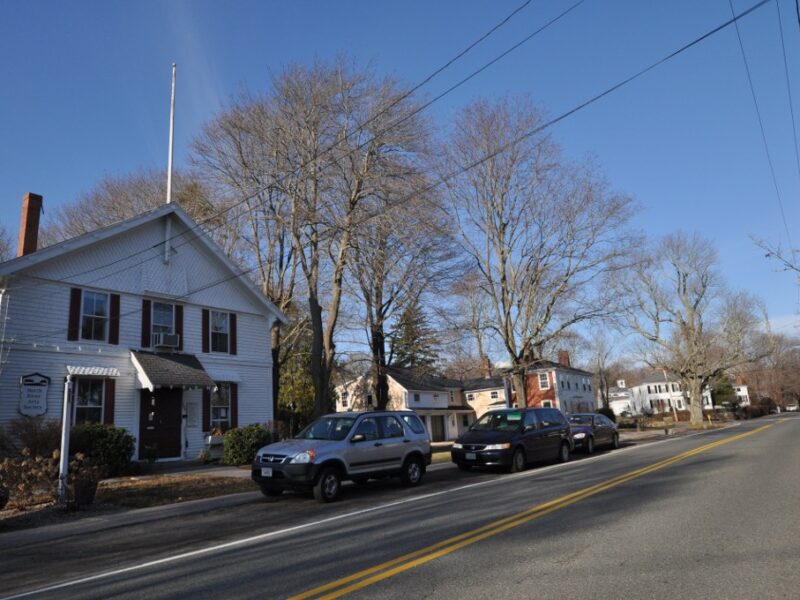
BOSTON (CN) — A controversial Massachusetts law designed to increase housing affordability by forcing sleepy exurban towns to allow high-density housing projects got a generally positive reception during oral argument at the state supreme court Wednesday.
The law, enacted five years ago, requires the 177 communities served by the greater Boston public transit system to adopt zoning rules allowing for multifamily housing and a minimum density of 15 units per acre within a half-mile radius of transit stops.
The new rules created a furor in many rural and exurban communities, which claimed that a flood of new apartments would fundamentally change the character of the towns and require building expensive new infrastructure.
The state high court held unanimously last year that the law didn’t violate the separation-of-powers doctrine even though the Legislature delegated many of the details to an administrative agency. But the town of Marshfield filed a separate lawsuit raising a different argument — that the law was an “unfunded mandate” in violation of other state statutes, and the town didn’t have to comply unless the state reimbursed it for its expenses.
Marshfield, a quiet beach community with some famous residents and an average home price of $850,000, had to hire an additional land-use planner “to try to find an area where we could actually accommodate this use,” said the town’s lawyer, Robert Galvin.
“There’s a whole series of places in the town of Marshfield where it would not even be physically possible to locate a development like this,” Galvin said. “It just wouldn’t work. The roads are not sufficient to handle this. What the planner did was spend extraordinary time and expense trying to model a place where a location like this would work.”
But the justices were skeptical.
“Forcing you to make difficult decisions is not a mandate,” said Justice Scott Kafker. “You made a choice to comply in one way rather than another, and that’s not a mandate. It seems like it fits within a classic incidental expense, and the fact that it was more expensive was the result of a choice you made.”
“The statute just requires one district of reasonable size,” added Justice Dalila Wendlandt. “The attorney general has said this could be complied with by one sentence … Couldn’t the town of Marshfield have complied by simply allowing multifamily housing in all of its districts?”
“It could have done that,” Galvin admitted.
“It should have done that,” Wendlandt commented. “Doesn’t that vitiate your case that this is an unfunded mandate? … I know that’s not what the statute requires, but it’s how you could have complied.”
“It’s not like an environmental regulation where you need to hire a consultant,” Kafker said. “This is just politically complicated.”
But when the state’s lawyer, Esme Caramello, took the lectern, the justices tried to pin down at what point a politically complicated state requirement could become a mandate.
“A town could say, we want this done properly, it’s very controversial, and in these little towns their zoning officer might not have the skill to do that,” Kafker observed.
“We’re in a housing crisis,” Caramello said. “Are there some communities where there’s opposition? Maybe,” she added with considerable understatement.
“In some cases, it’s not controversial because they’ve done it so well, because they had expertise,” Kafker noted.
Justice Serge Georges asked Caramello if drafting, engineering, compliance and administrative costs could ever be a mandate, and she said no, that a mandate required an ongoing direct expense such as a state requirement that towns bus schoolchildren to private schools. “Did that answer your question?”
“Kinda,” Georges said to laughter in the gallery. “But it’s not just as easy as, ‘We’re gonna put it here or there and that’s all there is to it.’ This is much more than what local zoning officials do. What is the limiting principle?”
The case drew two dozen amicus briefs from advocates on all sides.
Marshfield, which has a full-time population of 25,000 that doubles in the summer, was settled in the early 1600s by Pilgrims from nearby Plymouth and was the home of Daniel Webster. More recently it has attracted a number of celebrity residents including Aerosmith frontman Steven Tyler, actor Steve Carell and the late attorney F. Lee Bailey, who represented O.J. Simpson and Patty Hearst.
Subscribe to our free newsletters
Our weekly newsletter Closing Arguments offers the latest about ongoing trials, major litigation and rulings in courthouses around the U.S. and the world, while the monthly Under the Lights dishes the legal dirt from Hollywood, sports, Big Tech and the arts.