Search Articles


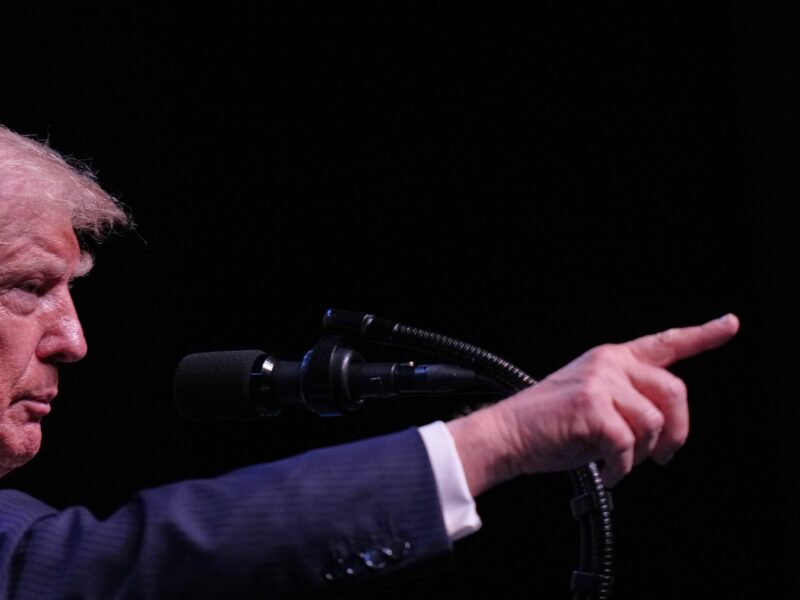
(CN) — With the threat of war resuming in the Middle East, a mercurial**** U.S. President Donald Trump on Wednesday ended a NATO summit in Turkey where he lashed out at his European allies before praising the alliance for its unity.
Trump’s two-day presence in Ankara sent confusing signals about how he views the NATO alliance and where he thinks the transatlantic relationship is going at a moment of intense global instability, with war raging in Ukraine and the Middle East veering off the rails again.
The summit was overshadowed by tit-for-tat strikes between Iran and the U.S. and Trump angrily denouncing Iranian leaders as “scum” and “evil.” A fragile 60-day truce was seriously in jeopardy by Wednesday.
At a final news conference Wednesday night, Trump applauded NATO, the 32-member U.S.-led alliance based in Brussels that has served as the West’s chief security arrangement since the end of World War II.
“I’ll tell you what,” Trump said. “If there’s one word that comes out of today it’s unification. I’ve never seen anything like it. Every one of those countries, they love us, they love each other. That was tremendous unification.”
He called it a “tremendously successful summit.”
Trump’s parting praise was jarring — though likely calculated —after he’d repeatedly told reporters at the summit he was upset with Europe for not helping the U.S. fight Iran, not spending enough on defense and not ceding Greenland to the U.S.
At one point Wednesday, Trump lashed out at Spain, berating it for not spending enough on defense and refusing to let American warplanes use its bases for strikes on Iran. Spain said it would have been illegal to do so, viewing the U.S. attacks as an act of aggression.
“I don’t want anything to do with Spain,” Trump said, turning to his White House team. “Cut off all trade with Spain, please, including visits.”
Spanish Socialist Prime Minister Pedro Sánchez, one of the only progressive leaders left in the European Union, has rankled Washington by recognizing a Palestinian state, questioning Europe’s rearmament push and calling the U.S. attacks on Iran illegal.
For their part, European leaders refrained from hitting back at Trump. The summit was kept deliberately short to prevent any flareups.
German Chancellor Friedrich Merz hailed the summit as a success and said he was “returning to Germany with the feeling that we made a big contribution to NATO staying together, to it becoming stronger, to it becoming more European.”
Merz said there was “a new feeling of European responsibility in the room” and that the era of “free-riding of the Europeans in NATO is over.”
Sánchez took no umbrage from Trump’s attacks and said ties between Spain and the U.S. were “very positive.”
“Relations between the United States and Spain are very positive in social, cultural, economic and also political terms,” Sanchez told reporters.
Despite Trump’s flashes of anger and displeasure, in the end he seemed to concede that Europe was carrying out his demand to spend more on defense. But he couched this shift as a benefit for the U.S. because, as he saw it, Europeans are buying American weapons.
“They all want American-made equipment,” he said. “We make the best equipment.”
He added: “As European nations rebuild their militaries, American equipment will be the largest beneficiary. The defense companies are going to be making most of that equipment, they want the American equipment because it works better.”
This, too, though is a point of contention. While Europe is spending vast sums on American weapons now, the European Union and its member states are eager to see much more money go to European manufacturers.
At last year’s annual summit, NATO’s members agreed to increase their defense spending from 2% of gross domestic product to 5% of GDP, a very tall order for Europe’s cash-strapped economies.
For years, Washington has urged European countries to spend more on defense and do more to take care of its security needs, and thereby free the U.S. to shift its focus toward China.
Russia’s invasion of Ukraine in February 2022 put even more pressure on Europe to rearm and prepare for potential war with Russia.
NATO’s new burden-sharing arrangement has been dubbed “NATO 3.0” and envisions a return to Cold War dynamics where the West faces the threat of conventional war, this time in the form of an aggressive Russia rather than the Soviet Union.
This understanding of NATO’s new strategy has been widely embraced by European leaders, many of whom are pushing for rapid rearmament.
NATO Secretary General Mark Rutte, a former Dutch prime minister, has gone to great lengths to show deference to Trump and convince him that Europe is shifting toward a war footing.
In late June, he went to visit Trump in the Oval Office armed with charts to prove NATO’s worth.
During that meeting, Rutte credited Trump with pushing the alliance toward greater military spending.
“This chart is about the ‘Trump Trillion,’” he said, referring to how European allies and Canada had added over $1.2 trillion in cumulative extra defense spending since 2017, the year Trump first took office.
He then showed another chart highlighting a significant recent spike that showed European allies and Canada spent almost 20% more on defense in 2025 than they had in 2024, an increase of $250 billion.
“I can assure you this is because of Russia, because of the threat,” Rutte told Trump at the time. “But I am also absolutely convinced that you, being president of the United States,” made the difference, “pushing for something which, since [President Dwight D.] Eisenhower, has not been achieved: which is the Europeans equalizing their defense spending with the United States.”
After talks ended Wednesday, Rutte said the summit had made for “a stronger, a fairer, and a more capable NATO.”
He said allies sealed $50 billion in new weapons deals at a defense industry forum on Tuesday, and had agreed to invest about $30 billion in fuel storage and distribution pipelines, including on NATO’s eastern flank.
NATO issued a six-paragraph communiqué upholding their alliance’s collective defense pact and promising Ukraine $80 billion in military aid both this year and next from Europe and Canada.
“Allies stand united in our unwavering support for Ukraine in defending its freedom, sovereignty and territorial integrity,” the statement said.
Courthouse News reporter Cain Burdeau is based in the European Union.
 Follow @cainburdeau
Subscribe to our free newsletters
Our weekly newsletter Closing Arguments offers the latest about ongoing trials, major litigation and rulings in courthouses around the U.S. and the world, while the monthly Under the Lights dishes the legal dirt from Hollywood, sports, Big Tech and the arts.