Search Articles



SAN LUIS OBISPO, Calif. (CN) — As the aroma of barbecued tri-tip wafted through the air and tourists visited a nearby surf shop in downtown San Luis Obispo, Michael LaFreniere stood at the top of the 34-foot bell tower in the historic mission building, attaching ropes to three clappers on a weekday afternoon.
Then, wearing noise-cancelling headphones, he positioned himself in the middle of the three large bells facing Mission Plaza below, stretched out the ropes and began tugging on each, creating a chiming chorus heard throughout this quaint Central Coast town.
When he finished, roughly two minutes later, he removed the headphones, detached the ropes and described the pattern he had just played.
“That is a faster-paced pattern,” he said, as the bells continued to send a hum aftershock through the plaza. “It’s more upbeat, for joyous occasions, like a wedding or Easter services and Christmas.”
Since 2020, LaFreniere has been the lead bell ringer at Mission San Luis Obispo de Tolosa, continuing a tradition that has existed for more than 250 years — and one that has involved his family for the past half century. In an era of automation, the San Luis Obispo mission is the last to use human bell ringers daily.
“It’s a neat connection to the community and a historic place,” he says. “This isn’t just another building in downtown SLO — it’s an iconic building, and it’s known worldwide.”
The mission is one of 21 erected in California by Spanish missionaries hoping to convert Indigenous populations to Catholicism while expanding European territories. The mission in San Luis Obispo was founded by Father Junipero Serra in 1772.
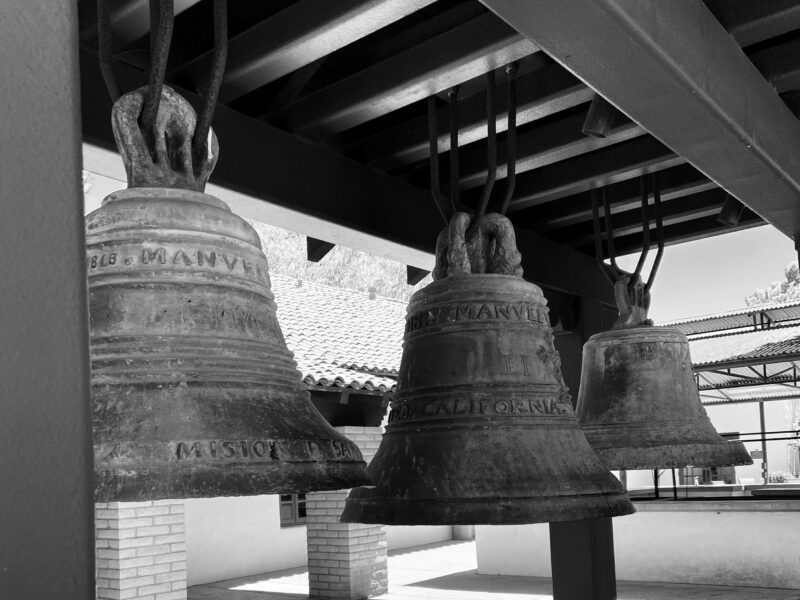
“The first-generation bells have been lost to history,” said Steve Schmidt, executive director of the nearby History Center of San Luis Obispo County. “That’s what Father Serra rang on Sept. 1, 1772. The second-generation bells (cast in 1818) came from Peru and took a 2 ½-year voyage to get here.”

Like all the missions, the bells helped structure the days for locals. Different bell patterns signaled weddings, funerals and religious holidays.
“Mostly, it was a call to prayer,” said Julia Costello, an archaeologist and co-author of “The California Missions: History, Art and Preservation.” “The bells would alert everybody within the sound of the bell to put down their work and come to the church for services.”
During the early missions days, Spanish missionaries taught young Native American boys how to ring the bells, said LaFreniere, who has also served as a docent at the mission for a decade. “And there was one Native American boy who rang the bells from the mission period up to the 1890s.”
That ringer shared his knowledge with 13-year-old Gregorio Silverio, who would go on to ring the bells for 60 years.
After Silverio’s death in 1954, the bells went silent for a while. Then, eventually, a local judge and Silverio’s granddaughter continued the tradition. Later, under a new priest, a church employee named Theresa Shipsey studied audio recordings of the bells created by Silverio and learned enough about the patterns from the judge and Silverio’s granddaughter to share with others.
“And she started a class to teach people how to ring the bells,” LaFreniere said.
In 1976, LaFreniere’s mother and grandmother learned to ring the bells.
“I’ve seen so many photos of my mom and grandmother and various other bell ringers and visitors in this tower,” he said, sitting where his grandmother once rang the bells. “It’s a very interesting feeling.”
The current bell tower, built in the 1930s, is a sparse space, featuring wood floors, a clock and logbook ringers use to document each time they ring the bells. While the tower has five openings for the bells, bats are surprisingly not that common, LaFreniere said — one is more likely to encounter an intruding possum here.
While he had visited his mother and grandmother in the bell tower when he was a child, LaFreniere first rang the bells himself in 2005 — just after the cracked 1818 bells were replaced.
Today, there are roughly 15 bell ringers at the mission, where the bells sound daily at noon and 6 p.m., and during weddings, quinceañeras, funerals and holidays; LaFreniere rings the bells at midnight on New Year’s Day. But not all bell ringers are equal.
“There are different skill levels of bell ringers,” LaFreniere said. “It’s not just as easy as pulling a rope to ring a bell. Pulling a rope to move the clapper to ring the bells is one thing, but getting it to actually sound nice is a different art and technique.”
The action has to be consistent, he said — you don’t want one note to stand out as louder or softer than the others. Meanwhile, the clapper has to have a bounce just right, and if it doesn’t bounce at all, it will mute.
“That’s what makes it ring,” he said.
Schmidt, the local historian who is also a bell ringer, said he’s impressed whenever he hears LaFreniere ring the wedding bell pattern.
“I’m, like, ‘Oh, he’s got skills,’” Schmidt said. “That’s a talent. That’s beautiful. What that man can do with these bells, and the music that he can create . . .”
Through the decades, mission bells have become one of the iconic visual representations of California – aided largely by the 700-mile stretch of Highway 101 that includes over 450 bell markers. One of the main promoters of those markers was the Automobile Club of Southern California.
“That was to promote tourism in California,” Costello said.

Highway 101, also known as El Camino Real — the royal road — connects the 21 missions from San Francisco to San Diego, and the highway bell markers were ostensibly seen as a nod to the missions.
“They could have used a cross, but that’s a little too religious,” Costello said. “And so they chose the bell as being kind of benign and cute. And you could recognize them at a distance.”
While the cross might better represent the missions, the bells clearly add to San Luis Obispo’s charm, providing a daily reminder that the historic structure remains the downtown centerpiece.
LaFreniere, who provides tech support for a local school district, mostly works the bells for weddings — at the busiest, he often has up to three weddings a day on a Saturday. As a wedding proceeds in the church below, he waits patiently in the tower, sometimes playing sudoku while listening to the ceremony on a speaker. And when the happy new couple rushes toward the front of the mission, preparing to burst through the doors, LaFreniere choreographs the moment with the jubilant bell pattern.
For each couple, Lafreniere knows, it’s a cinematic moment that will forever be burned in their minds.
“I get to be a part of the best day of their life,” he said.
Subscribe to our free newsletters
Our weekly newsletter Closing Arguments offers the latest about ongoing trials, major litigation and rulings in courthouses around the U.S. and the world, while the monthly Under the Lights dishes the legal dirt from Hollywood, sports, Big Tech and the arts.