Search Articles


(CN) — A Seventh Circuit panel on Friday upheld an Indiana law disallowing media access to witness state executions, finding the First Amendment does not guarantee special access to press.
“Journalists remain free to interview witnesses, report on any aspect of the proceeding and comment as they wish on the state’s choice to allow capital punishment or to execute a particular person,” U.S. District Judge Michael Scudder, a Donald Trump appointee, wrote for the 2-1 majority.
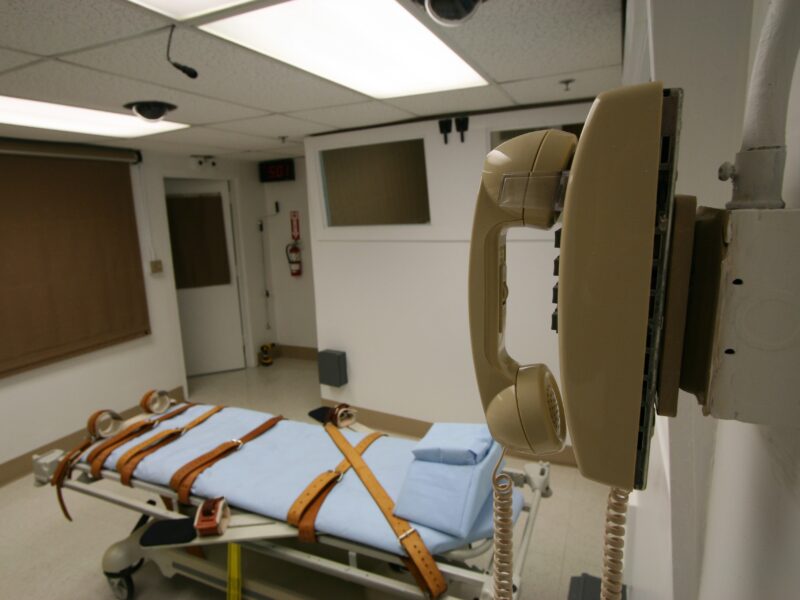
Indiana law limits execution attendees to the state prison warden, those assisting in the execution, the prison physician, one other physician, the incarcerated person’s spiritual advisor, the prison chaplain, up to eight immediate adult family members and up to five unspecified others.
It also provides a designated area for press but does not allow them to witness the executions directly. The Associated Press and other news outlets brought the challenge to Indiana’s prohibition on media from being present after the state resumed executions following a 15-year break.
The appellate panel, which heard oral arguments on the case in February, said First Amendment does not guarantee special access to the press which would not be afforded to the general public.
In particular, the panel’s majority found that the news outlets’ right of access argument — based on the Supreme Court’s recognition of a limited right to access certain governmental proceedings — stops short of applying to executions.
“The Supreme Court has only ever used it to assess whether the public has a right of access to traditional aspects of criminal proceedings,” Scudder wrote. “An execution does not resemble a court proceeding.”
Execution occurs outside of the adjudicative process, the panel found, after the factfinder has already determined guilt and the court has imposed a sentence and closed the case.
Although the law does not expressly ban journalists, the plaintiffs argued that preventing them from witnessing the execution first hand effectively treats them less favorably than members of the public because they are members of the press.
The majority was similarly unconvinced by this argument, pointing out that the high court has not extended such a broad definition of free exercise to the press clause.
The majority also found more open public scrutiny of an execution does not provide a “check on the activities of judges and litigants” or “foster more accurate fact finding,” as required by Seventh Circuit precedent in United States v. Eppinger.
Executions are not historically open to the press or general public in many parts of the country after the final public execution in the United States, which occurred in 1937, according to the panel.
During oral arguments, attorney Megan Michelle Smith argued on behalf of the state that the law protects certain standards of decency that have turned state executions from public spectacles to “private and less barbaric” events.
In the initial lawsuit, the news outlets highlighted the “outrageous” Indiana execution of William Vandiver, who was convicted of murdering his father-in-law and whose execution required multiple applications of electricity before being pronounced dead.
There were murky public reports on what happened, with a spokesperson for the jail simply saying the execution “did not go according to plan.”
In a dissent, U.S. Circuit Judge Candace Jackson-Akiwumi, a Joe Biden appointee, wrote the government cannot be accountable to the public in the execution chamber without journalists present.
“A government exercises its greatest power when it ends a person’s life,” Jackson-Akiwumi wrote. “As I see it, such severe and irreversible punishment on behalf of ‘the people’ must be observable to comply with the Constitution … But the public cannot oversee what it cannot observe.”
The majority conceded that increased scrutiny on the process may lead to more humane executions, but the benefits to the public do not outweigh the rights of the incarcerated person.
“As Indiana underscores, allowing uninvited strangers with no immediate connection to the underlying crime to watch a prisoner die risks offending the dignity of their final moments,” Scudder wrote for the majority, which also included U.S. Circuit Judge Doris Pryor, a Biden appointee.
The plaintiffs are represented by the Reporters Committee for Freedom of the Press, who could not be immediately reached for comment. The state did not immediately return a request for comment.
 Follow @desdev5
Subscribe to our free newsletters
Our weekly newsletter Closing Arguments offers the latest about ongoing trials, major litigation and rulings in courthouses around the U.S. and the world, while the monthly Under the Lights dishes the legal dirt from Hollywood, sports, Big Tech and the arts.