
 Search Articles


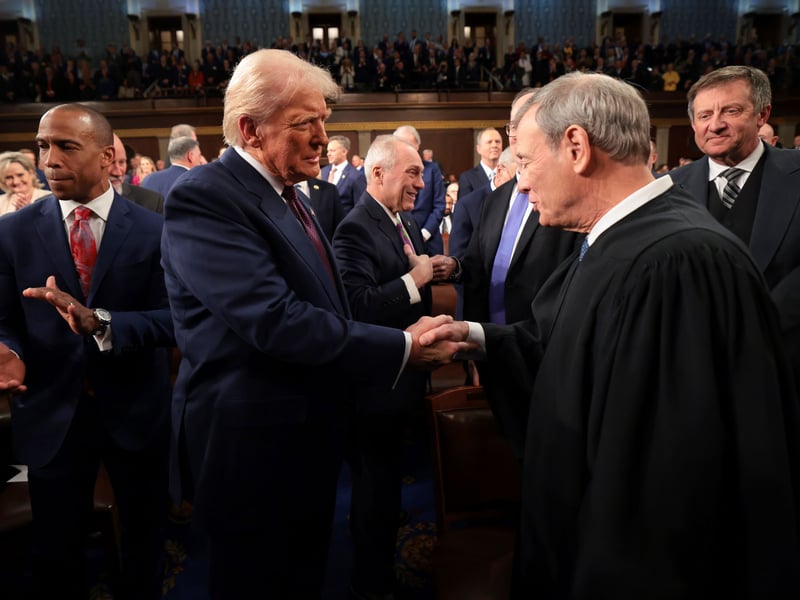
WASHINGTON (CN) — A string of lower court defeats was largely ignored by the White House this week as the administration boasted that it had collected nearly two dozen Supreme Court victories over the last few months.
Last week, a federal appeals court ruled that President Donald Trump’s “reciprocal” tariffs were unlawful; a judge refused to let the administration fast-track deportations; another judge blocked the deportation of Guatemalan children; and an appeals panel said the White House had to rehire a trade commissioner.
Seemingly unfazed, the administration posted a graphic listing “21 victories” at the Supreme Court on Monday, chronicling issues that coincided with Trump’s emergency appeals. The White House’s tally appeared inflated, however, compared to tabulations by Courthouse News and other news organizations.
Courthouse News’ running total found 18 Supreme Court rulings favorable to the administration, including on birthright citizenship, federal firings and immigration. NBC also concluded that Trump has prevailed in 18 out of 25 emergency appeals as of Tuesday.
One glaring discrepancy was that the administration’s list only referred to 20 cases, not 21 as indicated by the release headline. The White House also claimed victory in the high-profile case of Kilmar Abrego Garcia, who was wrongly sent to El Salvador’s notorious terrorism center.
Chief Justice John Roberts, a George W. Bush appointee, issued an administrative stay on a midnight deadline to return Abrego Garcia to Maryland in April. Administrative stays can be issued while the full court considers an appeal.
However, the full court went on to deny the bulk of Trump’s request — one of its rare refusals to concede to the administration’s wishes. In an unsigned order, the Supreme Court said the government was required to “facilitate” Abrego Garcia’s release from custody and return to the U.S.
The rejection launched a high-profile standoff between Trump and the courts that had some legal experts raising red flags about a constitutional crisis. Abrego Garcia was ultimately returned to the U.S. but now faces federal charges. The government is also fighting to deport him to a third country like Eswatini.
The White House did not respond to questions about why Abrego Garcia’s case was included on its list of Supreme Court victories. The administration also did not provide case names to clarify which rulings it was citing or why only 20 cases were on the list.
It appeared that the administration also counted a motion to clarify as a secondary “third-country removal” win. All of the other victories referred to grants from emergency applications submitted by the administration.
Trump’s winning streak at the high court has not gone unnoticed. Justice Ketanji Brown Jackson — one of the three liberal justices who has dissented from many of the administration’s wins — called out her colleagues for favoring the White House.
“This is Calvinball jurisprudence with a twist,” the Joe Biden appointee wrote in one such dissent. “Calvinball has only one rule: There are no fixed rules. We seem to have two: that one, and this administration always wins.”
Since taking office in January, Trump has filed 25 emergency applications, fighting off lower court restraints on any limits to executive authority. While the lower courts have overwhelmingly ruled against the president, the Supreme Court has done the opposite.
Even based on 18 wins, Trump holds an over 70% win rate at the high court, and the justices do not appear to be changing tack anytime soon. Trump’s bid to limit birthright citizenship notched three wins since it involved multiple applications.
The president also came out on top on the transgender military ban; third-country deportations; ending federal DEI funding; Education Department firings; multi-agency firings; Alien Enemies Act deportations; terminating probationary employees; terminating regulatory board members; removing protected status for Venezuelan migrants; revoking parole status for migrants from Cuba, Haiti, Nicaragua, and Venezuela migrants; social security data access; freedom of information act discovery; firing a consumer product safety board commissioner; National Institutes of Health funding; and immigration raids in California.
According to Courthouse News’ data, Trump lost two of the 25 emergency appeals he submitted — Abrego Garcia’s case and his initial application to slash foreign aid funds. One case was dismissed as moot. Trump withdrew two other emergency appeals due to lower court action, and another two are currently pending.
Just this week, Roberts handed Trump two temporary wins in those cases, allowing him to fire a Federal Trade Commission member and unilaterally withhold over $4 billion in congressionally appropriated foreign aid funds.
The opening salvo of Trump’s second term at the Supreme Court has been contained to the emergency docket. This is due to the preliminary nature of pending litigation against the administration.
Trump’s emergency docket applications requested pauses on lower court rulings, allowing the administration to take actions such as withholding funding, fire employees or deport immigrants before the underlying merits of the legal battles had been decided.
According to Steve Vladeck, a law professor at Georgetown University, the Trump administration is using the emergency docket like no other president in history. Vladeck, who authored “The Shadow Docket” about the high court’s emergency docket, said that during the 16 years of the George W. Bush and Barack Obama administrations, the federal government filed a total of eight emergency appeals, or about one every other term.
Most of these cases could come back up to the justices once the lower courts finish their reviews. On Tuesday, the Supreme Court granted the first merits appeal of Trump’s second term, agreeing to decide whether Trump can seize unilateral authority over global tariffs.
 Follow @KelseyReichmann
 Follow @kelseyreichmann.bsky.social
Subscribe to our free newsletters
Our weekly newsletter Closing Arguments offers the latest about ongoing trials, major litigation and rulings in courthouses around the U.S. and the world, while the monthly Under the Lights dishes the legal dirt from Hollywood, sports, Big Tech and the arts.