
 Search Articles


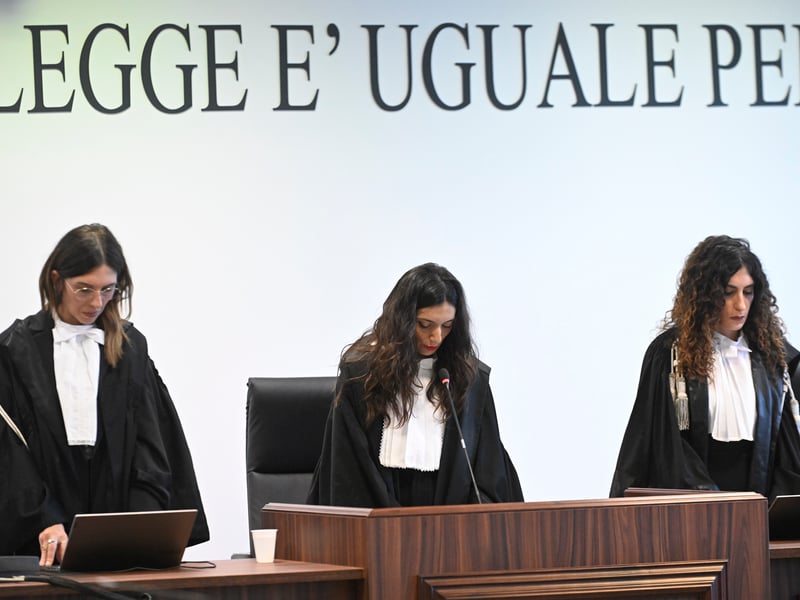
PALERMO, Sicily (CN) — Far-right Italian Prime Minister Giorgia Meloni is facing her first major setback with polls showing she may lose a referendum to overhaul the country’s judicial system.
On March 22-23, Italians will vote on constitutional changes Meloni says are needed to restore balance to a judiciary she argues is dominated by unaccountable left-wing factions blocking her government’s agenda.
Her criticism of judges echoes that of former Prime Minister Silvio Berlusconi, who spent years battling magistrates’ prosecutions and made curbing the judiciary a central political goal until his death in 2023.
Many judges, legal experts and opposition parties warn Meloni’s overhaul would instead undermine judicial independence by giving politicians greater control over the courts.
Critics also say the changes would add costs and do little to address deeper problems such as case backlogs, staff shortages and slow court proceedings.
Until recently, Meloni largely stayed on the sidelines, leaving ministers and allies to build support for the reforms. But that has changed as polls show the referendum is too close to call and the vote increasingly reflects a referendum on her government.
Meloni remains popular, with about 44% of Italians saying she is doing a good job. She is not required to call parliamentary elections until 2027.
The vote is critical as her government pursues other major changes, including greater regional autonomy, electoral reforms and direct election of prime ministers.
Opposition parties warn the reforms could entrench Meloni and her right-wing allies in power, while Meloni says they are meant to make Italian governments more stable.
This week, Meloni took center stage ahead of the referendum by releasing a 13-minute video on social media to champion the reforms as “liberating the judiciary” from politics and restoring its authority.
“Its objective is to make the justice system more modern, more meritocratic, more autonomous, more responsible,” she says in the video.
At an event on Thursday in Milan, Meloni spoke out even more forcefully, accusing judges of committing miscarriages of justice and derailing her government’s ability to fight crime and stop immigration.
“If the reform doesn’t pass this time, we will probably not have another chance,” she said. “We will find ourselves with even more powerful factions, even more negligent judges, even more surreal sentences, immigrants, rapists, pedophiles, drug dealers being freed and putting your security at risk.”
The referendum was triggered after parliament approved the changes last year. A simple majority is required to pass the reforms, and there is no turnout threshold, prompting both sides to campaign heavily on the complex issue.
There are three key elements to the overhaul.
First, it separates the career paths of judges and public prosecutors, preventing them from switching roles. Currently, magistrates can change tracks, though fewer than 1% do so.
Second, it would divide the High Judicial Council — which oversees judicial appointments and discipline — into three chambers: one for judges, one for prosecutors and a third to handle disciplinary cases involving both.
Finally, the reforms would change how members of these chambers are appointed.
Instead of judges electing their peers, selections would be made by drawing lots from among eligible judges and prosecutors.
“This removes the self-governance element — it’s luck that decides,” said Benedetta Lobina, a legal scholar at University College Dublin in Ireland who has studied the reforms.
“Generally, the Italian judiciary has been a pioneer of judicial self-governance, thanks to the drafters of the post-fascist constitution,” Lobina added, writing in an email. “This reform, if passed, would radically change the system.”
Additionally, a third of the members in the new chambers for prosecutors and judges would come from lists of candidates chosen by parliament by a simple majority vote. These appointments of so-called “lay members” outside the judiciary would also be done by drawing lots.
“This means that a ruling party can make a list choosing only partisan lay members (e.g., law professors),” Lobina said.
This could result in the chambers getting filled by politically appointed members with “a strong political agenda,” she said.
This arrangement could lead to a situation where randomly chosen magistrates could end up disorganized and split in the face of a bloc of members chosen by parliament.
“This asymmetry fosters politicization and weakens judicial self-governance,” Lobina said.
She said this dynamic could become even more problematic in the disciplinary chamber because lay members would be given even more power in its composition.
Lobina said the reforms seemed driven by politics rather than evidence, and that courts are rife with biased judges.
“To the best of my knowledge, there is no evidence to support these allegations,” she said. “The ‘currents’ within the judicial council mirror the political sphere quite evenly, so there are both progressive and conservative judges.”
She dismissed the government’s portrayal of Italian judges as left-leaning and as seeking to undermine Meloni’s agenda.
For example, Meloni has repeatedly accused judges of bias by blocking her government from sending migrants to processing centers in Albania rather than handling their claims in Italy.
“Those judges are simply upholding the constitutional or international law,” she said.
If the reform passes, it would represent the biggest overhaul of the judiciary since World War II.
Courthouse News reporter Cain Burdeau is based in the European Union.
 Follow @cainburdeau
Subscribe to our free newsletters
Our weekly newsletter Closing Arguments offers the latest about ongoing trials, major litigation and rulings in courthouses around the U.S. and the world, while the monthly Under the Lights dishes the legal dirt from Hollywood, sports, Big Tech and the arts.