
 Search Articles


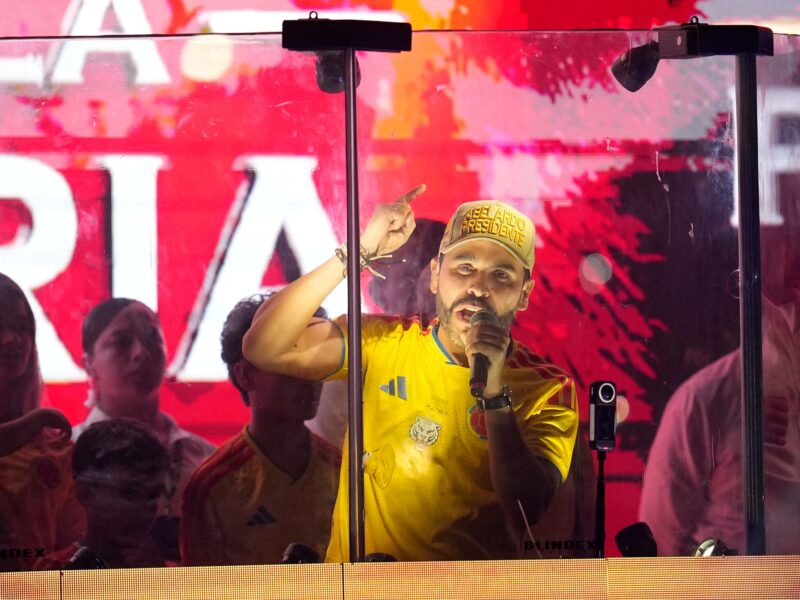
BOGOTÁ, Colombia (CN) — On Sunday, Colombians will elect their future president in what could become a pivotal election, with most polls favoring a far-right right political outsider, Abelardo de la Espriella ahead of the ruling Pacto Historico’s candidate, the leftist Senator Iván Cepeda.
The vote comes after four years of Gustavo Petro’s presidency, the first left-wing administration in Colombia’s modern history, and amid widespread public frustration over security, economic performance and the government’s failure to deliver on some of its most ambitious promises.
The contest has increasingly been framed by voters as a choice between continuity and a sharp political rupture. While Cepeda has campaigned on preserving and expanding Petro-era reforms, de la Espriella has presented himself as an anti-establishment figure who would reverse many of the current government’s policies.
A lawyer and television commentator who has never held elected office, de la Espriella has built his campaign around promises to restore security, cut through political gridlock and confront armed groups with a far tougher approach than the current administration. His rise has mirrored a broader trend across Latin America, where outsider candidates promising swift solutions to entrenched problems have found growing support.
Like many recent Latin American elections, this election is tainted by both the euphoria and fear brought by the expectations around a strident candidate who promises radical, relentless change to the historical issues of a country.
The race has also reflected a broader regional trend in which candidates promising tough security policies and a confrontation with traditional political elites have gained traction, echoing debates that have shaped recent elections elsewhere in Latin America.
On Thursday afternoon, just days before the polls open across the country, two very different scenes unraveled just miles away from each other.
In a centric area in northern Bogotá, a mid-upper class district, exhilarated voters wearing the country’s national team jersey and wielding Colombian flags marched across their neighborhood, between big shopping malls and luxury retail stores, chanting songs expressing their support towards “El Tigre” — the Tiger, as de la Espriella calls himself — handing out leaflets and haranguing cars to honk as they passed by.
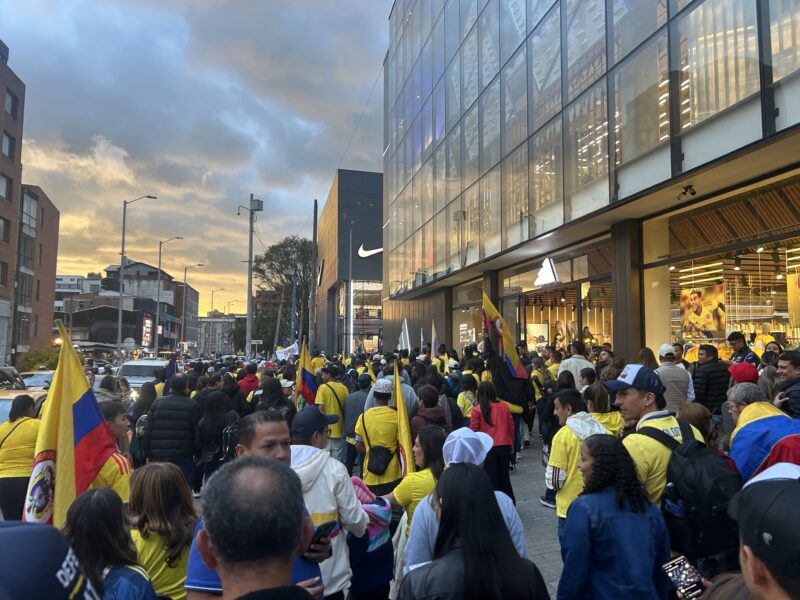
Liliana Vendir, a 66-year-old woman who said she lived off renting her properties, jumped excitedly as the rally advanced. “Abelardo will bring a much needed unity,” she said. “He will boost the private sector and, therefore, dismantle armed groups.”
One of the key talking points during the presidential campaign has been security, a topic the right-wing candidate has capitalized on due to the handling of the incumbent government of Petro, political leader of Cepeda’s movement, who promised to bring “total peace” but whom experts argue has mostly failed in that pursuit.
Violence has worsened in several regions during Petro’s term, with armed groups expanding their territorial presence in some areas despite ongoing negotiations with the government, making public security one of the most consistently cited concerns among voters.
De la Espriella, promises to crush the longstanding armed groups across the country, many of which are deeply rooted in communities across Colombia, a sign of an ongoing conflict half a century on. He opposed the policies of negotiations that have ruled the political approach towards conflict, and instead proposed tough policies, megaprisons and direct clashes to curb their extent.
Some of his voters hope foreign investment and an enlarged private sector will attract those who are financially vulnerable and find themselves attracted to the shiny businesses of the criminal organizations.
However, watchdog institutions have reported recruitment in the past decades has become more complex, subtle, and forced, which could make the identification of the leaders of crime more difficult, and civilians more prone to violent targeting — something that has happened in the past during the Álvaro Uribe government of the early 2000s and led to thousands of murders and human rights violations across Colombia.

Some miles away, in La Trocha, a cultural center founded by former guerrilla members who joined the peace accords — “the house of peace”, as they call it — young people gathered to discuss their vote days ahead of the election.
The center’s existence is itself a product of the 2016 peace agreement between the Colombian government and the FARC guerrillas, a landmark accord that remains politically divisive nearly a decade later and continues to shape debates over security, reconciliation and state policy.
At a table, three friends shared a beer while they discussed their anxieties about the election.
“I’ve come here to learn about his proposals,” said Lina María Insaguasti, a 25-year-old lawyer. “Because de la Espriella really scares me out.”
Although the group of friends did not entirely support Gustavo Petro, the incumbent president, political leader of Cepeda’s movement, they felt many of the mistakes of the administration could be fixed — and what has been done for the better, enhanced.
“I don’t want my country to become Milei’s Argentina or Bukele’s El Salvador,” said Melissa Gutiérrez, 41, originally from Medellín. Over the past weeks, she said, she had spent a consistent amount of time speaking with her family back home after realizing a strong fake news campaign had reached them, convincing them, among other things, that Cepeda takes part in a guerrilla group.
Cepeda, 63, spent most of his career defending conflict victims and taking part in dialogue and peace negotiations after his father, a congressman and leftist politician, was killed during a ruthless moment of the national conflict.
His candidacy has become a test of whether Colombia’s left can maintain political support after Petro’s presidency, which energized progressive voters but also faced declining approval ratings during much of its term.
During his campaign, despite criticism against Petro’s “total peace” program, he has stood by his commitment to continue the path of negotiations. Some of his center-left critics have said pointed that Colombia does not just need peace policies, but also security policies.
“There is really a lot at stake,” said Sergio Guzmán, analyst from Colombia Risk Analysis, a consultancy group. “Two entirely different visions of the country.”
Beyond the presidency, the result is expected to influence the future of Colombia’s peace process, relations with the private sector, and the country’s approach to organized crime and armed groups for years to come.
Polls will be open between 8 a.m. through 4 p.m. Bogotá time, with results expected by Sunday evening.
Lucía Cholakian Herrera is a Courthouse News correspondent covering Latin America, based in Buenos Aires. She reported from Bogotá, Colombia.
 Follow @luciacholakian
Subscribe to our free newsletters
Our weekly newsletter Closing Arguments offers the latest about ongoing trials, major litigation and rulings in courthouses around the U.S. and the world, while the monthly Under the Lights dishes the legal dirt from Hollywood, sports, Big Tech and the arts.
Additional Reads


 Indonesian policies draw scrutiny amid economic woes June 19, 2026